Und dann auf "Zum Home-Bildschirm [+]".

Stöbern
genialokal zum Startbildschirm hinzufügen
Installieren Sie die genialokal App auf Ihrem Startbildschirm für einen schnellen Zugriff und eine komfortable Nutzung.
Installieren Sie die genialokal App auf Ihrem Startbildschirm für einen schnellen Zugriff und eine komfortable Nutzung.
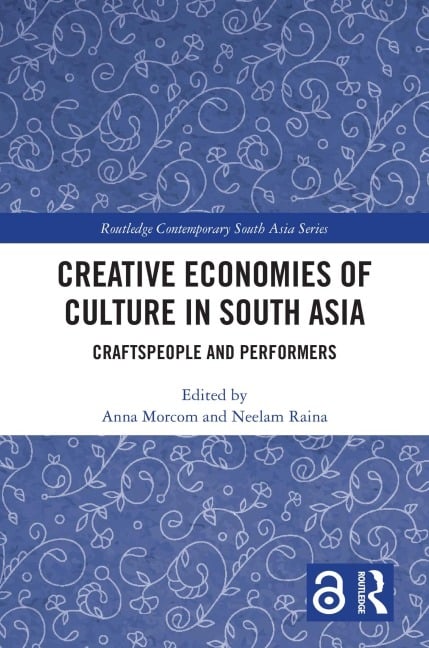
This book explores the crafts and performing arts of South Asia through a focus on labour and livelihood. It brings to light little-researched angles of social and political economies of culture and the ways in which they have shifted and changed in different historical eras and different political, economic, and social formations up to the present. In particular, through this focus on labour and livelihood, the contributors analyse the extensive parallels and similarities of arts and crafts on the one hand and music and performing arts on the other, ranging from questions of lineage, transmission, class/caste/community, professional versus amateur performers and artisans, to the impact of globalisation, neoliberal reforms, and mediatisation. Given the role of gender inequalities and differences within caste/community-based cultural production in South Asia across visual, material, and performing arts and crafts, this interdisciplinary perspective is particularly salient and links together broader sociological and historical trends in South Asian cultural or creative economies. Creative economies of culture explores labour and livelihood through a gamut of crafts and performing arts ranging from courtly and classical to commissioned to mass-produced, and in epochs ranging from colonial or feudal to globalised and neoliberal. In the process, it revisits, refines, or revises notions of social and cultural capital; socio-economic mobility; the value, role, and agency of crafts and performing arts; and the status of their artisans and performers. Original chapters written by contributors with an interdisciplinary background look at the survival and adaption of traditional artisanal communities; traditional forms of practice; historical shifts such as colonialism, industrialisation, and nationalism; as well as modern industries and institutions, including technologies of mass production and creative entrepreneurship. This book contextualises current debates within art, craft, music, and dance in South Asia. It develops new theoretical understandings of creative culture through a focus on labour and contributes to a range of social sciences, arts, and humanities disciplines, including South Asian studies, Ethnomusicology, Crafts and Design, Economic Anthropology, (Historical) Sociology and (Historical) Economics, Cultural History, Human Geography, and Creative Industries and Economies. Chapter 12 of this book is freely available as a downloadable Open Access PDF at http://www.taylorfrancis.com under a Creative Commons Attribution-Non Commercial-No Derivatives (CC-BY-NC-ND) 4.0 license
Anna Morcom is the Mohindar Brar Sambhi Chair of Indian Music in the Department of Ethnomusicology at UCLA. She studies the performing arts of India and Tibet from diverse perspectives analysing shifting configurations of social power and has published on courtesans, bar girls, queer performers, and classical musicians in India. Neelam Raina is an Associate Professor of International Development and Design at Middlesex University London. Her grant-funded research focusses on conflict and post-conflict economic reconstruction, material cultures, indigenous knowledge, displacement, and gender. Her interest lies in intersectional inequalities and inequities in fragile settings.
Creative Vocabularies of Work and Value in South Asia: A Foreword; Living, Adapting, and Creating: Craftspeople and Performers in South Asia: A Foreword; Introduction Living, Adapting, and Creating: Craftspeople and Performers in South Asia; Chapter 1. Musical Unfreedom and the Drummers' Dilemma: Cultural Labour and the Value of Music in Indian Caste Society; Chapter 2. U-aippu: Performance as Labour in a Tamil Theatre Tradition; Chapter 3. Narratives of Craft and Power in Sindh, Pakistan; Chapter 4. Artistic Labour at Stake: The Case of South Indian Courtesans' Changing Patterns of Professionalism in Colonial and Post-Colonial India; Chapter 5. Women, Crafts and Landscapes; Acknowledging Cultural Rights for Sustainable Development; Chapter 6. The Performance of Payment: Differentiating Devotional, Erotic and Classical Performing Arts in India; Chapter 7. Materializing Insurgency: Walnut-Wood Carving and the Material Culture of Conflict; Chapter 8. The Tawa'if in Colonial India: Changing Livelihoods and Emerging Technologies (1790s - 1920s); Chapter 9. Remaking Labouring Lives through Crisis: Artisan Weaponsmiths in Colonial North India; Chapter 10. Court Music Outside the Court: Defining the 'Professional' Musician in Nineteenth-Century Bengal; Chapter 11. The Hand in the Song: Understanding Performative Labour, Gender, and Livelihood in the Arts of Chitrakar Women of West Bengal; Chapter 12. Kashmir's Crafts Women: Tacit, Embodied Knowledge and its value in Post Conflict Reconstruction; Chapter 13. Kanchipuram as Brand Value: Weaving, Marketing Tradition in South India; Chapter 14. Drumming, Value, and Patronage in a Himalayan Village Economy; Chapter 15. Globalities and Temporalities of Artisanship: Lessons from an Indian Wood Art Industry; Chapter 16. The Gramophone, The Concert Stage and the Hindustani Musician as Commodity-Fetish; Chapter 17. The Business of Kollywood Dance in Chennai, India; Chapter 18. Surviving Revivals: Or Why the Work of Resuscitating Indian Crafts is Never Done; Index
Dieses eBook wird im PDF-Format geliefert und ist mit einem Adobe Kopierschutz (DRM) versehen. Sie können dieses eBook mit allen Geräten lesen, die das PDF-Format und den Adobe Kopierschutz (DRM) unterstützen.
Zum Beispiel mit den folgenden Geräten:
• tolino Reader
Laden Sie das eBook direkt über den Reader-Shop auf dem tolino herunter oder übertragen Sie das eBook auf Ihren tolino mit einer kostenlosen Software wie beispielsweise Adobe Digital Editions.
• Sony Reader & andere eBook Reader
Laden Sie das eBook direkt über den Reader-Shop herunter oder übertragen Sie das eBook mit der kostenlosen Software Sony READER FOR PC/Mac oder Adobe Digital Editions auf ein Standard-Lesegeräte mit epub- und Adobe DRM-Unterstützung.
• Tablets & Smartphones
Möchten Sie dieses eBook auf Ihrem Smartphone oder Tablet lesen, finden Sie hier unsere kostenlose Lese-App für iPhone/iPad und Android Smartphone/Tablets.
• PC & Mac
Lesen Sie das eBook direkt nach dem Herunterladen mit einer kostenlosen Lesesoftware, beispielsweise Adobe Digital Editions, Sony READER FOR PC/Mac oder direkt über Ihre eBook-Bibliothek in Ihrem Konto unter „Meine eBooks“ - „online lesen“.
Schalten Sie das eBook mit Ihrer persönlichen Adobe ID auf bis zu sechs Geräten gleichzeitig frei.
Bitte beachten Sie, dass die Kindle-Geräte das Format nicht unterstützen und dieses eBook somit nicht auf Kindle-Geräten lesbar ist.