Und dann auf "Zum Home-Bildschirm [+]".

Stöbern
genialokal zum Startbildschirm hinzufügen
Installieren Sie die genialokal App auf Ihrem Startbildschirm für einen schnellen Zugriff und eine komfortable Nutzung.
Installieren Sie die genialokal App auf Ihrem Startbildschirm für einen schnellen Zugriff und eine komfortable Nutzung.
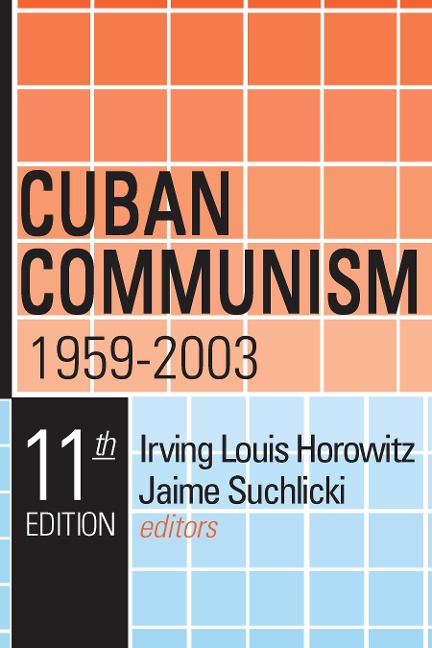
"Cuban Communism remains, like its previous ten editions, an important contribution to the field of Cuban Studies. It includes many useful chronological facts, as well as a selection of Fidel Castro's speeches which are interesting and informative for any reader interested in the island." -- Maria Gropas, Department of Social Anthropology, University of Cambridge This new 11th edition of a classic text, come to be known as "the bible of Cuban Studies," emphasizes two key issues of the twenty-first century. First, transition concerns in a world without Castro, and second, the continuing embargo of Cuba by the United States in the aftermath of a major change in the presidency. Cuban Communism has been updated to take account of changes in the 44 years of Castro's rule since seizing power in 1959. In addition to articles and essays that represent new developments in Cuba, the work boasts a database upgrade that makes it more important to students, scholars, and researchers. The volume has expanded the section on future prospects for civil society and democracy in a post-Castro environment; including "Regime Change in Cuba" by Eusebio Mujal-Leon and Joshua W. Busby; "Transition Scenarios" by Randolph H. Pherson, and "A Policy Conundrum over Cuba" by Edward Gonzalez. It also contains a chronology of events from 1959 through 2002. Finally, the new work contains a carefully constructed Who's Who of important players in Cuba and the regime during the Castro period up to the present. Other articles new to the 11th edition of Cuban Communism are by Ernesto Betancourt, "Cuba's Balance of Payment Gap"; Carmelo Mesa-Lago, "The Cuban Economy From 1999-2001"; Taylor Boas, "The Internet and U.S. Policy toward Cuba"; Aldo M. Leiva, "Environmental Technology Transfer and Foreign Investment"; Moises Asis, "Judaism in Cuba"; Wolf Grabendorff, "A View from the European Union." More than ever, it is a must volume for those interested in political systems and social structures. Irving Louis Horowitz is Hannah Arendt Distinguished Professor Emeritus of Sociology and Political Science at Rutgers University. Among his works are Three Worlds of Development, Beyond Empire and Revolution, and his Bacardi Lectures on Cuba that was published as The Conscience of Worms and the Cowardice of Lions. Jaime Suchlicki is Bacardi Professor of History at the Graduate School of International Studies at the University of Miami, and executive director of its Cuban-American and Cuban Center. He is author of From Columbus to Castro, University Students and Revolution in Cuba, and Mexico: From Montezuma to Nafta and Beyond.
1: History; 1: One Hundred Years of Ambiguity: U.S.-Cuba Relations in the 20th Century; 2: Cuba: The United States and Batista, 1952-1958; 3: The Sierra and the Plains; 4: Guerrillas at War; 5: Learning from the Cuban Missile Crisis; 6: Immutable Proclamations and Unintended Consequences; 7: Fidelismo: The Unfulfilled Ideology; 2: Economy; 8: The Cuban Economy in 1999-2001: Evaluation of Performance; 9: Labor Conditions in Revolutionary Cuba; 10: The Political Economy of Caudillismo; 11: Market-Oriented Marxism: Post-Cold War Transition in Cuba and Vietnam; 12: Waiting For Godot: Cuba's Stalled Reforms and Continuing Economic Crisis; 13: Cuba's Transition from Communism to Political and Economic Freedom; 14: Economic Organizations and Post-Castro Cuba; 3: Society; 15: Searching for Civil Society in Cuba; 16: The Conventionalization of Collective Behavior; 17: The Internet and U.S. Policy toward Cuba; 18: Women, Family, and the Cuban Revolution *; 19: Health Care in Cuba; 20: Cuba's Refugees: Manifold Migrations; 21: The Moral Basis of Cuban Society; 4: Military; 22: Political-Military Relations from 1959 to the Present; 23: Vanguard of the State: The Cuban Armed Forces in Transition; 24: Military Origin and Evolution of the Cuban Revolution; 25: The Cuban Armed Forces: Changing Roles, Continued Loyalties; 26: Cuban Military Influences on Political and Economic Decision-Making; 5: Polity; 27: Why the Cuban Regime Has Not Fallen; 28: Cuba: Without Subsidies; 29: Cuba: Economic Sanctions and American Diplomacy; 30: Cuba and the United States: Back to the Beginning; 31: Much Ado About Something?: Regime Change in Cuba; 32: The Cuban Revolution and Its Acolytes; 33: After Fidel, What?: Forecasting Institutional Changes in Cuba; 6: Transition to Civil Society; 34: The United States and Cuba: Future Security Issues; 35: Role of the United States and International Lending Institutions in Cuba's Transition; 36: Three Variations on Communist Successor Regimes; 37: Festina Lente: The United States and Cuba After Castro; 38: Humanitarian Assistance during a Democratic Transition in Cuba; 39: Economic and Social Disparities in Cuba: Recommendations for Change
Dieses eBook wird im PDF-Format geliefert und ist mit einem Adobe Kopierschutz (DRM) versehen. Sie können dieses eBook mit allen Geräten lesen, die das PDF-Format und den Adobe Kopierschutz (DRM) unterstützen.
Zum Beispiel mit den folgenden Geräten:
• tolino Reader
Laden Sie das eBook direkt über den Reader-Shop auf dem tolino herunter oder übertragen Sie das eBook auf Ihren tolino mit einer kostenlosen Software wie beispielsweise Adobe Digital Editions.
• Sony Reader & andere eBook Reader
Laden Sie das eBook direkt über den Reader-Shop herunter oder übertragen Sie das eBook mit der kostenlosen Software Sony READER FOR PC/Mac oder Adobe Digital Editions auf ein Standard-Lesegeräte mit epub- und Adobe DRM-Unterstützung.
• Tablets & Smartphones
Möchten Sie dieses eBook auf Ihrem Smartphone oder Tablet lesen, finden Sie hier unsere kostenlose Lese-App für iPhone/iPad und Android Smartphone/Tablets.
• PC & Mac
Lesen Sie das eBook direkt nach dem Herunterladen mit einer kostenlosen Lesesoftware, beispielsweise Adobe Digital Editions, Sony READER FOR PC/Mac oder direkt über Ihre eBook-Bibliothek in Ihrem Konto unter „Meine eBooks“ - „online lesen“.
Schalten Sie das eBook mit Ihrer persönlichen Adobe ID auf bis zu sechs Geräten gleichzeitig frei.
Bitte beachten Sie, dass die Kindle-Geräte das Format nicht unterstützen und dieses eBook somit nicht auf Kindle-Geräten lesbar ist.