Und dann auf "Zum Home-Bildschirm [+]".

Stöbern
genialokal zum Startbildschirm hinzufügen
Installieren Sie die genialokal App auf Ihrem Startbildschirm für einen schnellen Zugriff und eine komfortable Nutzung.
Installieren Sie die genialokal App auf Ihrem Startbildschirm für einen schnellen Zugriff und eine komfortable Nutzung.
Ihr gewünschter Artikel ist in 0 Buchhandlungen vorrätig - wählen Sie hier eine Buchhandlung in Ihrer Nähe aus:

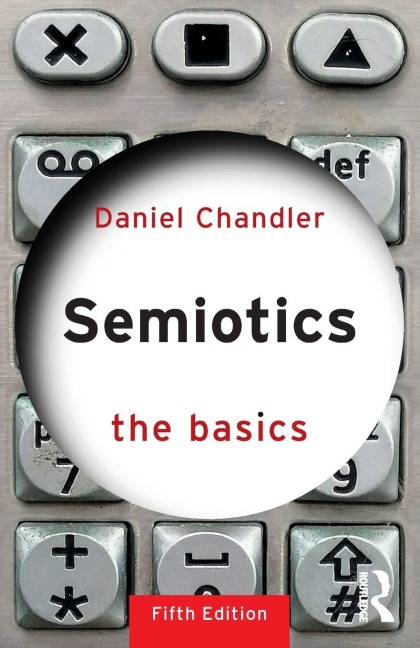
This fifth edition of the bestselling textbook is a major new revision, continuing to provide a concise introduction to the key concepts of semiotics in accessible and jargon-free language. A must-have guide for students of language, communication, media, and cultural studies at both undergraduate and postgraduate levels.
Daniel Chandler is an emeritus faculty member at Aberystwyth University, UK, and a consultant in marketing semiotics. He is also the senior compiler of A Dictionary of Media and Communication (3rd edition, Oxford University Press, 2020) and A Dictionary of Social Media (Oxford University Press, 2016).
List of illustrations Preface Acknowledgements Introduction Definitions Relation to philosophy and linguistics Structuralism Why study semiotics? 1 Models The semiotic triangle Natural vs. conventional signs The Saussurean model The arbitrariness of the linguistic sign The relational system The Peircean model Jakobson's model Sign relations Symbolic relations Iconic relations Indexical relations The case of photography Mixed modes Types and tokens Rematerializing the sign Hjelmslev's model Reflections Further reading 2 Realities Categorization Language, thought, and reality Referentiality Referentiality Modality The sign is not the thing Empty signifiers Reflections Further reading 3 Structures Horizontal and vertical axes The paradigmatic dimension The commutation test Oppositions Markedness Deconstruction Conceptual alignment The semiotic square The syntagmatic dimension Spatial relations Sequential relations Structural reduction Langue and parole Reflections Further reading 4 Codes The language model Digital and analogue codes Typologies Social codes Textual codes Genre Aesthetic realisms Invisible editing Interpretive codes Ways of reading Codification Limitations Reflections Further reading 5 Ways of meaning Rhetorical tropes Metaphor Metonymy Synecdoche Irony Master tropes Denotation and connotation Myth Reflections Further reading 6 Interactions Models of communication Context and relevance Communicative functions The positioning of the subject Modes of address Intertextuality Problematizing authorship No text is an island Intratextuality Textual framing Reflections Further reading 7 Perspectives Structuralist semiotics Poststructuralist semiotics The return of Saussure Social semiotics Cognitive semiotics Cartesian dualism Semiotic stances Mental representation Embodiment Methodologies An ecological and multimodal approach Reflections Further reading Going further Glossary References Index