Und dann auf "Zum Home-Bildschirm [+]".

Stöbern
genialokal zum Startbildschirm hinzufügen
Installieren Sie die genialokal App auf Ihrem Startbildschirm für einen schnellen Zugriff und eine komfortable Nutzung.
Installieren Sie die genialokal App auf Ihrem Startbildschirm für einen schnellen Zugriff und eine komfortable Nutzung.
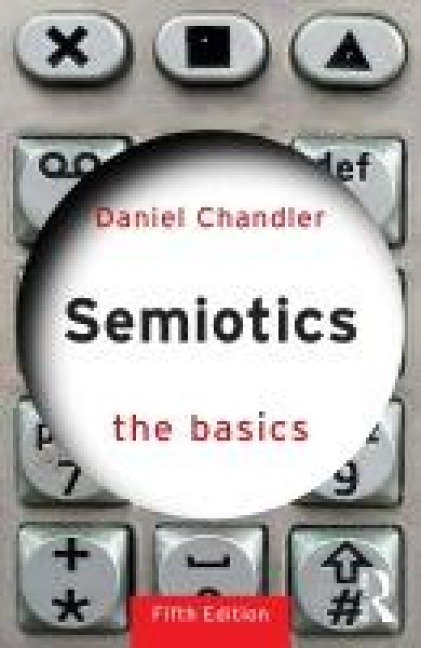
This fifth edition of the bestselling textbook is a major new revision, continuing to provide a concise introduction to the key concepts of semiotics in accessible and jargon-free language. Demystifying what is a complex, highly interdisciplinary field, key questions covered include: What are signs and codes? What can semiotics teach us about representation and reality? What tools does it offer for analysing texts and cultural practices? Semiotics: The Basics focuses on its application to communication and cultural studies. The latest edition features a greatly extended treatment of core concepts, in particular traditional historical models of the sign, the semiotic triangle, and distinctions between 'natural' and conventional signs. There is also a greater emphasis on 'the social life of signs'. With an extensive index, a comprehensive glossary, suggestions for review and for further reading, and a list of online resources, this must-have guide is both the ideal introductory text and an essential reference for students of language, communication, media, and cultural studies at both undergraduate and postgraduate levels.
Daniel Chandler is an emeritus faculty member at Aberystwyth University, UK, and a consultant in marketing semiotics. He is also the senior compiler of A Dictionary of Media and Communication (3rd edition, Oxford University Press, 2020) and A Dictionary of Social Media (Oxford University Press, 2016).
List of illustrations Preface Acknowledgements Introduction Definitions Relation to philosophy and linguistics Structuralism Why study semiotics? 1 Models The semiotic triangle Natural vs. conventional signs The Saussurean model The arbitrariness of the linguistic sign The relational system The Peircean model Jakobson's model Sign relations Symbolic relations Iconic relations Indexical relations The case of photography Mixed modes Types and tokens Rematerializing the sign Hjelmslev's model Reflections Further reading 2 Realities Categorization Language, thought, and reality Referentiality Referentiality Modality The sign is not the thing Empty signifiers Reflections Further reading 3 Structures Horizontal and vertical axes The paradigmatic dimension The commutation test Oppositions Markedness Deconstruction Conceptual alignment The semiotic square The syntagmatic dimension Spatial relations Sequential relations Structural reduction Langue and parole Reflections Further reading 4 Codes The language model Digital and analogue codes Typologies Social codes Textual codes Genre Aesthetic realisms Invisible editing Interpretive codes Ways of reading Codification Limitations Reflections Further reading 5 Ways of meaning Rhetorical tropes Metaphor Metonymy Synecdoche Irony Master tropes Denotation and connotation Myth Reflections Further reading 6 Interactions Models of communication Context and relevance Communicative functions The positioning of the subject Modes of address Intertextuality Problematizing authorship No text is an island Intratextuality Textual framing Reflections Further reading 7 Perspectives Structuralist semiotics Poststructuralist semiotics The return of Saussure Social semiotics Cognitive semiotics Cartesian dualism Semiotic stances Mental representation Embodiment Methodologies An ecological and multimodal approach Reflections Further reading Going further Glossary References Index
Dieses eBook wird im PDF-Format geliefert und ist mit einem Adobe Kopierschutz (DRM) versehen. Sie können dieses eBook mit allen Geräten lesen, die das PDF-Format und den Adobe Kopierschutz (DRM) unterstützen.
Zum Beispiel mit den folgenden Geräten:
• tolino Reader
Laden Sie das eBook direkt über den Reader-Shop auf dem tolino herunter oder übertragen Sie das eBook auf Ihren tolino mit einer kostenlosen Software wie beispielsweise Adobe Digital Editions.
• Sony Reader & andere eBook Reader
Laden Sie das eBook direkt über den Reader-Shop herunter oder übertragen Sie das eBook mit der kostenlosen Software Sony READER FOR PC/Mac oder Adobe Digital Editions auf ein Standard-Lesegeräte mit epub- und Adobe DRM-Unterstützung.
• Tablets & Smartphones
Möchten Sie dieses eBook auf Ihrem Smartphone oder Tablet lesen, finden Sie hier unsere kostenlose Lese-App für iPhone/iPad und Android Smartphone/Tablets.
• PC & Mac
Lesen Sie das eBook direkt nach dem Herunterladen mit einer kostenlosen Lesesoftware, beispielsweise Adobe Digital Editions, Sony READER FOR PC/Mac oder direkt über Ihre eBook-Bibliothek in Ihrem Konto unter „Meine eBooks“ - „online lesen“.
Schalten Sie das eBook mit Ihrer persönlichen Adobe ID auf bis zu sechs Geräten gleichzeitig frei.
Bitte beachten Sie, dass die Kindle-Geräte das Format nicht unterstützen und dieses eBook somit nicht auf Kindle-Geräten lesbar ist.