Und dann auf "Zum Home-Bildschirm [+]".

Stöbern
genialokal zum Startbildschirm hinzufügen
Installieren Sie die genialokal App auf Ihrem Startbildschirm für einen schnellen Zugriff und eine komfortable Nutzung.
Installieren Sie die genialokal App auf Ihrem Startbildschirm für einen schnellen Zugriff und eine komfortable Nutzung.


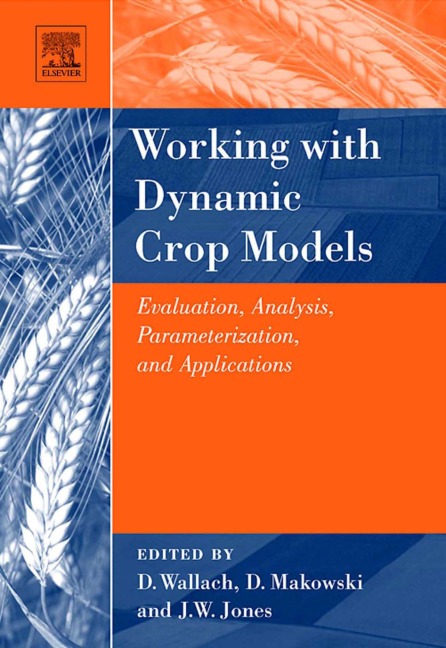
Mathematical models are being used more and more widely to study complex dynamic systems (global weather, ecological systems, hydrological systems, nuclear reactors etc. including the specific subject of this book, crop-soil systems). The models are important aids in understanding, predicting and managing these systems. Such models are complex and imperfect. One fundamental research direction is to seek a better understanding of how these systems function, and to propose mathematical expressions embodying that understanding. However, this is not sufficient. It is also essential to have tools (often mathematical and statistical methods) to aid in developing, improving and using the models built from those equations. The book is specifically concerned with the application of methods to crop models, but much of the material is also applicable to dynamic system models in other fields. The goal of this book is to fill that gap.* State-of-the-art methods explained simply and illustrated specifically for crop models* Parameter estimation - applying statistical methods to the complex case of crop models, including Bayesian methods * Includes model evaluation, understanding and estimating prediction error* Offers a unique data assimilation by using the Kalman filter and beyond
Daniel Wallach focuses on the application of statistical methods of dynamic systems, specifically on agronomy models. He has published in Agriculture, Ecosystems and Environment; Journal of Agricultural, Biological and Environmental Statistics and European Journal of Agronomy.David Makowski is an expert with the European Food Safety authority and the French Agency for Food, Environmental and Occupational Health and Safety and has authored 50 refereed articles and 10 book chapters on statistics, agricultural modeling and risk analysis.James Jones has authored more than 250 refereed scientific journal articles, developed and teached a graduate course based mostly on this book. He is a Fellow of the American Society of Agricultural and Biological Engineers, Fellow of the American Society of Agronomy, Fellow of the Soil Science Society of America and serves on several international science advisory committees related to agriculture and climate.Francois Brun specializes in agricultural modeling systems using the R language, and has published in Journal of Experimental Botany.
1The two forms of crop models2Evaluating crop models 3Uncertainty and sensitivity analysis for crop models4Parameter estimation for crop models5Data assimilation with crop models 6Representing and optimizing management decisions with crop models7Using crop models for multiple fieldsSECTION IIAPPLICATIONS 8Introduction to section II9Fundamental concepts of crop models illustrated by a comparative approach10Crop models with genotype parameters 11Model assisted genetic improvement of crops12Parameterization and evaluation of a corn crop model13Evaluation of a model for kiwifruit14Sensitivity and uncertainty analysis of a static denitrification model15Sensitivity analysis of PASTIS, a model of nitrogen transport and transformation in the soil 16Sensitivity analysis of GENESYS, a model for studying the effects of cropping system on gene flow17Data assimilation and parameter estimation for precision agriculture with the crop model STICS18Application of extended and ensemble Kalman filters to soil carbon estimation19Analyzing and improving corn irrigation strategies with MODERATO, a combination of a corn crop model and a decision model20Managing wheat for ethanol production. A multiple criteria approach