Und dann auf "Zum Home-Bildschirm [+]".

Stöbern
genialokal zum Startbildschirm hinzufügen
Installieren Sie die genialokal App auf Ihrem Startbildschirm für einen schnellen Zugriff und eine komfortable Nutzung.
Installieren Sie die genialokal App auf Ihrem Startbildschirm für einen schnellen Zugriff und eine komfortable Nutzung.
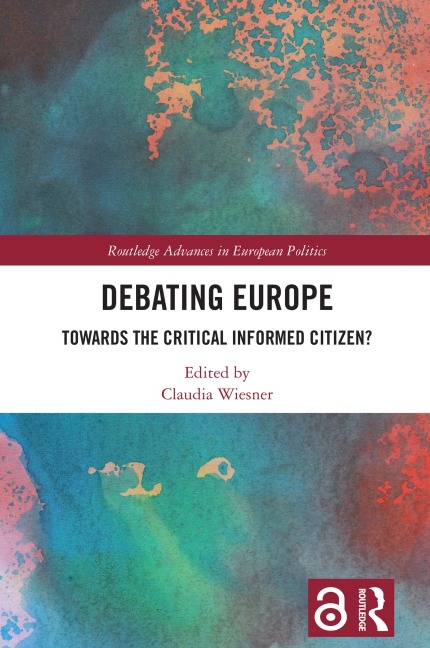
This book examines how Europe and the European Union are debated, politicised, and contested in a group of key (future) actors of European integration. Based on detailed focus group discussions with students in EU studies and the social sciences in six EU countries, the book presents the core results of the theoretical, conceptual, and empirical work of the Jean Monnet Networks "Debating Europe" (www.debating-europe.de) that set out to study the gap between the EU and its citizens. The following chapters first theorise and conceptualise the gap, to then present the core empirical findings from the collective research. These findings show that students' views on democracy in the EU are similar across the countries. Quite unexpectedly, students express strong claims to the EU, lining out a "Normative Power Europe 2.0" that is a global actor, defends democracy, and fights climate change. The EU is associated with values such as equality, freedom, and the rule of law. In particular, non-EU citizens see the EU as an ideal. Students make out several gaps: between citizens and EU institutions, among different member states, and among citizens. Finally, the results reveal the students as critical and informed, but passive EU citizens. This book is of key interest to scholars and students of European studies and EU integration studies, social and political sciences, and international relations. The Open Access version of this book, available at www.taylorfrancis.com, has been made available under a Creative Commons Attribution-Non Commercial-No Derivatives (CC-BY-NC-ND) 4.0 International license.
Claudia Wiesner is a professor of political science at Fulda University of Applied Sciences, Germany, an honorary professor at University College London, and adjunct professor at Jyväskylä University, Finland. She directs the Jean Monnet Centre of Excellence "Europe in the World" and the "Point Alpha Research Institute" (PARI), is principal investigator in several international research projects, and has been a visiting fellow at various international research institutions.
1. Introduction: The Puzzle of the Gap Between the EU and Its Citizens 2. Towards a Dynamic Understanding of Democracy in the EU: Politics, Politicisation and Debate 3. Rethinking EU Institutional Communication: Pathways to Democratic Legitimacy 4. Young People, Students and the EU: Critical Utilitarian Democrats 5. Focus Group Research Design: Methodology, Standards, and Findings 6. Studying Student Perceptions on the EU in an International Learning Interpretative and Comparative Research Design 7. Bulgaria, Croatia, Finland, France, Germany, and Slovenia: The Cases and the Context 8. Students as EU Citizens: Critical, Informed, Engaged, and Passive 9. Critical Informed Passive Citizens of a Normative Power Europe 2.0 10. Young Citizens' Visions of EU Democracy: A Research Outlook