Und dann auf "Zum Home-Bildschirm [+]".

Stöbern
genialokal zum Startbildschirm hinzufügen
Installieren Sie die genialokal App auf Ihrem Startbildschirm für einen schnellen Zugriff und eine komfortable Nutzung.
Installieren Sie die genialokal App auf Ihrem Startbildschirm für einen schnellen Zugriff und eine komfortable Nutzung.
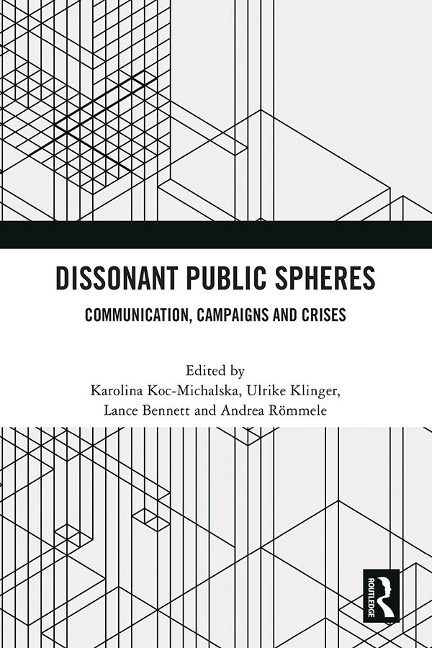
This book covers various aspects of political communication in dissonant public spheres and their impact on democratic processes. It expands research on campaigning beyond assumptions of well-functioning political systems, to better understand how the erosion of institutional legitimacy and trust affects communication processes. The volume approaches the concept of dissonant public spheres from four divergent perspectives: as instrumental threats to democracy, as communication performed by political actors, forms of engagement by citizens, and the nature of political conflicts. New perspectives are developed on how political candidates, organizations, and parties optimize their behaviour within dissonant political environments. These disrupted online communication environments reshape public spheres and change citizen engagement in ways that amplify political conflicts and crises. Chapters also examine the role of data-driven campaigning and address how limited access to platform data affects our understanding of dissonant public spheres. A significant new contribution to the field of political communication, this volume will be a key resource for scholars and researchers of communication studies, politics, media studies and sociology. The chapters in this book were originally published in Political Communication.
Karolina Koc-Michalska is Professor at Audencia Business School and Affiliated Researcher at CEVIPOF Sciences Po Paris, France, and University of Silesia, Poland. She is part of the NEPOCS group (nepocs.eu). She studies the strategies of political actors in the online environment and citizens' political engagement. She employs a comparative approach focusing on the United States and European countries. Ulrike Klinger is Professor for Digital Democracy at the European New School of Digital Studies, European University Viadrina, Frankfurt (Oder) in Germany. Her research focuses on digital political communication, technology and democracy, and the transformation of public spheres. Lance Bennett is Senior Research Fellow, Center for Journalism, Media & Democracy at the University of Washington, Seattle. Andrea Römmele is Dean of Executive Education and Professor of Communication in Politics and Civil Society at the Hertie School. Her research interests are comparative political communications, political parties and public affairs.
Introduction - Dissonant Public Spheres: Communication, Campaigns and Crises 1. Conditions of Campaigning in Dissonant Public Spheres and Crisis of Democracy 2. Data-Driven Campaigning as a Disruptive Force 3. The Data Abyss: How lack of data access leaves research and society in the dark 4. Farewell to Big Data? Studying Misinformation in Mobile Messaging Applications 5. Cross-Platform Emotions and Audience Engagement in Social Media Political Campaigning: Comparing Candidates' Facebook and Instagram Images in the 2020 US Election 6. Are Campaigns Getting Uglier, and Who Is to Blame? Negativity, Dramatization and Populism on Facebook in the 2014 and 2019 EP Election Campaigns 7. Damage Control: How Campaign Teams Interpret and Respond to Online Incivility 8. Dissonance from the Perspective of Agonistic Pluralism: A Study of Political Fragmentation on Facebook during the 2016 Austrian Presidential Election 9. The Campaign Disinformation Divide: Believing and Sharing News in the 2019 UK General Election 10. Abating Dissonant Public Spheres: Exploring the Effects of Affective, Ideological and Perceived Societal Political Polarization on Social Media Political Persuasion 11. Broadcasting Messages via Telegram: Pro-Government Social Media Control During the 2020 Protests in Belarus and 2022 Anti-War Protests in Russia 12. Political Polarization on the Digital Sphere: A Cross-platform, Over-time Analysis of Interactional, Positional, and Affective Polarization on Social Media
Dieses eBook wird im PDF-Format geliefert und ist mit einem Adobe Kopierschutz (DRM) versehen. Sie können dieses eBook mit allen Geräten lesen, die das PDF-Format und den Adobe Kopierschutz (DRM) unterstützen.
Zum Beispiel mit den folgenden Geräten:
• tolino Reader
Laden Sie das eBook direkt über den Reader-Shop auf dem tolino herunter oder übertragen Sie das eBook auf Ihren tolino mit einer kostenlosen Software wie beispielsweise Adobe Digital Editions.
• Sony Reader & andere eBook Reader
Laden Sie das eBook direkt über den Reader-Shop herunter oder übertragen Sie das eBook mit der kostenlosen Software Sony READER FOR PC/Mac oder Adobe Digital Editions auf ein Standard-Lesegeräte mit epub- und Adobe DRM-Unterstützung.
• Tablets & Smartphones
Möchten Sie dieses eBook auf Ihrem Smartphone oder Tablet lesen, finden Sie hier unsere kostenlose Lese-App für iPhone/iPad und Android Smartphone/Tablets.
• PC & Mac
Lesen Sie das eBook direkt nach dem Herunterladen mit einer kostenlosen Lesesoftware, beispielsweise Adobe Digital Editions, Sony READER FOR PC/Mac oder direkt über Ihre eBook-Bibliothek in Ihrem Konto unter „Meine eBooks“ - „online lesen“.
Schalten Sie das eBook mit Ihrer persönlichen Adobe ID auf bis zu sechs Geräten gleichzeitig frei.
Bitte beachten Sie, dass die Kindle-Geräte das Format nicht unterstützen und dieses eBook somit nicht auf Kindle-Geräten lesbar ist.