Und dann auf "Zum Home-Bildschirm [+]".

Stöbern
genialokal zum Startbildschirm hinzufügen
Installieren Sie die genialokal App auf Ihrem Startbildschirm für einen schnellen Zugriff und eine komfortable Nutzung.
Installieren Sie die genialokal App auf Ihrem Startbildschirm für einen schnellen Zugriff und eine komfortable Nutzung.
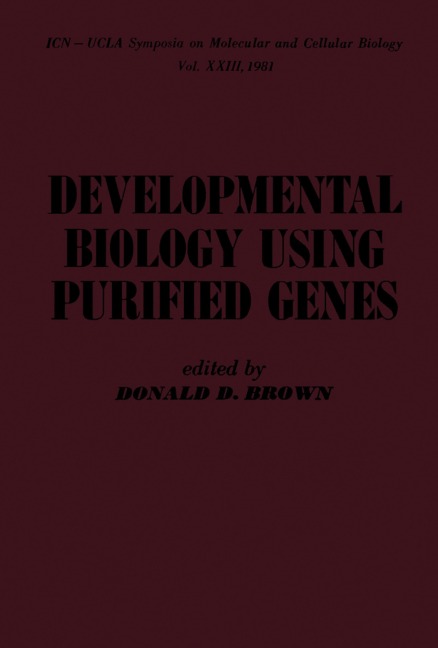
Developmental Biology Using Purified Genes is a compilation of papers presented at the 1981 ICN-UCLA Symposia on Developmental Biology Using Purified Genes, held in Keystone, Colorado. Contributors representing a wide range of disciplines explore the mechanisms underlying gene control of development and explain how purified genes are transcribed in cells, how DNA sequences and non-DNA molecules regulate development, and how gene-control molecules or other developmental determinants are unequally distributed among embryonic cells. Organized into nine sections comprised of 54 chapters, this volume begins with an overview of the mechanism by which gene activity is regionally controlled and its role in development. It then proceeds with a discussion on eukaryotic genes and their structure, including the collagen gene and the albumin gene family. The next chapters focus on the transcription and translation of yolk protein mRNA in the fat bodies of Drosophila, the organization and expression of the actin multi-gene family in Dictyostelium, the cDNA clones encoding mouse transplantation antigens, and the role of double minute chromosomes in unstable methotrexate resistance. The book also introduces the nucleosome core particle, regulatory factors involved in the transcription of mouse ribosomal genes, and developmental control of 5S RNA gene expression before concluding with a chapter on synthetic oligodeoxyribonucleotides and their use in the isolation of specific cloned DNA sequences. This book will be of interest to microbiologists, molecular biologists, embryologists, geneticists, and researchers working in the fields of genetics and developmental biology.
ContributorsPrefaceI. Keynote Address 1. Concepts of Gene Control in DevelopmentII. Structure of Eukaryotic Genes 2. The Dopa Decarboxylase Gene Locus of Drosophila melanogaster: Orientation of the Gene, and Preliminary Mapping of Genetic Markers 3. Tissue-Specific Expression of Mouse Alpha-Amylase Genes 4. The Collagen Gene 5. The Albumin Gene Family 6. Expression of ß-Like Globin Genes during Rabbit Embryogenesis 7. Intervening Sequence Mutation in a Cloned Human ß+-Thalassemic Globin Gene 8. Structures of Intergenic DNA of Non-Alpha Globin Genes of Man 9. Sequences of a Human Fibroblast Interferon Gene and Two Linked Human Leuckocyte Interferon Genes 10. Transcription and Translation of Yolk Protein mRNA in the Fat Bodies of DrosophilaIII. Multi-Gene Families and Complex Systems 11. Organization and Expression of the Actin Multi-Gene Family in Dictyostelium 12. The Actin Genes of Drosophila: Homologous Protein Coding Regions with Distinct Structural Arrangements and Chromosomal Locations 13. A Cluster of Drosophila Cuticle Genes 14. Organization and Evolution of the Developmentally RegulatedSilkmoth Chorion Gene Families 15. The Protamine Multi-Gene Family in the Developing Rainbow Trout Testes/Analysis of the ds-cDNA Clones 16. Isolation and Characterization of cDNA Clones Encoding Mouse Transplantation Antigens 17. Developmental Genetics of the Bithorax Complex in Drosophila 18. Genetic Dissection of Embryogenesis in Caenorhabditis elegansIV. Gene Amplification 19. Genes Coding for Metal-Induced Synthesis of RNA Sequences Are Differentially Amplified and Regulated in Mammalian Cells 20. Metallothionein-I Gene Amplification in Cadmium-Resistant Mouse Cell Lines 21. The Role of Double Minute Chromosomes in Unstable Methotrexate ResistanceV. Chromatin Structure 22. Modulation of the Structure of the Nucleosome Core Particle during Development 23. Evidence for a Structural Role of Copper in Histone-Depleted Chromosomes and Nuclei 24. Drosophila High Mobility Group ProteinsVI. Expression of Eukaryotic Genes: RNA Polymerases Forms I and II 25. Regulatory Factors Involved in the Transcription of Mouse Ribosomal Genes 26. Elements Required for Initiation of Transcription of the Ovalbumin Gene in Vitro 27. Identification of a Transcriptional Control Region Upstream from the HSV Thymidine Kinase Gene 28. Expression of ß-Globin Genes Modified by Restructuring and Site-Directed Mutagenesis 29. Modification of the Rabbit Chromosomal ß-Globin Gene by Restructuring and Site-Directed Mutagenesis 30. Transcription of Adenovirus DNA in Infected Cell Extracts 31. Characterization of Factors That Impart Selectivity to RNA Polymerase II in a Reconstituted System 32. Expression of the Heat Shock Genes in Drosophila melanogaster 33. Analysis of Eukaryotic Gene Transcription in VitroVII. Expression of Eukaryotic Genes: RNA Polymerases Form III 34. Studies on the Developmental Control of 5S RNA Gene Expression 35. Influence of a 5' Flanking Sequences on tRNA Transcription in Vitro 36. Transcription Initiation and Termination Signals in the Yeast Sup4 tRNATyr Gene 37. Processing of Yeast tRNATyr in Xenopus Oocytes Microinjected with Cloned Genes 38. The Control of Adenovirus VAI RNA Transcription 39. Regulation of Adenovirus VA RNA Gene ExpressionVIII. Viruses, Vectors, and Cell Transformation 40. Retrovirus Oncogenes 41. Isolation of a New Nondefective Adenovirus-SV40 Hybrid Virus from in Vitro Constructed Defective Viruses 42. Construction and Transfer of Recombinant Retrovirus Clones Carrying the HSV-1 Thymidine Kinase Gene 43. Rat Insulin Gene Covalently Linked to Bovine Papillomavirus DNA Is Expressed in Transformed Mouse Cells 44. The Development of Host Vectors for Directed Gene Transfers in Plants 45.