Und dann auf "Zum Home-Bildschirm [+]".

Stöbern
genialokal zum Startbildschirm hinzufügen
Installieren Sie die genialokal App auf Ihrem Startbildschirm für einen schnellen Zugriff und eine komfortable Nutzung.
Installieren Sie die genialokal App auf Ihrem Startbildschirm für einen schnellen Zugriff und eine komfortable Nutzung.
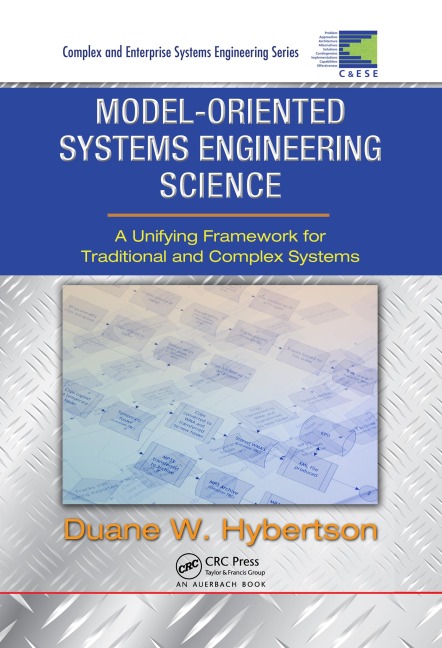
Systems engineering (SE) is experiencing a significant expansion that encompasses increasingly complex systems. However, a common body of knowledge on how to apply complex systems engineering (CSE) has yet to be developed. A combination of people and other autonomous agents, crossing organization boundaries and continually changing, these hybrid systems are less predictable while being more self-organizing and adaptive than traditional systems. The growing pains of this evolution and the ever-widening reach of SE technology require an effective foundation for integrating traditional and complex engineering methods, addressing machine and human interaction, as well as scaling up and down, from nano scale to the macro system-of-systems level. Model-oriented Systems Engineering Science: A Unifying Framework for Traditional and Complex Systems addresses solutions to that expansion and integration problem. This text takes advantage of better-understood systems science (SS) to support the transition, identifying and using commonalities between complex systems and other sciences, such as biology, sociology, cognitive science, organizational theory, and computational science. The author defines Model-oriented Systems Engineering Science (MOSES), an organized system that selects appropriate information from these disciplines and unifies it into a coherent framework. The result is a seamless approach to the class of systems across the extended scope of the new SE-a foundation upon which to develop an enhanced and unified SE. Modeling orientation (MO) provides a common perspective on the entire SES/SE enterprise, including all supporting sciences, engineering for the full range of traditional, complex, and hybrid systems, and their management. This book extends existing modeling approaches into an MO that views all science artifacts and engineering artifacts as models of systems. It organizes them into a virtual structured repository called the SE model space-effectively a container for the accumulating body of SE and SES knowledge in the form of models and patterns. By organizing and integrating all these elements into a common framework, the author makes the material not only easily accessible but also immediately applicable, and provides a well-grounded basis for future growth and evolution of the SE discipline.
Challenges and Opportunities for Systems Engineering. Systems Science Context. Core Concepts of Model-Oriented SE Science. Features of MOSES. The SE Model Space. Composition: Whole and Part. Commonization: Similarities and Differences. Conceptualization: Language and Ontology. Time: Change and Stability Views. Specification: Internal and External. Mapping and Unification. SE Actualization Processes.
Dieses eBook wird im PDF-Format geliefert und ist mit einem Adobe Kopierschutz (DRM) versehen. Sie können dieses eBook mit allen Geräten lesen, die das PDF-Format und den Adobe Kopierschutz (DRM) unterstützen.
Zum Beispiel mit den folgenden Geräten:
• tolino Reader
Laden Sie das eBook direkt über den Reader-Shop auf dem tolino herunter oder übertragen Sie das eBook auf Ihren tolino mit einer kostenlosen Software wie beispielsweise Adobe Digital Editions.
• Sony Reader & andere eBook Reader
Laden Sie das eBook direkt über den Reader-Shop herunter oder übertragen Sie das eBook mit der kostenlosen Software Sony READER FOR PC/Mac oder Adobe Digital Editions auf ein Standard-Lesegeräte mit epub- und Adobe DRM-Unterstützung.
• Tablets & Smartphones
Möchten Sie dieses eBook auf Ihrem Smartphone oder Tablet lesen, finden Sie hier unsere kostenlose Lese-App für iPhone/iPad und Android Smartphone/Tablets.
• PC & Mac
Lesen Sie das eBook direkt nach dem Herunterladen mit einer kostenlosen Lesesoftware, beispielsweise Adobe Digital Editions, Sony READER FOR PC/Mac oder direkt über Ihre eBook-Bibliothek in Ihrem Konto unter „Meine eBooks“ - „online lesen“.
Schalten Sie das eBook mit Ihrer persönlichen Adobe ID auf bis zu sechs Geräten gleichzeitig frei.
Bitte beachten Sie, dass die Kindle-Geräte das Format nicht unterstützen und dieses eBook somit nicht auf Kindle-Geräten lesbar ist.