Und dann auf "Zum Home-Bildschirm [+]".

Stöbern
genialokal zum Startbildschirm hinzufügen
Installieren Sie die genialokal App auf Ihrem Startbildschirm für einen schnellen Zugriff und eine komfortable Nutzung.
Installieren Sie die genialokal App auf Ihrem Startbildschirm für einen schnellen Zugriff und eine komfortable Nutzung.
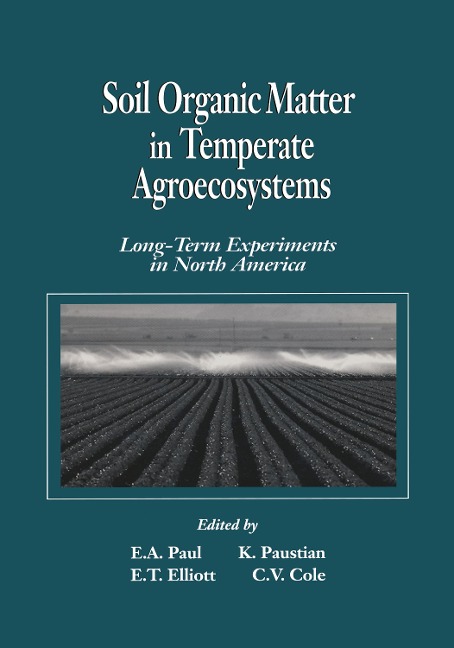
The presence - or absence - of soil organic matter (SOM) has important implications for agricultural productivity. It could also have significant implications for global climate due to its role as a source/sink of carbon. Therefore, it is important to understand the issues related to the accumulation or loss of SOM, to use what we have learned from experiments to make sound decisions about soil and crop management, and to test models and future concepts concerning SOM management. A database is included with the book, presenting tabular data for 34 sites in North America. Soil Organic Matter in Temperate Agroecosystems discusses all of these issues and more, answering such questions as:
E.A. Paul, Ph.D., Professor, Department of Crop and Soil Sciences, Michigan State University, has served as Chairperson of Crop and Soil Sciences at Michigan State University and as Chair of the Department of Plant and Soil Biology, University of California - Berkeley. Before that he was Professor of Soil Science at the University of Saskatchewan, Saskatoon, Canada. His major fields of interest shown in the extensive papers published have included microbial ecology, soil organic matter dynamics, nutrient cycling, and plant microbial interactions. National and international committees and professional society appointments have helped both his science and his profession. He has taught extensively at the undergraduate and graduate level and advised many successful students both in Canada and the U.S. Books edited include volumes 3, 4, and 5 of Soil Biochemistry published by Marcel Dekker. The textbook, Soil Microbiology and Biochemistry, co-edited with F.E. Clark and published by Academic Press has extensive readership and is being translated into three languages other than English. He is a fellow of the Canadian Society Soil Science, American Society of Agronomy, Soil Science Society of America, and the American Association for the Advancement of Science and a recipient of the Soil Science Society of America Research Award. Keith Paustian, Ph.D., is a Senior Research Scientist at the Natural Resource Ecology Laboratory (NREL), Colorado State University. Prior to his appointment at NREL in 1993, he was a Research Assistant Professor at the W.K. Kellogg Biological Station, Michigan State University (1989-1993) and Research Scientist at the Department of Ecology and Environmental Research, Swedish University of Agricultural Sciences, Uppsala, Sweden (1987-1989). Edward T. Elliott, Ph.D., is the Associate Director of the Natural Resource Ecology Laboratory and holds a joint appointment as Professor in the Soil and Crop Sciences Department at Colorado State University. He is the Director of the University Office of Ecosystem Research and Management. His B.Sc. and M.Sc. in Soil Science were obtained at Colorado State University and his Ph.D. in Ecology is from the University of Georgia, where he studied freshwater ecology. C. Vernon Cole, Ph.D., is a Senior Research Scientist with the Natural Resource Ecology Laboratory, Colorado State University. He was a Research Soil Scientist with the Agricultural Research Service, USDA from 1950 until his retirement in 1993. He contributed to significant advances in the knowledge of phosphorus chemistry in the first years of his career. A practical soil test developed from this research has been used worldwide and is the basis for identifying phosphorus deficient soils in much of the neutral and slightly weathered soils of the world.
The Role of Soil Organic Matter in Agricultural Systems and Global Change Impacts of Agriculture on Atmospheric Carbon Dioxide, K.W. Flach, T.O. Barnwell, Jr., and P. Crosson Management Controls on Soil Carbon, K. Paustian, H.P. Collins, and E.A. Paul Characterization of Soil Organic Carbon Relative to Its Stability and Turnover, H.P. Collins, E.A. Paul, K. Paustian, and E.T. Elliott Crop Residue Input to Soil Organic Matter, G.A. Buyanovsky and G.H. Wagner Biogeochemistry of Managed Grasslands in Central North America, I. C. Burke, W.K Lauenroth, and D. G. Milchunas Site Management Effects on Productivity and Soil Organic Matter in the Corn Belt Nitrogen Fertilizer and Legume-Cereal Rotation Effects on Soil Productivity and Organic Matter Dynamics in Wisconsin, M.B. Vanotti, L.G. Bundy, and A.E. Peterson Long-Term N Management Effects on Corn Yield and Soil C of an Aquic Haplustoll in Minnesota, D.R. Huggins and D.J. Fuchs Long Term Effects of Fertilizer and Manure on Corn Yield, Soil Carbon and Other Soil Chemical Properties in Michigan, M.L. Vitosh, R.E. Lucas, and G.H. Silva Long-Term Tillage and Periodic Plowing of a No-Tilled Soil in Michigan: Impacts, Yield and Soil Organic Matter, F.J. Pierce and M-C. Fortin Soil Organic Matter in Sugar Beet and Dry Bean Cropping Systems in Michigan, D.R. Christenson Soil Organic Carbon Changes Through Time at the University of Illinois Morrow Plots, R.G. Darmody and T.R. Peck Continuous Application of No-Tillage to Ohio Soils: Changes in Crop Yields and Organic Matter-Related Soil Properties, W.A. Dick, W.M. Edwards, and E.L. McCoy Management Impacts on SOM and Related Soil Properties in a Long Term Farming Systems Trial in Pennsylvania: 1981-1991, S.E. Peters, M.M. Wander, L.S. Saporito, G.H. Harris, and D.B. Friedman Crop Rotation, Manure, and Agricultural Chemical Effects on Dryland Crop Yield, SOM, and other Soil Characteristics over 16 Years in Eastern Nebraska, G.W. Lesoing
Dieses eBook wird im PDF-Format geliefert und ist mit einem Adobe Kopierschutz (DRM) versehen. Sie können dieses eBook mit allen Geräten lesen, die das PDF-Format und den Adobe Kopierschutz (DRM) unterstützen.
Zum Beispiel mit den folgenden Geräten:
• tolino Reader
Laden Sie das eBook direkt über den Reader-Shop auf dem tolino herunter oder übertragen Sie das eBook auf Ihren tolino mit einer kostenlosen Software wie beispielsweise Adobe Digital Editions.
• Sony Reader & andere eBook Reader
Laden Sie das eBook direkt über den Reader-Shop herunter oder übertragen Sie das eBook mit der kostenlosen Software Sony READER FOR PC/Mac oder Adobe Digital Editions auf ein Standard-Lesegeräte mit epub- und Adobe DRM-Unterstützung.
• Tablets & Smartphones
Möchten Sie dieses eBook auf Ihrem Smartphone oder Tablet lesen, finden Sie hier unsere kostenlose Lese-App für iPhone/iPad und Android Smartphone/Tablets.
• PC & Mac
Lesen Sie das eBook direkt nach dem Herunterladen mit einer kostenlosen Lesesoftware, beispielsweise Adobe Digital Editions, Sony READER FOR PC/Mac oder direkt über Ihre eBook-Bibliothek in Ihrem Konto unter „Meine eBooks“ - „online lesen“.
Schalten Sie das eBook mit Ihrer persönlichen Adobe ID auf bis zu sechs Geräten gleichzeitig frei.
Bitte beachten Sie, dass die Kindle-Geräte das Format nicht unterstützen und dieses eBook somit nicht auf Kindle-Geräten lesbar ist.