Und dann auf "Zum Home-Bildschirm [+]".

Stöbern
genialokal zum Startbildschirm hinzufügen
Installieren Sie die genialokal App auf Ihrem Startbildschirm für einen schnellen Zugriff und eine komfortable Nutzung.
Installieren Sie die genialokal App auf Ihrem Startbildschirm für einen schnellen Zugriff und eine komfortable Nutzung.
Ihr gewünschter Artikel ist in 0 Buchhandlungen vorrätig - wählen Sie hier eine Buchhandlung in Ihrer Nähe aus:

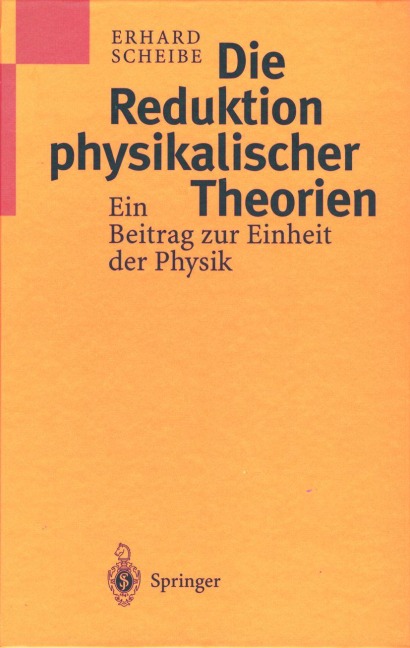
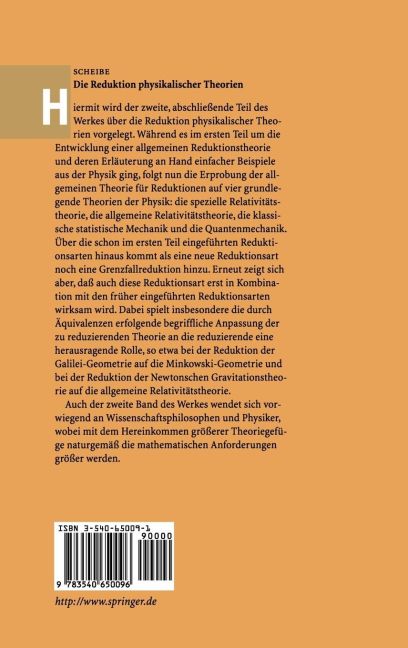
Der Autor präsentiert eine neue Theorie der Reduktion physikalischer Theorien, die nicht einen ein für alle Mal verbindlichen, allgemeinen Reduktionsbegriff zugrunde legt, sondern einen auf der Hintereinanderschaltung von Reduktionen rekursiven Aufbau gibt, bei dem alle Reduktionen als Kombinationen möglichst spezieller elementarer Reduktionen erscheinen. Dieser 2. Band zeigt die Tragweite des Konzepts an konkreten Beispielen aus der Physik: Spezielle und Allgemeine Relativitätstheorie, Quantenmechanik. Dem schwierigen Begriff der Mikroreduktion ist ein eigenes Kapitel gewidmet, das auch die Kinetische Theorie behandelt. Dieses systematisch angelegte Buch richtet sich an Leser, die an Wissenschaftstheorie interessiert sind, aber auch an Physiker ohne vertiefte philosophische Vorkenntnisse.
Erhard Scheibe (1927-2010) was for several decades the leading philosopher of physics in the German speaking world. He gained his Ph.D. in Mathematics from the University of Göttingen, where he worked with Werner Heisenberg at the Max Planck Institute for Physics. He later became Carl Friedrich von Weizsäcker's assistant at Hamburg. Erhard Scheibe obtained his Habilitation in 1963 from the University of Hamburg with a philosophical study of quantum mechanics. From 1964 to 1982 he was a full Professor of Philosophy in Göttingen, and from 1982 to 1992 in Heidelberg. Over the course of his career, Prof. Scheibe published six monographs in the philosophy and history of physics, edited the von Weizsäcker Festschrift and two conference proceedings, and wrote numerous essays on the philosophy and history of physics and on the history of philosophy.
Translators:
Brigitte Falkenburg holds a Ph.D. in Physics from the University of Heidelberg, a Ph.D. in Philosophy from the University of Bielefeld, and a Physics Diploma from the Technische Universität Berlin. She is Full Professor (emeritus) at the Technische Universität Dortmund. Her work focuses on the philosophy of physics and the history of philosophy (Kant, Neokantianism). In addition to almost 100 journal articles and book chapters in philosophy of physics, history of philosophy, and related subjects, Prof. Falkenburg has published six monographs on Kant, Hegel, philosophy of physics, and the philosophy of neuroscience. She has edited several books, among them Erhard Scheibe's "Selected Papers in the Philosophy of Physics".
Gregg Jaeger holds a Ph.D. in Physics from Boston University and B.Sc. degrees in Mathematics, Philosophy, and Physics from the University of Wisconsin-Madison. He is currently an Associate Professor of Natural Sciences and Mathematics at Boston University. His work focuses primarily on quantum theory. In addition to more than 70 journal articles in theoretical and experimental physics, history of science, philosophy, and mathematics, Prof. Jaeger has published three monographs in physics and the philosophy of science, edited two books and a number of conference proceedings in the foundations of quantum theory, and has written numerous book chapters in these fields.
VII. Reduktion auf relativistische Theorien.- 1. Geometrie: Assimilation der Grundbegriffe.- 2. Geometrie: Grenzfallreduktion.- 3. Geometrie: asymptotische Reduktion und Inkommensurabilität.- 4. Stoßmechanik.- 5. Mechanik eines Massenpunktes.- VIII. Reduktionen auf die allgemeine Relativitätstheorie.- 1. Die ?-Formulierung der allgemeinen Relativitätstheorie.- 2. Die Reduktion peziell-relativistischer (Nicht-Gravitations-) Theorien uf allgemein-relativistische Theorien.- 3. Der Fall ?= 0 und die Newtonsche Anpassung.- 4. Linearisierte Theorie und Newtonsche Näherung.- 5. Schwarzschild vs. Kepler.- 6. Individuelle Grenzfälle und allgemeine Grenzfallreduktion.- IX. Mikroreduktionen.- 1. Reduktionismus.- 2. Kinetische Theorie I: keine Wechselwirkung.- 3. Kinetische Theorie II: die Boltzmann Gleichung.- X. Klassische Mechanik und Quantenmechanik.- 1. Grundlagen und Probleme.- 2. Ehrenfestsche Sätze, Mittelwerte und klassische Bahnen.- 3. Klassischer Grenzfall und Hamilton/Jacobi Gleichung.- 4. Die Weyl/Wigner Transformation.- Literatur.- Personenverzeichnis.- I.