Und dann auf "Zum Home-Bildschirm [+]".

Stöbern
genialokal zum Startbildschirm hinzufügen
Installieren Sie die genialokal App auf Ihrem Startbildschirm für einen schnellen Zugriff und eine komfortable Nutzung.
Installieren Sie die genialokal App auf Ihrem Startbildschirm für einen schnellen Zugriff und eine komfortable Nutzung.
Ihr gewünschter Artikel ist in 0 Buchhandlungen vorrätig - wählen Sie hier eine Buchhandlung in Ihrer Nähe aus:

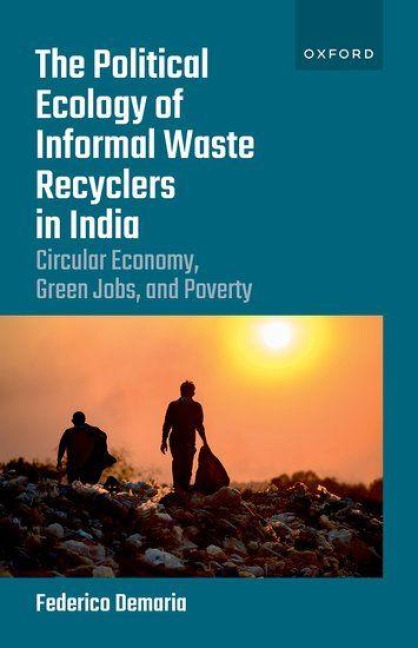
The questions related to waste management are not merely technical; what, how, where, and by whom becomes intrinsically political questions. This book is about the power relations in recycling, from the viewpoint of political ecology, and ecological economics.
Federico Demaria is an Associate Professor in Ecological Economics and Political Ecology at the University of Barcelona, and a senior researcher at the Institute of Environmental Science and Technology (ICTA), Autonomous University of Barcelona. His research aims to inform theory on how environments are shaped, politicized, and contested. He is an editor of the journal Sustainability Science, and a member of the editorial board of Ecological Economics. He is also an expert reviewer for the Intergovernmental Panel on Climate Change (IPCC). He has been a visiting scholar at research centres in India, China, USA, UK, Netherlands, Croatia, Germany, and Italy. He is the co-editor of Degrowth: A Vocabulary for a New Era (2014) and Pluriverse: A Post-development Dictionary (2019), and a co-author of The Case for Degrowth (2020).
- 1: Introduction: Waste Is Increasingly a Site of Social Conflict - 2: Theoretical Framework: Ecological Economics, Political Ecology, and Waste Studies - 3: Shipbreaking in Alang: A Conflict Against Capital Accumulation by Contamination - 4: Delhi's Waste Conflict: An Unlikely Alliance Against Capital Accumulation by Dispossession and Contamination - 5: Informal Waste Recyclers and Their Environmental Services: A Case for Recognition and Capital De- Accumulation - 6: Conclusions: How Environments Are Shaped, Politicized, and Contested