Und dann auf "Zum Home-Bildschirm [+]".

Stöbern
genialokal zum Startbildschirm hinzufügen
Installieren Sie die genialokal App auf Ihrem Startbildschirm für einen schnellen Zugriff und eine komfortable Nutzung.
Installieren Sie die genialokal App auf Ihrem Startbildschirm für einen schnellen Zugriff und eine komfortable Nutzung.
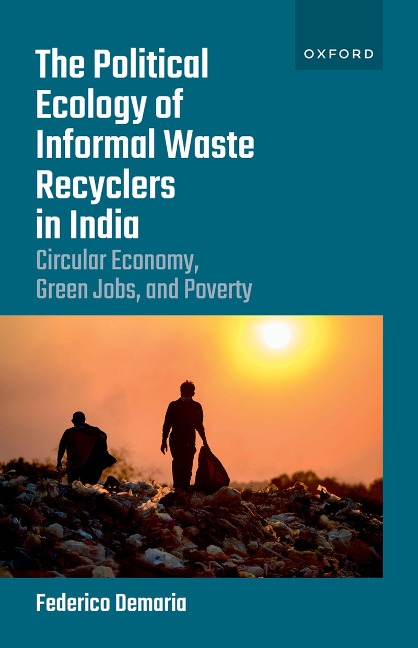
Waste is increasingly a site of social conflict. The questions related to waste management are not merely technical; what, how, where, and by whom become intrinsically political questions. This book is about the power relations in recycling, from the viewpoint of political ecology and ecological economics. Informal waste recyclers are invisible for citizens and public policy. This book focuses on environmental conflicts involving them, with two emblematic case studies from India. Firstly, ship breaking, where the metabolism of a global infrastructure, namely shipping, shifts social and environmental costs to very localized communities in order to obtain large profits. Secondly, the conflict around municipal solid waste management in Delhi shows how environmental costs are shifted to urban residents, and recyclers are dispossessed of their livelihood source: recyclable waste. The first is an example of capital accumulation by contamination, while the second involves both dispossession and contamination. The struggles of informal recyclers constitute an attempt to re-politicize waste metabolism beyond techno-managerial solutions by fostering counter-hegemonic discourses and praxis. The book presents a range of experiences, mostly in India but with examples from all over the world, to inform theory on how environments are shaped, politicized, and contested.
Federico Demaria is an Associate Professor in Ecological Economics and Political Ecology at the University of Barcelona, and a senior researcher at the Institute of Environmental Science and Technology (ICTA), Autonomous University of Barcelona. His research aims to inform theory on how environments are shaped, politicized, and contested. He is an editor of the journal Sustainability Science, and a member of the editorial board of Ecological Economics. He is also an expert reviewer for the Intergovernmental Panel on Climate Change (IPCC). He has been a visiting scholar at research centres in India, China, USA, UK, Netherlands, Croatia, Germany, and Italy. He is the co-editor of Degrowth: A Vocabulary for a New Era (2014) and Pluriverse: A Post-development Dictionary (2019), and a co-author of The Case for Degrowth (2020).
- 1: Introduction: Waste Is Increasingly a Site of Social Conflict - 2: Theoretical Framework: Ecological Economics, Political Ecology, and Waste Studies - 3: Shipbreaking in Alang: A Conflict Against Capital Accumulation by Contamination - 4: Delhi's Waste Conflict: An Unlikely Alliance Against Capital Accumulation by Dispossession and Contamination - 5: Informal Waste Recyclers and Their Environmental Services: A Case for Recognition and Capital De- Accumulation - 6: Conclusions: How Environments Are Shaped, Politicized, and Contested
Dieses eBook wird im PDF-Format geliefert und ist mit einem Adobe Kopierschutz (DRM) versehen. Sie können dieses eBook mit allen Geräten lesen, die das PDF-Format und den Adobe Kopierschutz (DRM) unterstützen.
Zum Beispiel mit den folgenden Geräten:
• tolino Reader
Laden Sie das eBook direkt über den Reader-Shop auf dem tolino herunter oder übertragen Sie das eBook auf Ihren tolino mit einer kostenlosen Software wie beispielsweise Adobe Digital Editions.
• Sony Reader & andere eBook Reader
Laden Sie das eBook direkt über den Reader-Shop herunter oder übertragen Sie das eBook mit der kostenlosen Software Sony READER FOR PC/Mac oder Adobe Digital Editions auf ein Standard-Lesegeräte mit epub- und Adobe DRM-Unterstützung.
• Tablets & Smartphones
Möchten Sie dieses eBook auf Ihrem Smartphone oder Tablet lesen, finden Sie hier unsere kostenlose Lese-App für iPhone/iPad und Android Smartphone/Tablets.
• PC & Mac
Lesen Sie das eBook direkt nach dem Herunterladen mit einer kostenlosen Lesesoftware, beispielsweise Adobe Digital Editions, Sony READER FOR PC/Mac oder direkt über Ihre eBook-Bibliothek in Ihrem Konto unter „Meine eBooks“ - „online lesen“.
Schalten Sie das eBook mit Ihrer persönlichen Adobe ID auf bis zu sechs Geräten gleichzeitig frei.
Bitte beachten Sie, dass die Kindle-Geräte das Format nicht unterstützen und dieses eBook somit nicht auf Kindle-Geräten lesbar ist.