Und dann auf "Zum Home-Bildschirm [+]".

Stöbern
genialokal zum Startbildschirm hinzufügen
Installieren Sie die genialokal App auf Ihrem Startbildschirm für einen schnellen Zugriff und eine komfortable Nutzung.
Installieren Sie die genialokal App auf Ihrem Startbildschirm für einen schnellen Zugriff und eine komfortable Nutzung.
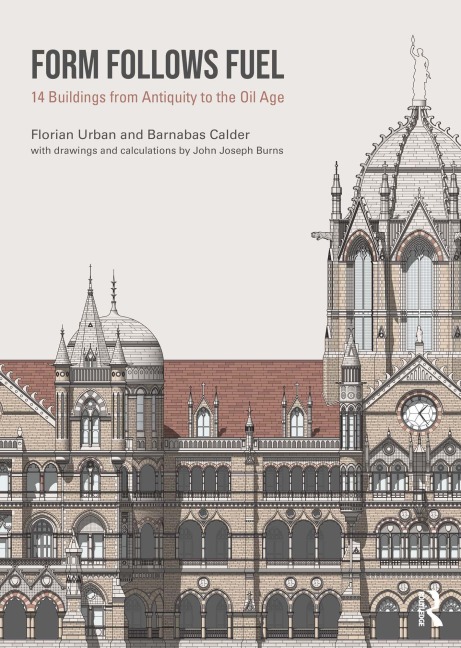
Modernists believed that "form follows function." Form Follows Fuel shows that in fact energy has been the biggest influence on the world's architecture throughout the history of our species. The availability of energy under different fuel regimes - including human labour, firewood, coal, oil, gas, and renewables - shapes architecture at all scales, from what gets built to how its doors hinge. This book is the first to quantify energy inputs for a range of buildings worldwide and across the historical record. In the process, it challenges today's architects, offers practical solutions to today's ecological crises, and highlights the aspects of today's buildings that make architecture responsible for 37% of human climate-changing emissions. It reveals the enormously lower impacts of historical alternatives to today's default building practices. This book shows that the shift to modern fossil fuel use, from the seventeenth century, came to be the most consequential move in the history of architecture as well as in human history in general. This brought about remarkable wealth for the built environment and at the same time unprecedented dangers for our planet, as evidenced by the exacerbating climate emergency. This book consists of 14 accessibly written case studies, illustrated with beautiful and revealing new measured drawings of each project by John Joseph Burns. Each chapter focuses on a single structure in a particular historical context, sometimes contrasted to similar buildings, from subsistence farming to advanced global capitalism. The chapters analyse the consumption of embodied and operational energy in these buildings, and also discuss questions of recycling and adaptive reuse. They complement precise descriptions with hard numbers on materials and construction, using robustly sourced approximations where exact figures are not available. The case studies rely on both published research and the authors' own calculations and allow systematic comparison across different global regions and historical periods. Cases include architectural icons such as the Great Pyramid of Giza, the Baths of Caracalla, the Mausoleum of Qin Shi Huang, the Seagram Building, and Terminal 1 of Kuala Lumpur International Airport, as well as common types such as a pre-modern stone house, a late-nineteenth-century tenement, and a modernist panel block. Examples are taken from different regions of the world, including ancient China, pre-Columbian Mexico, and modern Europe. This book is an important contribution to architectural historical research, written for students, academics and building professionals as well as for a general audience.
Florian Urban is an architectural historian, Professor, and Head of History of Architecture and Urban Studies (HAUS) at the Glasgow School of Art. He was born and raised in Germany, and holds an MA in Urban Planning from UCLA and a PhD in History and Theory of Architecture from MIT. He is the author, among others, of the books Neo-historical East Berlin - Architecture and Urban Design in the German Democratic Republic 1970-1990 (2009), Tower and Slab - Histories of Global Mass Housing (2012), The New Tenement - Architecture in the Inner City since 1970 (2018), and Postmodern Architecture in Socialist Poland - Transformation, Symbolic Form and National Identity (2021). @florianurban.bsky.social Barnabas Calder is a historian of architecture and Head of the History of Architecture Research Cluster at the University of Liverpool. He specialises in the relationship between architecture and energy throughout human history. He also works on British architecture since 1945, and on the intersections between energy systems and human culture. He is the author of Raw Concrete: The Beauty of Brutalism (2016) and Architecture: From Pre-history to Climate Emergency (2021). @barnabascalder.bsky.social, Insta: @BarnabasCalder, #ArchitectureAndEnergy
Introduction - Form Follows Fuel Methodology 1-2. You may be a Pharaoh: The Great Pyramid in Giza and the Seagram Building in New York 3. A Dwelling in a Low-Energy Society: Blackhouse in Arnol, Scotland 4. A Rammed-Earth Dwelling: Teleuk in Mourla, Cameroon 5. A Mausoleum in an Agrarian Empire: The Burial Mound of the First Chinese Emperor near Xi'an 6. Monumental Architecture without Wheels, Iron or Draft Animals: The Great Temple in Tenochtitlan/ Mexico City 7. Leisure from the Emperor: The Baths of Caracalla, Rome 8. Fossil Coal and Capitalist Growth: a Georgian House at 36 Great James Street, London 9. The Transport Revolution: Chhatrapati Shivaji Maharaj Terminus, Mumbai 10. Early mass housing in an industrial city: Tenement at Rostocker Straße 44, Berlin 11. Early mass housing in a colonial context: Jianyeli Lilong ensemble, Shanghai 12. The Modern Factory: Original Assembly Building at the Ford Plant in Highland Park near Detroit 13. Mass housing at its peak: Panel Block at Ulitsa Grimau 14, Moscow 14. The Contemporary Airport: Kuala Lumpur International 15. Conclusion: Architecture for the Post-Oil Era? Annex 1: Basic Energy Figures Annex 2: Human Labour, an Elusive Quantity
Dieses eBook wird im PDF-Format geliefert und ist mit einem Adobe Kopierschutz (DRM) versehen. Sie können dieses eBook mit allen Geräten lesen, die das PDF-Format und den Adobe Kopierschutz (DRM) unterstützen.
Zum Beispiel mit den folgenden Geräten:
• tolino Reader
Laden Sie das eBook direkt über den Reader-Shop auf dem tolino herunter oder übertragen Sie das eBook auf Ihren tolino mit einer kostenlosen Software wie beispielsweise Adobe Digital Editions.
• Sony Reader & andere eBook Reader
Laden Sie das eBook direkt über den Reader-Shop herunter oder übertragen Sie das eBook mit der kostenlosen Software Sony READER FOR PC/Mac oder Adobe Digital Editions auf ein Standard-Lesegeräte mit epub- und Adobe DRM-Unterstützung.
• Tablets & Smartphones
Möchten Sie dieses eBook auf Ihrem Smartphone oder Tablet lesen, finden Sie hier unsere kostenlose Lese-App für iPhone/iPad und Android Smartphone/Tablets.
• PC & Mac
Lesen Sie das eBook direkt nach dem Herunterladen mit einer kostenlosen Lesesoftware, beispielsweise Adobe Digital Editions, Sony READER FOR PC/Mac oder direkt über Ihre eBook-Bibliothek in Ihrem Konto unter „Meine eBooks“ - „online lesen“.
Schalten Sie das eBook mit Ihrer persönlichen Adobe ID auf bis zu sechs Geräten gleichzeitig frei.
Bitte beachten Sie, dass die Kindle-Geräte das Format nicht unterstützen und dieses eBook somit nicht auf Kindle-Geräten lesbar ist.