Und dann auf "Zum Home-Bildschirm [+]".

Stöbern
genialokal zum Startbildschirm hinzufügen
Installieren Sie die genialokal App auf Ihrem Startbildschirm für einen schnellen Zugriff und eine komfortable Nutzung.
Installieren Sie die genialokal App auf Ihrem Startbildschirm für einen schnellen Zugriff und eine komfortable Nutzung.
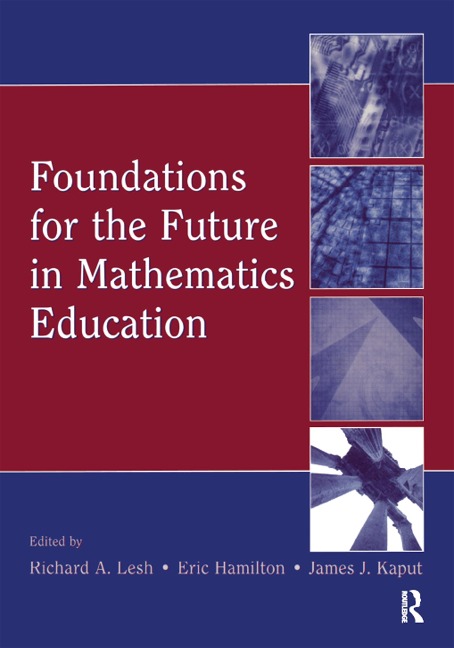
The central question addressed in Foundations for the Future in Mathematics Education is this: What kind of understandings and abilities should be emphasized to decrease mismatches between the narrow band of mathematical understandings and abilities that are emphasized in mathematics classrooms and tests, and those that are needed for success beyond school in the 21st century? This is an urgent question. In fields ranging from aeronautical engineering to agriculture, and from biotechnologies to business administration, outside advisors to future-oriented university programs increasingly emphasize the fact that, beyond school, the nature of problem-solving activities has changed dramatically during the past twenty years, as powerful tools for computation, conceptualization, and communication have led to fundamental changes in the levels and types of mathematical understandings and abilities that are needed for success in such fields. For K-12 students and teachers, questions about the changing nature of mathematics (and mathematical thinking beyond school) might be rephrased to ask: If the goal is to create a mathematics curriculum that will be adequate to prepare students for informed citizenship-as well as preparing them for career opportunities in learning organizations, in knowledge economies, in an age of increasing globalization-how should traditional conceptions of the 3Rs be extended or reconceived? Overall, this book suggests that it is not enough to simply make incremental changes in the existing curriculum whose traditions developed out of the needs of industrial societies. The authors, beyond simply stating conclusions from their research, use results from it to describe promising directions for a research agenda related to this question. The volume is organized in three sections: *Part I focuses on naturalistic observations aimed at clarifying what kind of "mathematical thinking" people really do when they are engaged in "real life" problem solving or decision making situations beyond school. *Part II shifts attention toward changes that have occurred in kinds of elementary-but-powerful mathematical concepts, topics, and tools that have evolved recently-and that could replace past notions of "basics" by providing new foundations for the future. This section also initiates discussions about what it means to "understand" the preceding ideas and abilities. *Part III extends these discussions about meaning and understanding-and emphasizes teaching experiments aimed at investigating how instructional activities can be designed to facilitate the development of the preceding ideas and abilities. Foundations for the Future in Mathematics Education is an essential reference for researchers, curriculum developers, assessment experts, and teacher educators across the fields of mathematics and science education.
Richard A. Lesh, Eric Hamilton and James J. Kaput
Contents: Preface: R.A. Lesh, Foundations for the Future in Engineering and Other Fields That Are Heavy Users of Mathematics, Science, & Technology. Part I: E. Hamilton, What Changes Are Occurring in the Kind of Problem Solving Situations Where Mathematical Thinking is Needed Beyond School?C. Hoyles, R. Noss, The Meanings of Statistical Variation in the Context of Work. J. Gainsburg,Problem Solving and Learning in Everyday Structural Engineering Work. B. Goldstein, R. Hall, Modeling Without End: Conflict Across Organizational and Disciplinary Boundaries in Habitat Conservation Planning. W-M. Roth, Mathematical Modeling 'in the Wild': A Case of Hot Cognition. D.W. Shaffer, Learning in Design. R. Núñez, The Cognitive Science of Mathematics: Why Is It Relevant for Mathematics Education? Part II: R.A. Lesh, What Changes Are Occurring in the Kind of Elementary-but-Powerful Mathematics Concepts That Provide New Foundations for the Future? J.L. Schwartz, Models, Simulations, and Exploratory Environments: A Tentative Taxonomy. J.J. Kaput, R.A. Lesh, S. Hegedus, Technology Becoming Infrastructural in Mathematics Education. M. Thompson, C. Yoon, Why Build a Mathematical Model? Taxonomy of Situations That Create the Need for a Model to Be Developed. C. Yoon, M. Thompson, Cultivating Modeling Abilities. J.G. Rosenstein, Discrete Mathematics in 21st Century Education: An Opportunity to Retreat From the Rush to Calculus. T. Hills, A.C. Huford, W.M. Stroup, R.A. Lesh, Formalizing Learning as a Complex System: Scale Invariant Power Law Distributions in Group and Individual Decision Making. A. diSessa, Systemics of Learning for a Revised Pedagogical Agenda. G. Harel, The DNR System as a Conceptual Framework for Curriculum Development and Instruction. G.A. Goldin, Aspects of Affect and Mathematical Modeling Processes. Part III:R.A. Lesh, What Kind of Instructional Activities Are Needed to Develop New Levels and Types of Understanding and Ability?M. Le Vasan, R.A. Lesh, M.A. Bakar, Beyond Efficiency: A Critical Perspective of Singapore's Educational Reforms. R.A. Lesh, C. Yoon, J. Zawojewski, John Dewey Revisited-Making Mathematics Practical Versus Making Practice Mathematical. E. Hamilton, R.A. Lesh, F. Lester, C. Yoon, The Use of Reflection Tools in Building Personal Models of Problem-Solving. W.M. Stroup, N. Ares, A.C. Hurford, R.A. Lesh,Diversity by Design: The What, Why, and How of Generativity in Next-Generation Classroom Networks. F.G. Martin, M.A. Hjalmarson, P.C. Wankat, When the Model Is a Program. M.A. Hjalmarson, M. Cardella, P.C. Wankat, Uncertainty and Iteration in Design Tasks for Engineering Students. R.Y. Schorr, L. Warner, D. Gearhar, M. Samuels, Teacher Development in a Large Urban District and the Impact on Students. R.A. Lesh, E. Hamilton, J.J. Kaput, Directions for Future Research.
Dieses eBook wird im PDF-Format geliefert und ist mit einem Adobe Kopierschutz (DRM) versehen. Sie können dieses eBook mit allen Geräten lesen, die das PDF-Format und den Adobe Kopierschutz (DRM) unterstützen.
Zum Beispiel mit den folgenden Geräten:
• tolino Reader
Laden Sie das eBook direkt über den Reader-Shop auf dem tolino herunter oder übertragen Sie das eBook auf Ihren tolino mit einer kostenlosen Software wie beispielsweise Adobe Digital Editions.
• Sony Reader & andere eBook Reader
Laden Sie das eBook direkt über den Reader-Shop herunter oder übertragen Sie das eBook mit der kostenlosen Software Sony READER FOR PC/Mac oder Adobe Digital Editions auf ein Standard-Lesegeräte mit epub- und Adobe DRM-Unterstützung.
• Tablets & Smartphones
Möchten Sie dieses eBook auf Ihrem Smartphone oder Tablet lesen, finden Sie hier unsere kostenlose Lese-App für iPhone/iPad und Android Smartphone/Tablets.
• PC & Mac
Lesen Sie das eBook direkt nach dem Herunterladen mit einer kostenlosen Lesesoftware, beispielsweise Adobe Digital Editions, Sony READER FOR PC/Mac oder direkt über Ihre eBook-Bibliothek in Ihrem Konto unter „Meine eBooks“ - „online lesen“.
Schalten Sie das eBook mit Ihrer persönlichen Adobe ID auf bis zu sechs Geräten gleichzeitig frei.
Bitte beachten Sie, dass die Kindle-Geräte das Format nicht unterstützen und dieses eBook somit nicht auf Kindle-Geräten lesbar ist.