Und dann auf "Zum Home-Bildschirm [+]".

Stöbern
genialokal zum Startbildschirm hinzufügen
Installieren Sie die genialokal App auf Ihrem Startbildschirm für einen schnellen Zugriff und eine komfortable Nutzung.
Installieren Sie die genialokal App auf Ihrem Startbildschirm für einen schnellen Zugriff und eine komfortable Nutzung.
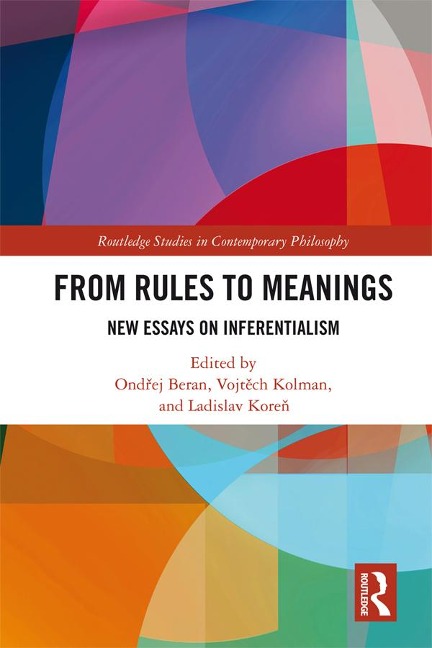
Inferentialism is a philosophical approach premised on the claim that an item of language (or thought) acquires meaning (or content) in virtue of being embedded in an intricate set of social practices normatively governed by inferential rules. Inferentialism found its paradigmatic formulation in Robert Brandom's landmark book Making it Explicit, and over the last two decades it has established itself as one of the leading research programs in the philosophy of language and the philosophy of logic. While Brandom's version of inferentialism has received wide attention in the philosophical literature, thinkers friendly to inferentialism have proposed and developed new lines of inquiry that merit wider recognition and critical appraisal. From Rules to Meaning brings together new essays that systematically develop, compare, assess and critically react to some of the most pertinent recent trends in inferentialism. The book's four thematic sections seek to apply inferentialism to a number of core issues, including the nature of meaning and content, reconstructing semantics, rule-oriented models and explanations of social practices and inferentialism's historical influence and dialogue with other philosophical traditions. With contributions from a number of distinguished philosophers-including Robert Brandom and Jaroslav Peregrin-this volume is a major contribution to the philosophical literature on the foundations of logic and language.
Ondrej Beran is a researcher, currently based at the Centre for Ethics (University of Pardubice). His publications, ongoing work, and areas of research interest include the philosophy of language, ethics, the philosophy of religion, and feminist philosophy. He has also translated some of Wittgenstein's works into Czech Vojtech Kolman is Associate Professor of Logic at the Faculty of Arts, Charles University in Prague. His research focuses mainly on themes from the philosophy of mathematics, the history of logic, pragmatism, and the philosophy of the arts. He is author of the book Zahlen and numerous articles in international journals (Synthese, Erkenntnis, Hegel-Bulletin, Allgemeine Zeitschrift für Philosophie and others). Ladislav Koren is the Chair of the Department of Philosophy and Social Sciences at the University of Hradec Králové and a researcher at the Czech Academy of Sciences. His areas of interest include epistemology, philosophy of language, philosophy of logic, philosophy of mind, and philosophy of social sciences. His publications include research articles in international journals (Synthese, Journal of Social Ontology) and Volumes (Routledge).
Introduction: Inferentialism's Years of Travel and Its Logico-Philosophical Calling Ladislav Koren and Vojtech Kolman Part I: Language and Meaning 1. Grounding Assertion and Acceptance in Mental Imagery Christopher Gauker 2. Semantics: Why Rules Ought to Matter Hans-Johann Glock 3. Quine Peregrinating: Norms, Dispositions, and Analyticity Gary Kemp 4. Let's Admit Defeat: Assertion, Denial, and Retraction Bernhard Weiss Part II: Logic and Semantics 5. Inferentialism, Structure, and Conservativeness Ole Hjortland and Shawn Standefer 6. From Logical Expressivism to Expressivist Logics: Sketch of a Program and Some Implementations Robert Brandom 7. Inferentialist-Expressivism for Explanatory Vocabulary Jared Millson, Kareem Khalifa, and Mark Risjord 8. Logical Expressivism and Logical Relations Lionel Shapiro 9. Propositional Contents and the Logical Space Ladislav Koren 10. Assertion, Inference, and the Conditional Peter Milne Part III: Rules, Agency, and Explanation 11. Natural Cultural Inferentialism Joseph Rouse 12. Inferentialism: Where Do We Go from Here? Jaroslav Peregrin 13. The Nature and Diversity of Rules Vladimír Svoboda 14. Governed by Rules, or Subjects to Rules? Ondrej Beran Part IV: History and Present 15. Inferentialism after Kant Danielle Macbeth 16. Inferentialism, Naturalism, and the Ought-To-Be's of Perceptual Cognition James O'Shea 17. Inferentialism and Its Mathematical Precursor Vojtech Kolman 18. Inferentialism and the Reception of Testimony Leila Haaparanta
Dieses eBook wird im PDF-Format geliefert und ist mit einem Adobe Kopierschutz (DRM) versehen. Sie können dieses eBook mit allen Geräten lesen, die das PDF-Format und den Adobe Kopierschutz (DRM) unterstützen.
Zum Beispiel mit den folgenden Geräten:
• tolino Reader
Laden Sie das eBook direkt über den Reader-Shop auf dem tolino herunter oder übertragen Sie das eBook auf Ihren tolino mit einer kostenlosen Software wie beispielsweise Adobe Digital Editions.
• Sony Reader & andere eBook Reader
Laden Sie das eBook direkt über den Reader-Shop herunter oder übertragen Sie das eBook mit der kostenlosen Software Sony READER FOR PC/Mac oder Adobe Digital Editions auf ein Standard-Lesegeräte mit epub- und Adobe DRM-Unterstützung.
• Tablets & Smartphones
Möchten Sie dieses eBook auf Ihrem Smartphone oder Tablet lesen, finden Sie hier unsere kostenlose Lese-App für iPhone/iPad und Android Smartphone/Tablets.
• PC & Mac
Lesen Sie das eBook direkt nach dem Herunterladen mit einer kostenlosen Lesesoftware, beispielsweise Adobe Digital Editions, Sony READER FOR PC/Mac oder direkt über Ihre eBook-Bibliothek in Ihrem Konto unter „Meine eBooks“ - „online lesen“.
Schalten Sie das eBook mit Ihrer persönlichen Adobe ID auf bis zu sechs Geräten gleichzeitig frei.
Bitte beachten Sie, dass die Kindle-Geräte das Format nicht unterstützen und dieses eBook somit nicht auf Kindle-Geräten lesbar ist.