Und dann auf "Zum Home-Bildschirm [+]".

Stöbern
genialokal zum Startbildschirm hinzufügen
Installieren Sie die genialokal App auf Ihrem Startbildschirm für einen schnellen Zugriff und eine komfortable Nutzung.
Installieren Sie die genialokal App auf Ihrem Startbildschirm für einen schnellen Zugriff und eine komfortable Nutzung.
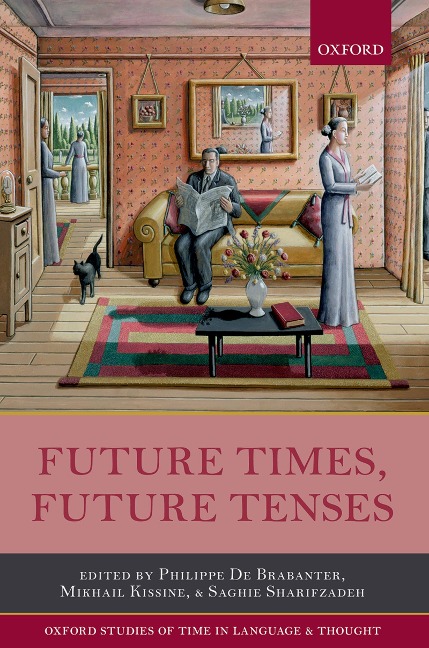
Future Times, Future Tenses examines how the future is expressed by means of tense, aspect, and modality across a wide range of languages, among them French, Polish, Basque, Turkish, and West Greenlandic. From the present point of view, the future is not fixed: while there is arguably only one past, the future is largely open and/or indeterminate. Reference to the future has thus become one of the most hotly-debated topics in contemporary linguistics: the interactions of future tense with future time, and of future tense with the semantics of possible worlds, are crucial to any satisfactory account of temporal linguistics. This book considers and seeks a resolution to outstanding issues in the field by uniting linguistic and philosophical perspectives on future reference in natural language. Scholars from different parts of the world approach these issues from a variety of theoretical perspectives, including those of linguistic typology, formal semantics, pragmatics, and philosophy of language. In the process they question the very validity of the traditional notion of a specific marker for future tense. The book shows the close connections between linguistic, logical, metaphysical, ontological, and epistemological issues concerning the future and reveals the value of linking linguistic considerations of tense and aspect to philosophical approaches to modality and time.
Philippe De Brabanter holds a PhD in Linguistics from the Université Libre de Bruxelles (2002). A member of Institut Jean Nicod and Maître de Conférences at Université Paris-Sorbonne until 2012, he currently teaches English linguistics at the Université Libre de Bruxelles. His research has centred on the semantics-pragmatics interface, with special attention to ordinary meta-discourse (quotation, semantic deference and metalinguistic anaphora). Mikhail Kissine is assistant professor at the Université Libre de Bruxelles. He is the author of From Utterances to Speech Acts (CUP, 2013), and the co-author, with Mark Jary, of Imperatives (CUP, in press). In addition, he has published widely on semantics, pragmatics and philosophy of language. Saghie Sharifzadeh is a Maître de Conférences at the Université Paris - Sorbonne. She holds a PhD in English Linguistics from the same university (2012) as well as the agrégation in English. She has worked extensively on the English verb and on verbal anaphora, and has recently been focusing on colour terms.
- 1: Philippe De Brabanter, Mikhail Kissine, and Saghie Sharifzadeh: Introduction - 2: Isidora Stojanovic: Talking about the Future: Unsettled truth and assertion - 3: Fabio Del Prete: The interpretation of indefinites in future tense sentences: A novel argument for the modality of will - 4: Bridget Copley: Causal chains for futurates - 5: Richard M. Weist: Future temporal reference in child language - 6: Naja Trondhjem: Markers of futurity and aspect in West Greenlandic - 7: Gerd Jendraschek: Future tense, prospective aspect, and irrealis mood as part of the situation perspective: Insights from Basque, Turkish, and Papuan - 8: Joanna Blaszczak, Patrycja Jablonska, Dorota Klimek-Jankowska, and Krzystof Migdalski: The riddle of 'Future Tense' in Polish - 9: Alexandra Y. Aikhenvald: On future in commands - 10: Victoria Escandell-Vidal: Evidential futures: The case of Spanish - 11: Louis de Saussure: Future reference and current relevance with the French composed past
Dieses eBook wird im PDF-Format geliefert und ist mit einem Adobe Kopierschutz (DRM) versehen. Sie können dieses eBook mit allen Geräten lesen, die das PDF-Format und den Adobe Kopierschutz (DRM) unterstützen.
Zum Beispiel mit den folgenden Geräten:
• tolino Reader
Laden Sie das eBook direkt über den Reader-Shop auf dem tolino herunter oder übertragen Sie das eBook auf Ihren tolino mit einer kostenlosen Software wie beispielsweise Adobe Digital Editions.
• Sony Reader & andere eBook Reader
Laden Sie das eBook direkt über den Reader-Shop herunter oder übertragen Sie das eBook mit der kostenlosen Software Sony READER FOR PC/Mac oder Adobe Digital Editions auf ein Standard-Lesegeräte mit epub- und Adobe DRM-Unterstützung.
• Tablets & Smartphones
Möchten Sie dieses eBook auf Ihrem Smartphone oder Tablet lesen, finden Sie hier unsere kostenlose Lese-App für iPhone/iPad und Android Smartphone/Tablets.
• PC & Mac
Lesen Sie das eBook direkt nach dem Herunterladen mit einer kostenlosen Lesesoftware, beispielsweise Adobe Digital Editions, Sony READER FOR PC/Mac oder direkt über Ihre eBook-Bibliothek in Ihrem Konto unter „Meine eBooks“ - „online lesen“.
Schalten Sie das eBook mit Ihrer persönlichen Adobe ID auf bis zu sechs Geräten gleichzeitig frei.
Bitte beachten Sie, dass die Kindle-Geräte das Format nicht unterstützen und dieses eBook somit nicht auf Kindle-Geräten lesbar ist.