Und dann auf "Zum Home-Bildschirm [+]".

Stöbern
genialokal zum Startbildschirm hinzufügen
Installieren Sie die genialokal App auf Ihrem Startbildschirm für einen schnellen Zugriff und eine komfortable Nutzung.
Installieren Sie die genialokal App auf Ihrem Startbildschirm für einen schnellen Zugriff und eine komfortable Nutzung.
Ihr gewünschter Artikel ist in 0 Buchhandlungen vorrätig - wählen Sie hier eine Buchhandlung in Ihrer Nähe aus:

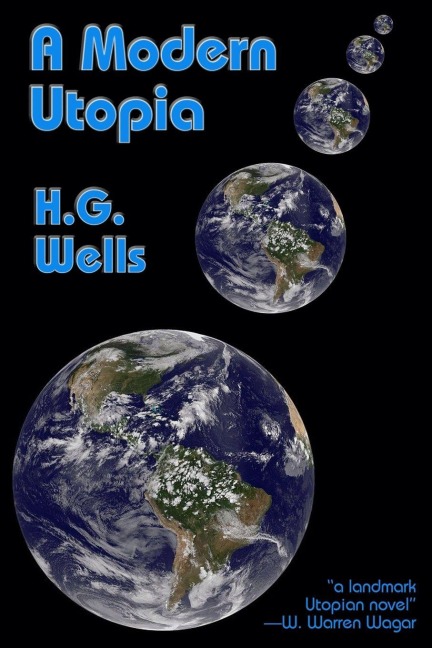
A Modern Utopia is one of H.G. Wells' explorations of social problems set in the form of a novel, but it is more a complex investigation of what might be than a mere fictional story.
The unnamed narrator and a traveling companion find themselves on a parallel Earth, where the geology, biology, and very people are duplicates of those we know. They differ, however, in their outlook on life, methods of living and organizing themselves, and many other sociological issues. Through the eyes of the two we recognize (and their doppelgangers on this other Earth), we explore the possibilities provided in Wells' utopian society, where people work for the common betterment, rather than personal enrichment.
Complex, visionary, and thought-provoking, author Joseph Conrad complained of the book that Wells did not "take sufficient account of human imbecility which is cunning and perfidious."
British author Herbert George Wells (1866-1946) was at home in many genres, including history, politics, and social commentary, as well as the fiction for which he is best remembered today. He was one of the fathers of modern science fiction, and was nominated for the Nobel Prize in Literature four times (in 1921, 1932, 1935, and 1946). He is the author of such enduring classics as The Time Machine (1895), The Island of Doctor Moreau (1896), The Invisible Man (1897), and The War of the Worlds (1898).
A Modern Utopia is an early one of the 50 novels—and an even greater number of nonfiction works—H.G. Wells produced during a writing career that spanned decades. His first novel, The Time Machine, appeared in 1895, while his last followed in 1941, You Can't Be Too Careful. His non-fiction books debuted with a Text-Book of Biology in 1893, through a discussion of Marxism vs Liberalism in 1945.
H.G. Wells (1866-1946) was an author of science-fiction works-including The War of the Worlds and Star Begotten-who had significant influence on society's vision of the future.H.G. Wells was born Herbert George Wells on September 21, 1866, in Bromley, England. He was educated at a private school in Bromley, Midhurst Grammar School; and the Normal School of Science, now the Royal College of Science, London University.His parents were shopkeepers from a working-class background. His father's shop failed and the family struggled financially. His two older brothers were apprenticed to a draper and his mother was employed on an estate as a housekeeper. It was there that H.G. discovered, in the owner's extensive library, the works of Jonathan Swift and other important writers of the Enlightenment, including Voltaire.As a teen-ager, Wells was apprenticed as a draper, but eventually quit. He became a teacher and won a scholarship to the Normal School of Science, London University, where he studied a variety of subjects, including physics, chemistry, astronomy and biology.Wells' first novel, The Time Machine, became an overnight literary success when it was published in 1895. It was quickly followed by The Island of Dr. Moreau (1896), The Invisible Man (1897) and The War of the Worlds (1898). These are all considered to be early examples of science fiction and today, many consider him to be the "father" of the literary genre.H.G. Wells died on August 13, 1946 in London, England.