Und dann auf "Zum Home-Bildschirm [+]".

Stöbern
genialokal zum Startbildschirm hinzufügen
Installieren Sie die genialokal App auf Ihrem Startbildschirm für einen schnellen Zugriff und eine komfortable Nutzung.
Installieren Sie die genialokal App auf Ihrem Startbildschirm für einen schnellen Zugriff und eine komfortable Nutzung.


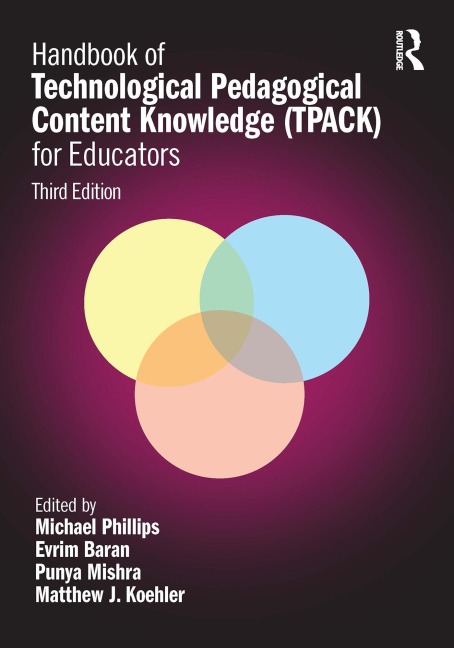
The third edition of the Handbook of Technological Pedagogical Content Knowledge (TPACK) for Educators addresses the concept and implementation of technological pedagogical content knowledge. One of the most highly cited and widely recognized frameworks in educational technology, the TPACK construct provides teachers with the knowledge and skills they need to meaningfully integrate technology into teaching in specific content areas. This thorough, substantive revision explores the emerging theoretical developments, empirical efforts, digital technologies, and diverse contextual factors that impact TPACK's evolution and enactment around the world. Critical perspectives on TPACK, research on its deployment across specific content areas, and integration into teacher education and professional development frame a variety of new and updated chapters covering research methods, contextual knowledge, artificial intelligence, and more. The Handbook of Technological Pedagogical Content Knowledge (TPACK) for Educators is simultaneously a mandate and a manifesto on engagement with technology in today's classrooms.
Michael Phillips is Professor of Digital Transformation in the Faculty of Education at Monash University, Australia. Evrim Baran is Professor of Educational Technology and Human-Computer Education at Iowa State University, USA. Punya Mishra is Director of Innovative Learning Futures at the Learning Engineering Institute and Professor at the Mary Lou Fulton College of Teaching and Learning Innovation at Arizona State University, USA. Matthew J. Koehler is Professor of Educational Psychology and Educational Technology at Michigan State University, USA.
Introduction Section I: TPACK and Context 1. Enacting Technological Pedagogical Content Knowledge in the COVID-19 Era: Advancements in Understanding Contextual Factors 2. TPACK's Contextual Knowledge: Exploring EFL Teachers' Technological Pedagogical Practices in Iran, Libya, Syria, Tunisia, and Yemen 3. Reimagining TPACK in the Landscape of Early Childhood Education 4. Developing Teachers' Contextual Knowledge and TPACK in a Pedagogical Change Laboratory Section II: TPACK Framework and Theory 5. TP(A)CK's Many Derivatives: Accretion or Evolution? 6. Introducing FULL TPACK: Expanding the TPACK Framework to Include a Comprehensive View of Contextual Knowledge (XK) 7. TPACK as a Resource for Teaching Professional Ethical Knowledge in the Training of Social Sciences Teachers 8. ConteXt Is Key: UDL and TPACK = Universal Access to Learning Section III: TPACK in Practice 9. Applying the TPACK Framework: Guiding Faculty Development for Generative Artificial Intelligence Literacy 10. TPACK Development in Teacher Education: A Simulation-Based Learning Approach 11. Implications of the TPACK Framework for Developing Computationally Literate Preservice Teachers 12. Linking TPACK and Equity-Based Mathematics Teaching 13. Challenges and Opportunities: The Influence of Artificial Intelligence Powered Tools on Developing Teachers' TPACK Section IV: TPACK Research and Approaches 14. How Is TPACK Used in PK-12 Technology Integration Professional Development Models?: A Systematic Literature Review 15. Examining Dimensions of Preservice Teachers' TPACK for Elementary Mathematics 16. Measuring TPACK Learning: A Modern Measurement Approach for TPACK 17. Gathering Evidence of Teachers' TPACK through Discourse Analysis of Their Coursework in an Online Professional Development Course: A Case Study
Dieses eBook wird im PDF-Format geliefert und ist mit einem Adobe Kopierschutz (DRM) versehen. Sie können dieses eBook mit allen Geräten lesen, die das PDF-Format und den Adobe Kopierschutz (DRM) unterstützen.
Zum Beispiel mit den folgenden Geräten:
• tolino Reader
Laden Sie das eBook direkt über den Reader-Shop auf dem tolino herunter oder übertragen Sie das eBook auf Ihren tolino mit einer kostenlosen Software wie beispielsweise Adobe Digital Editions.
• Sony Reader & andere eBook Reader
Laden Sie das eBook direkt über den Reader-Shop herunter oder übertragen Sie das eBook mit der kostenlosen Software Sony READER FOR PC/Mac oder Adobe Digital Editions auf ein Standard-Lesegeräte mit epub- und Adobe DRM-Unterstützung.
• Tablets & Smartphones
Möchten Sie dieses eBook auf Ihrem Smartphone oder Tablet lesen, finden Sie hier unsere kostenlose Lese-App für iPhone/iPad und Android Smartphone/Tablets.
• PC & Mac
Lesen Sie das eBook direkt nach dem Herunterladen mit einer kostenlosen Lesesoftware, beispielsweise Adobe Digital Editions, Sony READER FOR PC/Mac oder direkt über Ihre eBook-Bibliothek in Ihrem Konto unter „Meine eBooks“ - „online lesen“.
Schalten Sie das eBook mit Ihrer persönlichen Adobe ID auf bis zu sechs Geräten gleichzeitig frei.
Bitte beachten Sie, dass die Kindle-Geräte das Format nicht unterstützen und dieses eBook somit nicht auf Kindle-Geräten lesbar ist.