Und dann auf "Zum Home-Bildschirm [+]".

Stöbern
genialokal zum Startbildschirm hinzufügen
Installieren Sie die genialokal App auf Ihrem Startbildschirm für einen schnellen Zugriff und eine komfortable Nutzung.
Installieren Sie die genialokal App auf Ihrem Startbildschirm für einen schnellen Zugriff und eine komfortable Nutzung.
Ihr gewünschter Artikel ist in 0 Buchhandlungen vorrätig - wählen Sie hier eine Buchhandlung in Ihrer Nähe aus:

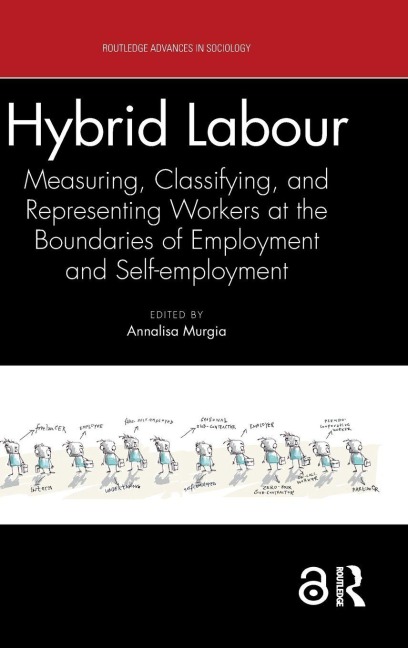
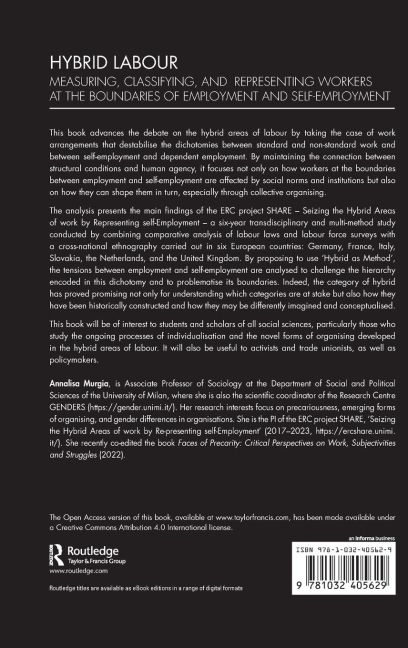
This book advances the debate on the hybrid areas of labour by taking the case of work arrangements that destabilise the dichotomies between standard and non-standard work, and between self-employment and dependent employment.
Annalisa Murgia is Associate Professor of Sociology at the Department of Social and Political Sciences of the University of Milan, where she is also the scientific coordinator of the Research Centre GENDERS (https://gender.unimi.it/). Her research interests focus on precariousness, emerging forms of organising, and gender differences in organisations. She is the PI of the ERC project SHARE, 'Seizing the Hybrid Areas of work by Re-presenting self-Employment' (2017-2023, https://ercshare.unimi.it/). She recently cöedited the book Faces of Precarity: Critical Perspectives on Work, Subjectivities and Struggles (2022).
Preface PART 1. The State of the Art 1. Working at the Boundaries: An Introduction to Solo Self-employment 2. A Statistical Portrait of the Workers at the Boundaries of Employment and Self-employment in Europe: Who Are They and What Do They Do? 3. Regulating Labour at the Border between Employment and Self-employment: An Enduring Challenge 4. When Labour Diversifies, Its Collective Representation Does Too PART 2. Epistemological and Methodological Approach 5. Hybrid as an Epistemological and Methodological Approach 6. Research Contexts and Methods PART 3. SHARE: A Transdisciplinary and Multi-Method Study Conducted in Six European Countries 7. Deconstructing Labour Statistics by Reconstructing the Concepts of Autonomy and Dependency 8. Hybrid Work in Hybrid Organisations. Labour Law and New Organisational Methods 9. A Comparative Ethnography on the Collective Representation in the Hybrid Areas of Labour 10. Hybrid Cooperatives: An Alternative to Self-employment Ensuring Autonomy, Security, and Solidarity 11. If Work Is Hybrid, Are Workers Hybrid Too? Old and New Challenges for Approaching Heterogeneous Workers 12. Hybrid Practices of Organising: How Workers Mobilise between Employment and Self-employment 13. Hybrid Forms of Organising Are Growing and so Are Workers' Networks: The Emergence of National and Transnational Alliances 14. A Hybrid Attempt to Regulate Labour: Recent Developments under the European Union's Legal Framework Afterword