Und dann auf "Zum Home-Bildschirm [+]".

Stöbern
genialokal zum Startbildschirm hinzufügen
Installieren Sie die genialokal App auf Ihrem Startbildschirm für einen schnellen Zugriff und eine komfortable Nutzung.
Installieren Sie die genialokal App auf Ihrem Startbildschirm für einen schnellen Zugriff und eine komfortable Nutzung.

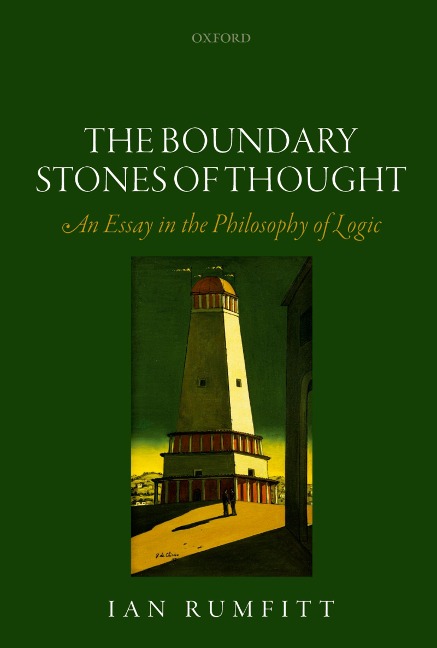
The Boundary Stones of Thought seeks to defend classical logic from a number of attacks of a broadly anti-realist character. Ian Rumfitt is sympathetic to many of the premisses underlying these attacks. Indeed, he regards some of them as effective challenges to certain principles of classical semantics, notably the Principle of Bivalence. He argues, though, that they are ineffective against classical logic itself. The book starts by considering the general problem of how conflicts over logical laws may be rationally discussed and adjudicated. This leads to a consideration of the nature of logic: Rumfitt identifies the particular features that mark out logical consequence from other consequence relations, and he advances a new argument for the ancient thesis that there is a modal element in the notion of logical consequence. He develops a theory of that modal element in terms of perhaps incomplete possibilities, rather than fully determinate possible worlds. Some prima facie powerful arguments against the validity of certain classical logical laws are then analysed in the light of this account of logic. Throughout, care is taken to separate lines of anti-classical argument that, although distinct, are often run together or confused. The analysis yields, as by-products, semantic theories for a number of problematical areas of discourse. These areas include our talk about sub-atomic particles, about the infinite, about infinitesimals, about sets, and vague discourse. Rumfitt concludes by defending his stance of accepting classical logic while rejecting Bivalence, against Aristotle's argument that a classical logician is committed to Bivalence. The ultimate aim is to liberate classical logic from the dead hand of classical semantics.
Ian Rumfitt studied philosophy at Balliol College, Oxford and at Princeton University. He has taught the subject at Keele University, the University of Michigan at Ann Arbor, University College, Oxford (where he was a Tutorial Fellow for seven years), and at Birkbeck College, London (where he was Professor of Philosophy from 2005 until 2013). He is now Professor of Philosophy at the University of Oxford and a Senior Research Fellow at All Souls College. He has published many articles in philosophical logic, in the philosophy of language, and in metaphysics.
- 1: Introduction - PART ONE: THE NATURE OF LOGIC - 2: Logical laws - 3: Logical necessity - PART TWO: FIVE ATTACKS ON CLASSICAL LOGIC - 4: The argument of Dummett's 'Truth' - 5: The verificationist attack on classical logic - 6: Possibilities - 7: Challenges from the infinite and from the infinitesimal - 8: The challenge from vagueness - 9: On the use of classical logic in set theory - 10: Conclusion - Bibliography - Index
Dieses eBook wird im PDF-Format geliefert und ist mit einem Adobe Kopierschutz (DRM) versehen. Sie können dieses eBook mit allen Geräten lesen, die das PDF-Format und den Adobe Kopierschutz (DRM) unterstützen.
Zum Beispiel mit den folgenden Geräten:
• tolino Reader
Laden Sie das eBook direkt über den Reader-Shop auf dem tolino herunter oder übertragen Sie das eBook auf Ihren tolino mit einer kostenlosen Software wie beispielsweise Adobe Digital Editions.
• Sony Reader & andere eBook Reader
Laden Sie das eBook direkt über den Reader-Shop herunter oder übertragen Sie das eBook mit der kostenlosen Software Sony READER FOR PC/Mac oder Adobe Digital Editions auf ein Standard-Lesegeräte mit epub- und Adobe DRM-Unterstützung.
• Tablets & Smartphones
Möchten Sie dieses eBook auf Ihrem Smartphone oder Tablet lesen, finden Sie hier unsere kostenlose Lese-App für iPhone/iPad und Android Smartphone/Tablets.
• PC & Mac
Lesen Sie das eBook direkt nach dem Herunterladen mit einer kostenlosen Lesesoftware, beispielsweise Adobe Digital Editions, Sony READER FOR PC/Mac oder direkt über Ihre eBook-Bibliothek in Ihrem Konto unter „Meine eBooks“ - „online lesen“.
Schalten Sie das eBook mit Ihrer persönlichen Adobe ID auf bis zu sechs Geräten gleichzeitig frei.
Bitte beachten Sie, dass die Kindle-Geräte das Format nicht unterstützen und dieses eBook somit nicht auf Kindle-Geräten lesbar ist.