Und dann auf "Zum Home-Bildschirm [+]".

Stöbern
genialokal zum Startbildschirm hinzufügen
Installieren Sie die genialokal App auf Ihrem Startbildschirm für einen schnellen Zugriff und eine komfortable Nutzung.
Installieren Sie die genialokal App auf Ihrem Startbildschirm für einen schnellen Zugriff und eine komfortable Nutzung.
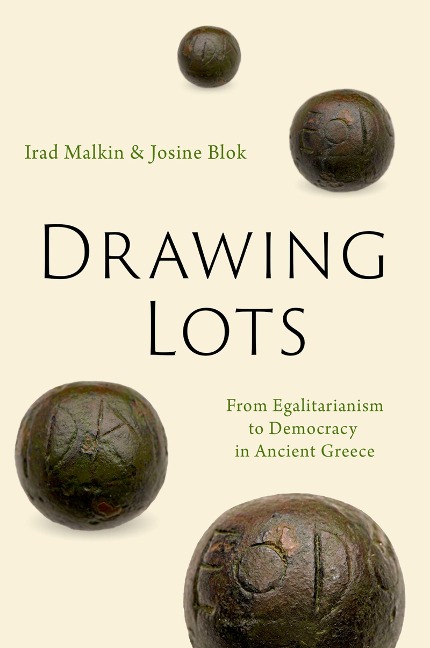
For the first time, this volume by two leading historians offers a comprehensive study of drawing lots as a central institution of ancient Greek society. Drawing lots expressed an egalitarian mindset that guided selection, procedure, and distribution by lot and was eventually introduced for polis governance, a Greek innovation that appears to be of increasing relevance today.
The authors explore the egalitarian, "horizonal," mindset expressed in using the lot instead of a top-down vision of authority and sovereignty. Drawing lots presupposed equality among participants deserving equal "portions" and was used for distributing land, inheritance, booty, sacrificial meat, selecting individuals, setting turns, mixing and reorganizing groups, and divining the will of the gods. Lot-oracles were used for divination; otherwise, the gods guarded the justice of the procedure but only rarely determined the outcome. It was a self-evident method broadly and ubiquitously applied. Drawing lots would crystallize community boundaries and emphasize its sovereignty. The book further investigates the transposition of the drawing of lots to the governance of the polis. The implied egalitarianism of the lot often conflicted with top-down perceptions of society and the values of inequality, status, and merit. Drawing lots was introduced into oligarchies and democracies at an uneven pace and scale. Its wide use in the democracy of classical Athens was an exceptional case, eye-catching both in antiquity and today.
The book concludes with a discussion about the meaning of the Greek examples for drawing lots today and the increasing interest in using random selection in politics as a possibility for modern democracies around the world. The appendix surveys the Greek vocabulary of lottery practices.
Irad Malkin is Emeritus Professor of History at Tel Aviv University, a Foreign Member of the Athens National Academy, a member of the European Network for the Study of Ancient Greek History, and the author of numerous books, including A Small Greek World. Josine Blok is Professor Emeritus of Ancient History and Classical Civilization at Utrecht University, a member of the Royal Dutch Academy of Sciences, and co-founder and chair of the European Network for the Study of Ancient Greek History. Her previous books include Citizenship in Classical Athens.
List of abbreviations Preface Introduction Greeks drawing lots: the practice and the mindset of egalitarianism Part I The lottery mindset: religion and society 1. Lotteries divine and human: the world of the Homeric epics 2. When does the lot reflect the will of the gods? Lots, oracles, divination, and the notion of moira 3. Sacrifice and feast: social values and the distribution of meat by lot Part II Equal and fair: inheritance, colonization, and mixture 4. Partible Inheritance by lot 5. Drawing lots on the Athenian stage 6. Founding cities and sharing in the polis: equality, allotment, and civic mixture Part III Drawing lots in polis governance 7. Setting the stage 8. Drawing lots for polis office 9. Drawing lots for governance: a political innovation Part IV Conclusions 10. Conclusions and implications 11. Drawing lots today: fair distribution and a stronger democracy Appendix A Lexicographical survey: lottery practices in the archaic and classical periods Bibliography Index Index locorum
Dieses eBook wird im PDF-Format geliefert und ist mit einem Adobe Kopierschutz (DRM) versehen. Sie können dieses eBook mit allen Geräten lesen, die das PDF-Format und den Adobe Kopierschutz (DRM) unterstützen.
Zum Beispiel mit den folgenden Geräten:
• tolino Reader
Laden Sie das eBook direkt über den Reader-Shop auf dem tolino herunter oder übertragen Sie das eBook auf Ihren tolino mit einer kostenlosen Software wie beispielsweise Adobe Digital Editions.
• Sony Reader & andere eBook Reader
Laden Sie das eBook direkt über den Reader-Shop herunter oder übertragen Sie das eBook mit der kostenlosen Software Sony READER FOR PC/Mac oder Adobe Digital Editions auf ein Standard-Lesegeräte mit epub- und Adobe DRM-Unterstützung.
• Tablets & Smartphones
Möchten Sie dieses eBook auf Ihrem Smartphone oder Tablet lesen, finden Sie hier unsere kostenlose Lese-App für iPhone/iPad und Android Smartphone/Tablets.
• PC & Mac
Lesen Sie das eBook direkt nach dem Herunterladen mit einer kostenlosen Lesesoftware, beispielsweise Adobe Digital Editions, Sony READER FOR PC/Mac oder direkt über Ihre eBook-Bibliothek in Ihrem Konto unter „Meine eBooks“ - „online lesen“.
Schalten Sie das eBook mit Ihrer persönlichen Adobe ID auf bis zu sechs Geräten gleichzeitig frei.
Bitte beachten Sie, dass die Kindle-Geräte das Format nicht unterstützen und dieses eBook somit nicht auf Kindle-Geräten lesbar ist.