Und dann auf "Zum Home-Bildschirm [+]".

Stöbern
genialokal zum Startbildschirm hinzufügen
Installieren Sie die genialokal App auf Ihrem Startbildschirm für einen schnellen Zugriff und eine komfortable Nutzung.
Installieren Sie die genialokal App auf Ihrem Startbildschirm für einen schnellen Zugriff und eine komfortable Nutzung.
Ihr gewünschter Artikel ist in 0 Buchhandlungen vorrätig - wählen Sie hier eine Buchhandlung in Ihrer Nähe aus:

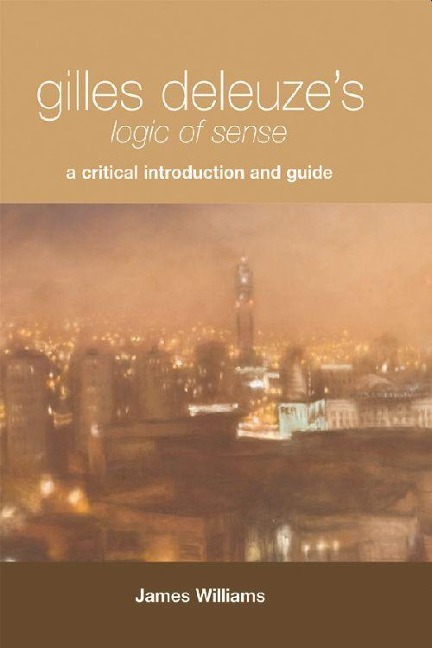
This book offers the first critical study of The Logic of Sense, Gilles Deleuze's most important work on language and ethics, as well as the main source for his vital philosophy of the event. Deleuze's philosophy has always promised a revolution in ethical theories and in our understanding of the relation between language, thought and action. This book develops a critical reading of Deleuze's work in order to convey the potential and risks of his new approaches to questions of how to live an intense life in response to the excitement and danger of events. This interpretation covers all aspects of Deleuze's book, including engagements with phenomenology, with analytic philosophy of language, with stoicism, with literary theory and with psychoanalysis. Its aim is to open new debates and develop current ones around Deleuze's work in philosophy, politics, literature, linguistics and sociology.
James Williams is Honorary Professor of Philosophy and member of the Alfred Deakin Institute for Citizenship and Globalization at Deakin University. He has published widely on contemporary French philosophy and is currently working on a critique of the idea of extended mind from the point of view of process philosophy.
ContentsChapter 1. Introduction to the logic of sense* Event and structure* Life and morals* Reading Logic of Sense* Preliminary critical questionsChapter 2. Language and event* Events as effects* Unfolding the circle of the proposition: denotation, manifestation, signification and sense* Sense and the circle* Series and paradox* Structure and esoteric words* Paradox and nonsenseChapter 3. Philosophy as event* Philosophy and diagrams* Height, depth and surface* Individuals* Singularities and sense* Transcendental deductions* Singularities and series* Problems* The connection of events* The ideal game* Static genesis* Deleuze and HusserlChapter 4. Morals and events* Placing the human* Principles for moral problems* How moral problems are replayed* How to act morally (principles)* How to act morally (examples)* The crack-up* Individuals, solipsism and the communication of events* Time and univocityChapter 5. Thought and the unconscious* The thinker deposed* Thought and problems* Seriation and the phantasm* Thought and sexuality* Dynamic genesisChapter 6. Conclusion: on method and metaphysicsBibliography