Und dann auf "Zum Home-Bildschirm [+]".

Stöbern
genialokal zum Startbildschirm hinzufügen
Installieren Sie die genialokal App auf Ihrem Startbildschirm für einen schnellen Zugriff und eine komfortable Nutzung.
Installieren Sie die genialokal App auf Ihrem Startbildschirm für einen schnellen Zugriff und eine komfortable Nutzung.
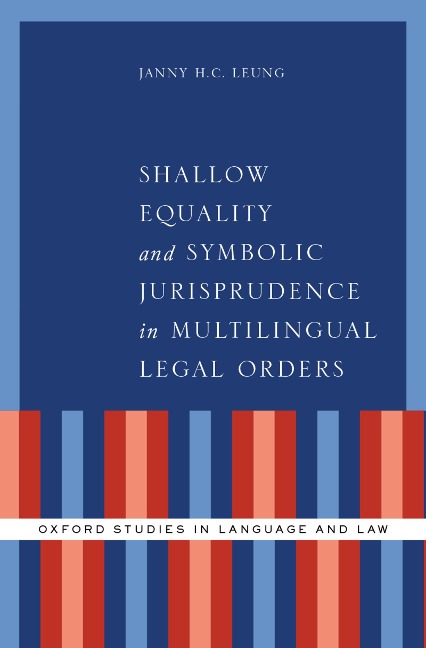
What challenges face jurisdictions that attempt to conduct law in two or more languages? How does choosing a legal language affect the way in which justice is delivered? Answers to these questions are vital for the 75 officially bilingual and multilingual states of the world, as well as for other states contemplating a move towards multilingualism. Arguably such questions have implications for all countries in a world characterized by the pressures of globalization, economic integration, population mobility, decolonization, and linguistic re-colonization. For lawyers, addressing such challenges is made essential by the increased frequency and scale of transnational legal dealings and proceedings, as well as by the lengthening reach of international law. But it is not only policy makers, legislators, and other legal practitioners who must think about such questions. The relationship between societal multilingualism and law also raises questions for the burgeoning field of language and law, which posits--among other tenets--the centrality of language in legal processes. In this book, Janny H.C. Leung examines key aspects of legal multilingualism. Drawing extensively on case studies, she describes the implications of the legal, practical, and ideological dilemmas encountered in a given country when it becomes bilingual or multilingual, discussing such issues as: how legal certainty and the linguistic ideology of authenticity may be challenged in a multilingual jurisdiction; how courts balance the language preferences of different courtroom participants; and what historical, socio-political and economic factors may influence the decision to cement a given language as a jurisdiction's official language. Throughout, Leung elaborates a theory of "symbolic jurisprudence" to explore common dilemmas found across countries, despite their varied political and cultural settings, and argues that linguistic equality as proclaimed and practiced today is a shallow kind of equality. Although officially multilingual jurisdictions appear to be more inclusive than their monolingual counterparts, they run the risk of disguising substantive inequalities and displacing real efforts for more progressive social change. This is the first book to offer overarching discussion of how such issues relate to each other, and the first systematic study of legal multilingualism as a global phenomenon.
Janny H.C. Leung is Associate Professor of English and Program Director of Law and Literary Studies (BA&LLB) at The University of Hong Kong. She obtained her M.Phil. and Ph.D. in English and Applied Linguistics from the University of Cambridge, an LLB from the University of London, and an LLM from Yale Law School. In 2013-2014, she was a Visiting Scholar at the Harvard Yenching Institute, Harvard University. In 2017, she was elected to the Executive Committee of the International Association of Forensic Linguists.
Introduction. Language and Law in the Whirlpool of Politics Chapter One. Tracing Linguistic Management through Time: Law as a Lens Chapter Two. Mapping a Global Phenomenon: The Spectacle of Official Multilingualism Chapter Three. How Official Multilingualism Works: A Symbolic Jurisprudence Chapter Four. Institutionalizing Multilingualism: Watchdogs on a Leash and the Bureaucratic Trap Chapter Five. Creating Multilingual Legal Texts: Domination and Dependence Chapter Six. Interpreting Multilingual Legislation: The Limits of Language and the Certainty of Uncertainty Chapter Seven. Conferring Official Language Rights in Legal Communication: Access to Justice and Conflict of Laws Chapter Eight. Concluding Remarks on Linguistic Equality, Strategic Pluralism and Linguistic Justice
Dieses eBook wird im PDF-Format geliefert und ist mit einem Adobe Kopierschutz (DRM) versehen. Sie können dieses eBook mit allen Geräten lesen, die das PDF-Format und den Adobe Kopierschutz (DRM) unterstützen.
Zum Beispiel mit den folgenden Geräten:
• tolino Reader
Laden Sie das eBook direkt über den Reader-Shop auf dem tolino herunter oder übertragen Sie das eBook auf Ihren tolino mit einer kostenlosen Software wie beispielsweise Adobe Digital Editions.
• Sony Reader & andere eBook Reader
Laden Sie das eBook direkt über den Reader-Shop herunter oder übertragen Sie das eBook mit der kostenlosen Software Sony READER FOR PC/Mac oder Adobe Digital Editions auf ein Standard-Lesegeräte mit epub- und Adobe DRM-Unterstützung.
• Tablets & Smartphones
Möchten Sie dieses eBook auf Ihrem Smartphone oder Tablet lesen, finden Sie hier unsere kostenlose Lese-App für iPhone/iPad und Android Smartphone/Tablets.
• PC & Mac
Lesen Sie das eBook direkt nach dem Herunterladen mit einer kostenlosen Lesesoftware, beispielsweise Adobe Digital Editions, Sony READER FOR PC/Mac oder direkt über Ihre eBook-Bibliothek in Ihrem Konto unter „Meine eBooks“ - „online lesen“.
Schalten Sie das eBook mit Ihrer persönlichen Adobe ID auf bis zu sechs Geräten gleichzeitig frei.
Bitte beachten Sie, dass die Kindle-Geräte das Format nicht unterstützen und dieses eBook somit nicht auf Kindle-Geräten lesbar ist.