Und dann auf "Zum Home-Bildschirm [+]".

Stöbern
genialokal zum Startbildschirm hinzufügen
Installieren Sie die genialokal App auf Ihrem Startbildschirm für einen schnellen Zugriff und eine komfortable Nutzung.
Installieren Sie die genialokal App auf Ihrem Startbildschirm für einen schnellen Zugriff und eine komfortable Nutzung.
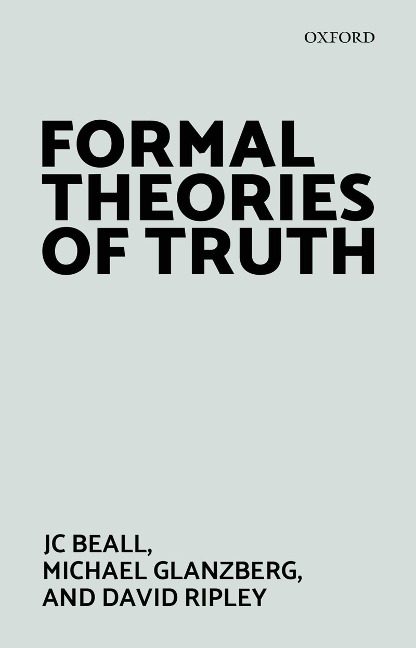
Truth is one of the oldest and most central topics in philosophy. Formal theories explore the connections between truth and logic, and they address truth-theoretic paradoxes such as the Liar. Three leading philosopher-logicians now present a concise overview of the main issues and ideas in formal theories of truth. Beall, Glanzberg, and Ripley explain key logical techniques on which such formal theories rely, providing the formal and logical background needed to develop formal theories of truth. They examine the most important truth-theoretic paradoxes, including the Liar paradoxes. They explore approaches that keep principles of truth simple while relying on nonclassical logic; approaches that preserve classical logic but do so by complicating the principles of truth; and approaches based on substructural logics that change the shape of the target consequence relation itself. Finally, inconsistency and revision theories are reviewed, and contrasted with the approaches previously discussed. For any reader who has a basic grounding in logic, this book offers an ideal guide to formal theories of truth.
Jc Beall is Board of Trustees Distinguished Professor of Philosophy at the University of Connecticut and Professor of Philosophy at the University of Tasmania. He is the author of Spandrels of Truth (2009) and co-author of Logical Pluralism (2005), both published by OUP.
Michael Glanzberg is Professor of Philosophy at Northwestern University, having previously taught at MIT, the University of Toronto, and the University of California, Davis. He works in the areas of philosophy of language, logic, and metaphysics. He is the editor of the Oxford Handbook of Truth (2018).
David Ripley is Lecturer in Philosophy at Monash University, Australia, having previously been Associate Professor of Philosophy at the University of Connecticut. He works mainly on logic and the philosophy of language, with special attention to the relations between logic and language, and what we can learn about these relations by studying paradoxes of truth, validity, and vagueness.
- 1: Introduction - 2: Truth-theoretic paradoxes: a select sampling - 3: Ingredients of a Liar - 4: Preliminaries and technicalities - 5: Nonclassical logic: unrestricted capture--release - 6: Classical logic: restricted capture--release - 7: Digging beneath the structure - 8: Other directions: revision and inconsistency - 9: Closing remarks
Dieses eBook wird im PDF-Format geliefert und ist mit einem Adobe Kopierschutz (DRM) versehen. Sie können dieses eBook mit allen Geräten lesen, die das PDF-Format und den Adobe Kopierschutz (DRM) unterstützen.
Zum Beispiel mit den folgenden Geräten:
• tolino Reader
Laden Sie das eBook direkt über den Reader-Shop auf dem tolino herunter oder übertragen Sie das eBook auf Ihren tolino mit einer kostenlosen Software wie beispielsweise Adobe Digital Editions.
• Sony Reader & andere eBook Reader
Laden Sie das eBook direkt über den Reader-Shop herunter oder übertragen Sie das eBook mit der kostenlosen Software Sony READER FOR PC/Mac oder Adobe Digital Editions auf ein Standard-Lesegeräte mit epub- und Adobe DRM-Unterstützung.
• Tablets & Smartphones
Möchten Sie dieses eBook auf Ihrem Smartphone oder Tablet lesen, finden Sie hier unsere kostenlose Lese-App für iPhone/iPad und Android Smartphone/Tablets.
• PC & Mac
Lesen Sie das eBook direkt nach dem Herunterladen mit einer kostenlosen Lesesoftware, beispielsweise Adobe Digital Editions, Sony READER FOR PC/Mac oder direkt über Ihre eBook-Bibliothek in Ihrem Konto unter „Meine eBooks“ - „online lesen“.
Schalten Sie das eBook mit Ihrer persönlichen Adobe ID auf bis zu sechs Geräten gleichzeitig frei.
Bitte beachten Sie, dass die Kindle-Geräte das Format nicht unterstützen und dieses eBook somit nicht auf Kindle-Geräten lesbar ist.