Und dann auf "Zum Home-Bildschirm [+]".

Stöbern
genialokal zum Startbildschirm hinzufügen
Installieren Sie die genialokal App auf Ihrem Startbildschirm für einen schnellen Zugriff und eine komfortable Nutzung.
Installieren Sie die genialokal App auf Ihrem Startbildschirm für einen schnellen Zugriff und eine komfortable Nutzung.
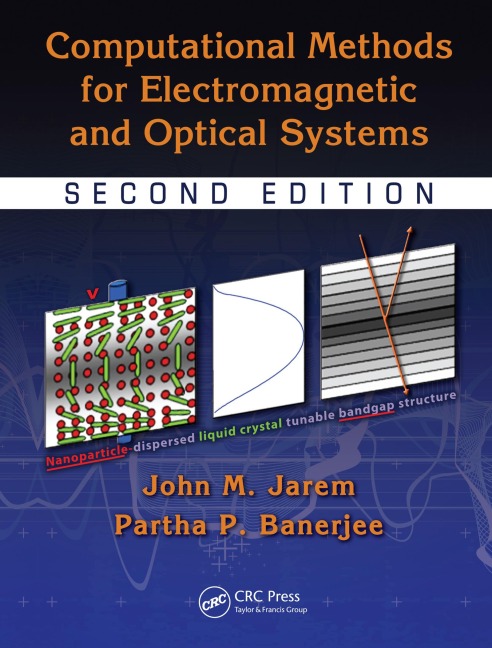
The current rapid and complex advancement applications of electromagnetic (EM) and optical systems calls for a much needed update on the computational methods currently in use. Completely revised and reflecting ten years of develoments, this second edition of the bestselling Computational Methods for Electromagnetic and Optical Systems provides the update so desperately needed in this field. Offering a wealth of new material, this second edition begins with scalar wave propagation and analysis techniques, chiral and metamaterials, and photonic band gap structures. It examines Pontying vector and stored energy, as well as energy, group, and phase velocities; reviews k-space state variable formation with applications to anistropic planar systems; and presents full-field rigorous coupled wave analysis of planar diffraction gratings with applications to H-mode, E-mode, crossed gratings, single and multilayered diffraction grating analysis, and diffraction from anistropic gratings. Later chapters highlight spectral techniques and RCWA as applied to the analysis of dynamic wave-mixing in PR materials with induced transmission and reflection gratings and demonstrate the RCWA algorithm to analyze cylindrical and spherical systems using circular, bipolar cylindrical, and spherical coordinates. The book concludes with several RCWA computational case studies involving scattering from spatially inhomogeneous eccentric circular cylinders, solved in bipolar coordinates. Many of these examples apply the complex Poynting theorem or the forwardscattering (optical) theorem to validate numerical solutions by verifying power conservation. Using common computational tools such as Fortran, MATLAB, COMSOL, and RSOFT, the text offers numerous examples to illuminate the material, many of which employ a full-field vector approach to analyze and solve Maxwell's equations in anisotropic media where a standard wave equation approach is intractable. Designed to introduce novel spectral computational techniques, the book demonstrates the application of these methods to analyze a variety of EM and optical systems.
John M. Jarem, Partha P. Banerjee
Mathematical Preliminaries. Scalar EM Beam Propagation in Inhomogeneous Media. EM Wave Propagation in Linear Media. Spectral State Variable Formulation for Planar Systems. Planar Diffraction Gratings. Application of RCWA to Analysis of Induced Photorefractive Gratings. Rigorous Coupled Wave Analysis of Inhomogeneous. Rigorous Coupled Wave Analysis of Inhomogeneous Bipolar Cylindrical Systems. Bipolar Coordinate RCWA Computational Examples and Case Studies.
Dieses eBook wird im PDF-Format geliefert und ist mit einem Adobe Kopierschutz (DRM) versehen. Sie können dieses eBook mit allen Geräten lesen, die das PDF-Format und den Adobe Kopierschutz (DRM) unterstützen.
Zum Beispiel mit den folgenden Geräten:
• tolino Reader
Laden Sie das eBook direkt über den Reader-Shop auf dem tolino herunter oder übertragen Sie das eBook auf Ihren tolino mit einer kostenlosen Software wie beispielsweise Adobe Digital Editions.
• Sony Reader & andere eBook Reader
Laden Sie das eBook direkt über den Reader-Shop herunter oder übertragen Sie das eBook mit der kostenlosen Software Sony READER FOR PC/Mac oder Adobe Digital Editions auf ein Standard-Lesegeräte mit epub- und Adobe DRM-Unterstützung.
• Tablets & Smartphones
Möchten Sie dieses eBook auf Ihrem Smartphone oder Tablet lesen, finden Sie hier unsere kostenlose Lese-App für iPhone/iPad und Android Smartphone/Tablets.
• PC & Mac
Lesen Sie das eBook direkt nach dem Herunterladen mit einer kostenlosen Lesesoftware, beispielsweise Adobe Digital Editions, Sony READER FOR PC/Mac oder direkt über Ihre eBook-Bibliothek in Ihrem Konto unter „Meine eBooks“ - „online lesen“.
Schalten Sie das eBook mit Ihrer persönlichen Adobe ID auf bis zu sechs Geräten gleichzeitig frei.
Bitte beachten Sie, dass die Kindle-Geräte das Format nicht unterstützen und dieses eBook somit nicht auf Kindle-Geräten lesbar ist.