Und dann auf "Zum Home-Bildschirm [+]".

Stöbern
genialokal zum Startbildschirm hinzufügen
Installieren Sie die genialokal App auf Ihrem Startbildschirm für einen schnellen Zugriff und eine komfortable Nutzung.
Installieren Sie die genialokal App auf Ihrem Startbildschirm für einen schnellen Zugriff und eine komfortable Nutzung.
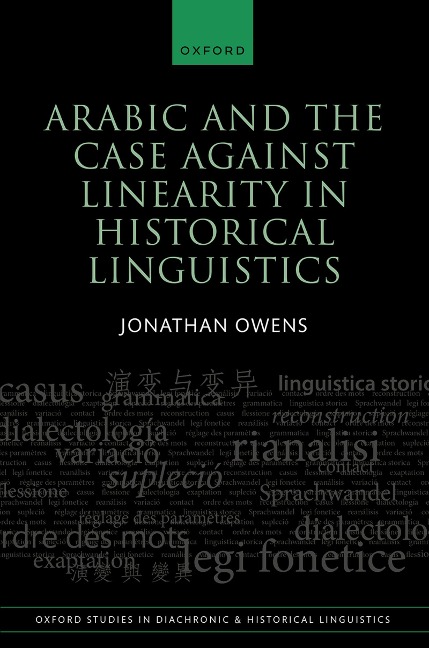
This book explores the long history of the Arabic language, from pre-Islamic Arabic via the Classical era of the Arabic grammarians up to the present day. While most traditional accounts have been dominated by a linear understanding of the development of Arabic, this book instead advocates a multiple pathways approach to Arabic language history. Arabic has multifarious sources: its relations to other Semitic languages, an old epigraphic and papyrological tradition, a vibrant and linguistically original classical Arabic linguistic tradition, and a widely dispersed array of contemporary spoken varieties. These diverse sources present a challenge to and an opportunity for defining a holistic but not necessarily linear Arabic language history.
The geographical breadth and chronological depth of Arabic make it a fertile ground for a critical appraisal and application of perspectives from a range of subdisciplines including sociolinguistics, typology, grammaticalization, and corpus linguistics. Jonathan Owens draws on these approaches to investigate more than 20 individual case studies that cover more than 1500 years of documented and reconstructed history: the results demonstrate that Arabic is a far more complex historical object than traditional accounts have assumed. This complexity is further explored in a comparison of the historical morphology of three languages that can be compared over roughly the same period (500 AD-2022 AD): Icelandic, English, and Arabic. Icelandic and English are diametrically opposed on a parameter of linearity. Icelandic is effectively alinear: the morphology of the earliest Icelandic writings is the morphology of today. English is linear, having undergone a drastic change in morphology from its Old English stage to the Middle English period. Arabic is shown to be alinear in many important respects, but multilinear in others, with different sorts of linguistic changes being spread across many individual historical speech communities.
Jonathan Owens is Emeritus Professor of Arabic linguistics at Bayreuth University. He has published over a dozen books, including A Linguistic History of Arabic (OUP, 2006; paperback 2009) and The Oxford Handbook of Arabic Linguistics (OUP, 2013; paperback 2019). He has created two online oral, text-based databanks, one for the Arabic of the Lake Chad area, and one for Glavda. In 2018 he received the Muhammad Bin Rashid Al Maktoum Arabic Language Award for special services to the Arabic language.
- 1: Introduction - Part I. Old Arabic - 2: Arabic and Semitic - 3: Arabs and Arabic - 4: Three types of pre- and early Islamic sources: The pre-Sibawaihian setting - Part II. Reconstruction - 5: Punctuation and language history: I/I + D, inheritance/innovation and diffusion - 6: Four issues in Arabic historical linguistics - Part III. Contact - 7: Arabic in contact: Aramaic - 8: Morphosyntax as an adaptive mechanism I: Idioms - 9: Morphosyntax as an adaptive mechanism II: The expansive demonstrative - Part IV. Stability - 10: Language stability I: Three case sketches - 11: Language stability II: Watching paint dry, or, metrics for measuring language stability - Part V. Taxonomy - 12: Towards a typology for historical linguistics - 13: Summing up - 14: Why Arabic is special, and special for historical linguistics
Dieses eBook wird im PDF-Format geliefert und ist mit einem Adobe Kopierschutz (DRM) versehen. Sie können dieses eBook mit allen Geräten lesen, die das PDF-Format und den Adobe Kopierschutz (DRM) unterstützen.
Zum Beispiel mit den folgenden Geräten:
• tolino Reader
Laden Sie das eBook direkt über den Reader-Shop auf dem tolino herunter oder übertragen Sie das eBook auf Ihren tolino mit einer kostenlosen Software wie beispielsweise Adobe Digital Editions.
• Sony Reader & andere eBook Reader
Laden Sie das eBook direkt über den Reader-Shop herunter oder übertragen Sie das eBook mit der kostenlosen Software Sony READER FOR PC/Mac oder Adobe Digital Editions auf ein Standard-Lesegeräte mit epub- und Adobe DRM-Unterstützung.
• Tablets & Smartphones
Möchten Sie dieses eBook auf Ihrem Smartphone oder Tablet lesen, finden Sie hier unsere kostenlose Lese-App für iPhone/iPad und Android Smartphone/Tablets.
• PC & Mac
Lesen Sie das eBook direkt nach dem Herunterladen mit einer kostenlosen Lesesoftware, beispielsweise Adobe Digital Editions, Sony READER FOR PC/Mac oder direkt über Ihre eBook-Bibliothek in Ihrem Konto unter „Meine eBooks“ - „online lesen“.
Schalten Sie das eBook mit Ihrer persönlichen Adobe ID auf bis zu sechs Geräten gleichzeitig frei.
Bitte beachten Sie, dass die Kindle-Geräte das Format nicht unterstützen und dieses eBook somit nicht auf Kindle-Geräten lesbar ist.