Und dann auf "Zum Home-Bildschirm [+]".

Stöbern
genialokal zum Startbildschirm hinzufügen
Installieren Sie die genialokal App auf Ihrem Startbildschirm für einen schnellen Zugriff und eine komfortable Nutzung.
Installieren Sie die genialokal App auf Ihrem Startbildschirm für einen schnellen Zugriff und eine komfortable Nutzung.
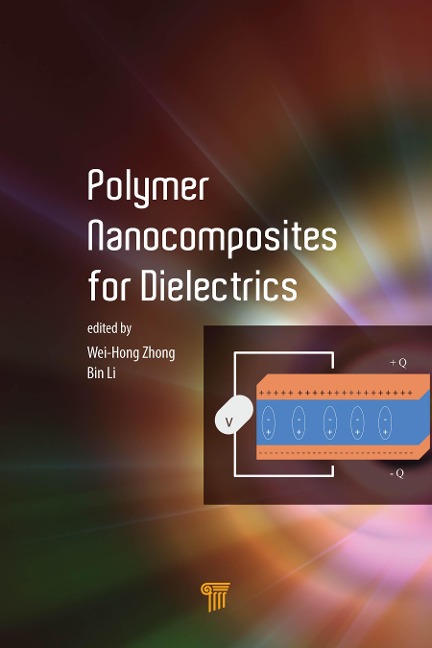
Polymers have been used as dielectric materials owing to their light weight, great flexibility, and processability as well as high insulation properties. To enhance their performance for various desired dielectric applications, fabrication of polymeric nanocomposites is believed to be one of the most effective approaches. By controlling the nanomaterial dispersion and interfacial structures with the polymer matrices in nanocomposites, dielectric properties can be tailored for specific applications. This book reviews representative polymer nanocomposite systems, focusing on the roles of nanodispersion, interfacial structures, and properties of polymer matrix materials in the dielectric properties and energy storage performance. The book reviews various dielectric relaxation models applicable to the analysis of polymer nanocomposites. It compiles the recent progress in new dielectric polymer nanocomposites based on biomaterials and hybrid nanomaterial systems for advanced dielectric applications.
Wei-Hong Zhong is an endowed chair professor, Westinghouse Distinguished Professor, at the Washington State University, USA, since 2007. She received her PhD in materials science and engineering at Beijing University of Aeronautics and Astronautics, China, in 1994, where she was promoted to full professor in 1999. Prof. Zhong began her faculty career at North Dakota State University, USA, in 2003. She is a reviewer/panelist of grant proposals for the United States National Science Foundation and the United States Department of Energy and a nanotechnology consultant for The Boeing Company since 2006. She has received numerous awards and honors, including the Dow Chemical Composites Educator of the Year 2011 by the Society of Plastic Engineers, and has authored nearly 300 publications in polymer composites and energy materials. Bin Li is assistant professor in the Department of Mechanical Engineering at Wichita State University, USA, since 2013. He received his PhD in mechanical engineering from the Washington State University in 2012 and joined its School of Mechanical and Materials Engineering as an assistant research professor in the same year. His active research and teaching areas include design, synthesis, and manufacturing of advanced polymers, biomaterials, and their nanocomposites for sustainable aviation and energy applications.
Basics of Polymers and Polymer Nanocomposites as Dielectric Materials. Theoretical Analysis of Dielectric Relaxation in Polymer Nanocomposites. Perovskite Ceramics and Their Polymer Nanocomposites. Graphitic Nanomaterials and Their Polymer Nanocomposites for Dielectric Applications. Polyvinylidene Fluoride in Dielectric Nanocomposites. Copolymers in Dielectric Polymer Nanocomposites. Dielectric Properties of Bionanocomposites. Hybrid Polymer Nanocomposite Systems.
Dieses eBook wird im PDF-Format geliefert und ist mit einem Adobe Kopierschutz (DRM) versehen. Sie können dieses eBook mit allen Geräten lesen, die das PDF-Format und den Adobe Kopierschutz (DRM) unterstützen.
Zum Beispiel mit den folgenden Geräten:
• tolino Reader
Laden Sie das eBook direkt über den Reader-Shop auf dem tolino herunter oder übertragen Sie das eBook auf Ihren tolino mit einer kostenlosen Software wie beispielsweise Adobe Digital Editions.
• Sony Reader & andere eBook Reader
Laden Sie das eBook direkt über den Reader-Shop herunter oder übertragen Sie das eBook mit der kostenlosen Software Sony READER FOR PC/Mac oder Adobe Digital Editions auf ein Standard-Lesegeräte mit epub- und Adobe DRM-Unterstützung.
• Tablets & Smartphones
Möchten Sie dieses eBook auf Ihrem Smartphone oder Tablet lesen, finden Sie hier unsere kostenlose Lese-App für iPhone/iPad und Android Smartphone/Tablets.
• PC & Mac
Lesen Sie das eBook direkt nach dem Herunterladen mit einer kostenlosen Lesesoftware, beispielsweise Adobe Digital Editions, Sony READER FOR PC/Mac oder direkt über Ihre eBook-Bibliothek in Ihrem Konto unter „Meine eBooks“ - „online lesen“.
Schalten Sie das eBook mit Ihrer persönlichen Adobe ID auf bis zu sechs Geräten gleichzeitig frei.
Bitte beachten Sie, dass die Kindle-Geräte das Format nicht unterstützen und dieses eBook somit nicht auf Kindle-Geräten lesbar ist.