Und dann auf "Zum Home-Bildschirm [+]".

Stöbern
genialokal zum Startbildschirm hinzufügen
Installieren Sie die genialokal App auf Ihrem Startbildschirm für einen schnellen Zugriff und eine komfortable Nutzung.
Installieren Sie die genialokal App auf Ihrem Startbildschirm für einen schnellen Zugriff und eine komfortable Nutzung.
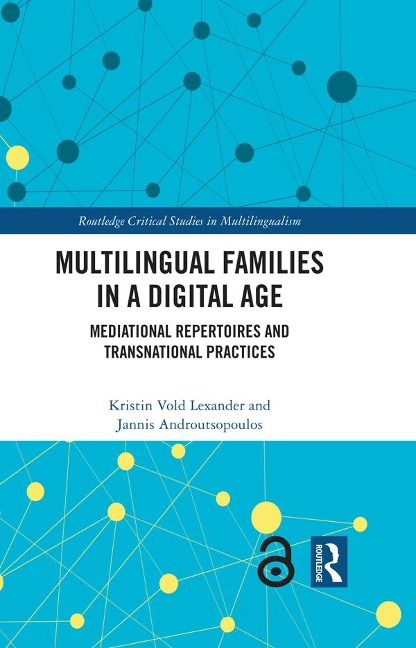
This book offers new insights into transnational family life in today's digital age, exploring the media resources and language practices parents and children employ toward maintaining social relationships in digital interactions and constructing transnational family bonds and identities. The book seeks to expand the boundaries of existing research on family multilingualism, in which digital communication has been little studied until now. Drawing on ethnographic studies of four families of Senegalese background in Norway, Lexander and Androutsopoulos develop an integrated approach which weaves together participants' linguistic choices for situated interaction, the affordances of digital technologies, and the families' language and media ideologies. The book explores such key themes as the integration of linguistic and media resources in family repertoires, creative practices of digital translanguaging, engagement in diaspora practices, and opportunities of digital communication for the development of children's heritage language skills. With an innovative perspective on 'doing family' in the digital age, this book will be of interest to students and scholars in multilingualism, sociolinguistics, digital communication, language and communication, and language and media.
Kristin Vold Lexander, PhD, is a researcher at Inland Norway University of Applied Sciences, and a former postdoctoral fellow at MultiLing Center for Multilingualism in Society Across the Lifespan, University of Oslo. She has worked on digital interaction in Senegalese contexts since 2005 and has published a range of articles and book chapters on the subject. Jannis Androutsopoulos, Dr. Phil., is Professor of German and Media Linguistics at Universität Hamburg, Germany, and from 2016 to 2023 was a research professor at MultiLing, University of Oslo. His research interests include the sociolinguistics of mediated communication and multilingualism online. He is editor of Polymedia in Interaction, Special Issue of Pragmatics and Society 12:5 (2021), and Digital language practices: media, awareness, pedagogy, Special Issue of Linguistics and Education 62 (2021).
List of tables, images, and figures Preface Acknowledgments 1 Introduction: Doing family and language in a digital age 1.1 A day in the digital life of a young multilingual family member 1.2 Theoretical dimensions: Family multilingualism, digital interaction, and polymedia 1.3 Fieldwork for this book 1.4 Outline of the book 2 Multilingual families online: Repertoires and practices 2.1 Multilingual practices 2.1.1 Practice approaches to multilingualism 2.1.2 Repertoires and registers 2.2 Family multilingualism 2.2.1 Family language policy and practice 2.2.2 Heritage language practices and heritage language socialisation 2.2.3 The discursive construction of the multilingual family space 2.2.4 A 'digital turn' in FLP literature 2.3 Multilingualism online 2.3.1 Code-switching approaches 2.3.2 Networked multilingualism and digital translanguaging 2.3.3 Affordances for mediated interaction in the digital ecology 2.4 Transnational families and digitally mediated communication 2.4.1 'Doing family' transnationally 2.4.2 Digital co-presence in transnational families 2.2.3 Polymedia: An ecology of media choices 2.2.4 Language and media in family-making practices 2.5 Conclusion: Towards the study of mediational repertoires 3 Media and language use in multilingual families: An ethnographic study in Norway 3.1 Sociolinguistic research with Senegalese migrants in Norway 3.1.1 Language and society in Senegal 3.1.2 Language and immigration in Norway 3.1.3 Senegalese immigrants in Norway 3.2 Presentation of participants 3.2.1 The Diagne family 3.2.2 The Bâ family 3.2.3 The Sagna family 3.2.4 The Coly family 3.3 The families' linguistic repertoires 3.3.1 Wolof 3.3.2 Joola 3.3.3 Peul 3.3.4 French 3.3.5 Arabic 3.3.6 English 3.3.7 Norwegian 4 Visualising languages, modalities, and media: From language portraits to mediagrams 4.1 Visualizing repertoires 4.1.1 Language portraits and network graphs 4.1.2 Media maps 4.1.3 Mediagrams 4.2 Data collection 4.3 Developing mediagrams 4.4 Data analysis 4.5 Ethical considerations and other challenges 5 Analyzing mediagrams: Mediational choices in polymedia environments 5.1 Pleasure and pressure: Balancing co-presence 5.2 Multilingualism and multimodality: Managing a network of generations 5.3 Media, language, and connectedness: A comparison of three fathers 5.4 Media choices 5.5 Conclusions 6 'Doing family' online: Translocality, connectivity, and affection 6.1 Language, power, morality, and solidarity in the family 6.2 Translocal connectivities 6.2.1 Mediated interaction in the household: Coordinating family issues 6.2.2 Translocal household interaction: Making decisions and sharing 6.2.3 Transnational family-making: Power, solidarity, and teasing 6.3 Multilingual expressions of affection 6.3.1 Wife and husband 6.3.2 Parents and children 6.3.3 Extended family and beyond 6.4 Conclusions 7 Transnational families, diaspora practices, and digital polycentricity 7.1 Diaspora and digital diaspora 7.2 Digital diaspora and polycentricity 7.3 Polycentric participation: A kaleidoscope of practices 7.3.1 Digital spaces of diasporic sociality 7.3.2 The Senegalese public sphere 7.3.3 Religious discourse 7.3.4 Beyond diaspora: Traces of Norway and global pop culture 7.4 Conclusions 8 Heritage language repertoires 8.1 Parents' ideologies of linguistic heritage 8.2 Heritage language repertoires in time and space 8.3 Children's transnational heritage language practices 8.3.1 Heritage repertoires by interlocutors 8.3.2 Heritage language registers 8.3.3 Learning Wolof through online interaction 8.4 Conclusions: Heritage languages and mediational repertoires 9 Conclusions 9.1 Multi-sited ethnography: Studying mediational repertoires 9.2 Transnational connectivity and family multilingualism 9.3 A digital perspective on heritage language repertoires References Index
Dieses eBook wird im PDF-Format geliefert und ist mit einem Adobe Kopierschutz (DRM) versehen. Sie können dieses eBook mit allen Geräten lesen, die das PDF-Format und den Adobe Kopierschutz (DRM) unterstützen.
Zum Beispiel mit den folgenden Geräten:
• tolino Reader
Laden Sie das eBook direkt über den Reader-Shop auf dem tolino herunter oder übertragen Sie das eBook auf Ihren tolino mit einer kostenlosen Software wie beispielsweise Adobe Digital Editions.
• Sony Reader & andere eBook Reader
Laden Sie das eBook direkt über den Reader-Shop herunter oder übertragen Sie das eBook mit der kostenlosen Software Sony READER FOR PC/Mac oder Adobe Digital Editions auf ein Standard-Lesegeräte mit epub- und Adobe DRM-Unterstützung.
• Tablets & Smartphones
Möchten Sie dieses eBook auf Ihrem Smartphone oder Tablet lesen, finden Sie hier unsere kostenlose Lese-App für iPhone/iPad und Android Smartphone/Tablets.
• PC & Mac
Lesen Sie das eBook direkt nach dem Herunterladen mit einer kostenlosen Lesesoftware, beispielsweise Adobe Digital Editions, Sony READER FOR PC/Mac oder direkt über Ihre eBook-Bibliothek in Ihrem Konto unter „Meine eBooks“ - „online lesen“.
Schalten Sie das eBook mit Ihrer persönlichen Adobe ID auf bis zu sechs Geräten gleichzeitig frei.
Bitte beachten Sie, dass die Kindle-Geräte das Format nicht unterstützen und dieses eBook somit nicht auf Kindle-Geräten lesbar ist.