Und dann auf "Zum Home-Bildschirm [+]".

Stöbern
genialokal zum Startbildschirm hinzufügen
Installieren Sie die genialokal App auf Ihrem Startbildschirm für einen schnellen Zugriff und eine komfortable Nutzung.
Installieren Sie die genialokal App auf Ihrem Startbildschirm für einen schnellen Zugriff und eine komfortable Nutzung.


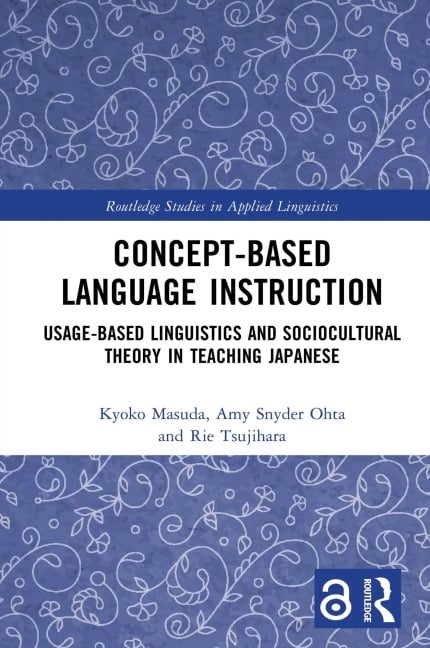
This volume showcases how concept-based language instruction (C-BLI) can be effectively integrated into foreign language instruction. C-BLI is grounded in the relationship between theory, research, and practice, incorporating visual aids called SCOBAs (schemas for a complete orientating basis of action) designed to teach accurate scientific concepts. SCOBAs materialize L2 usage-based linguistic and cultural concepts to create tools that promote conceptual understanding and internalization. Three overview chapters lay out the book's sociocultural theoretic foundations, the role of mediation, usage-based linguistics, and the concept of subjective construal; internalization and its role in re-mediating the mind for L2 learning; and L2 pragmatics teaching and assessment. Subsequent chapters enact praxis via classroom research on C-BLI. Each study focuses on a difficult-to-acquire area of Japanese pragmatics and/or grammar, incorporating SCOBAs that teach core concepts; instruction moves from SCOBA-mediated interactive lecture to internalization tasks involving languaging to language practice. Each chapter concludes with a section for critical reflection to inform future research and materials design. With its focus on research-teaching connections via praxis elucidating the power of linking concept-based language instruction with usage-based linguistics, this book will interest students and scholars of second language acquisition, language teaching and learning, applied linguistics, Japanese, and Asian languages. Chapter 1 of this book is freely available as a downloadable Open Access PDF at http://www.taylorfrancis.com under a Creative Commons Attribution-Non Commercial-No Derivatives (CC-BY-NC-ND) 4.0 license.
Kyoko Masuda is Professor of Japanese Applied Linguistics at the Georgia Institute of Technology. Her current research areas include Japanese discourse studies, applied cognitive linguistics, sociocultural theory, second language acquisition, and role language/mimetic words used in Manga. Amy Snyder Ohta is Professor of Japanese Applied Linguistics at the University of Washington. Her research uses sociocultural theory to consider the learning and teaching of Japanese as a foreign language, interlanguage pragmatics, classroom research, interview research, and autoethnography. Rie Tsujihara is Affiliate Assistant Professor of Japanese Applied Linguistics at the University of Washington, lecturer of Japanese at the University of Washington, and lecturer of Japanese at Cascadia College. Her research focuses on the learning and teaching of Japanese as a foreign language, both pragmatics and grammar, with a special interest in sociocultural theory.
Contents List of figures Acknowledgements List of Abbreviations Part I: Concept-based language instruction: A radical blending of theory and practice 1. Concept-based language instruction: combining sociocultural theory and usage-based linguistics to transform language pedagogy 2. Promoting internalization in concept-based language instruction Part II: Using concept-based language instruction to teach Japanese pragmatics 3. Teaching pragmatics with concept-based language instruction 4. Japanese style-shifting through concepts 5. Teaching subjective construal and interactional particles as invaluable linguistic resources in Japanese conversation 6. Teaching thanking in Japanese: a conceptual approach to speech acts Part III: Using concept-based language instruction to teach Japanese grammar 7. Teaching motion verbs: perspective as foundational to Japanese grammar 8. Japanese benefactives and the speaker's perspective 9. Teaching Japanese tense and aspect conceptually 10. Teaching the Japanese causative by incorporating insights from corpus studies 11. The passive and the speaker's perspective in Japanese: focusing on "undergoing" 12. Moving forward with concept-based language instruction Index
Dieses eBook wird im PDF-Format geliefert und ist mit einem Adobe Kopierschutz (DRM) versehen. Sie können dieses eBook mit allen Geräten lesen, die das PDF-Format und den Adobe Kopierschutz (DRM) unterstützen.
Zum Beispiel mit den folgenden Geräten:
• tolino Reader
Laden Sie das eBook direkt über den Reader-Shop auf dem tolino herunter oder übertragen Sie das eBook auf Ihren tolino mit einer kostenlosen Software wie beispielsweise Adobe Digital Editions.
• Sony Reader & andere eBook Reader
Laden Sie das eBook direkt über den Reader-Shop herunter oder übertragen Sie das eBook mit der kostenlosen Software Sony READER FOR PC/Mac oder Adobe Digital Editions auf ein Standard-Lesegeräte mit epub- und Adobe DRM-Unterstützung.
• Tablets & Smartphones
Möchten Sie dieses eBook auf Ihrem Smartphone oder Tablet lesen, finden Sie hier unsere kostenlose Lese-App für iPhone/iPad und Android Smartphone/Tablets.
• PC & Mac
Lesen Sie das eBook direkt nach dem Herunterladen mit einer kostenlosen Lesesoftware, beispielsweise Adobe Digital Editions, Sony READER FOR PC/Mac oder direkt über Ihre eBook-Bibliothek in Ihrem Konto unter „Meine eBooks“ - „online lesen“.
Schalten Sie das eBook mit Ihrer persönlichen Adobe ID auf bis zu sechs Geräten gleichzeitig frei.
Bitte beachten Sie, dass die Kindle-Geräte das Format nicht unterstützen und dieses eBook somit nicht auf Kindle-Geräten lesbar ist.