Und dann auf "Zum Home-Bildschirm [+]".

Stöbern
genialokal zum Startbildschirm hinzufügen
Installieren Sie die genialokal App auf Ihrem Startbildschirm für einen schnellen Zugriff und eine komfortable Nutzung.
Installieren Sie die genialokal App auf Ihrem Startbildschirm für einen schnellen Zugriff und eine komfortable Nutzung.
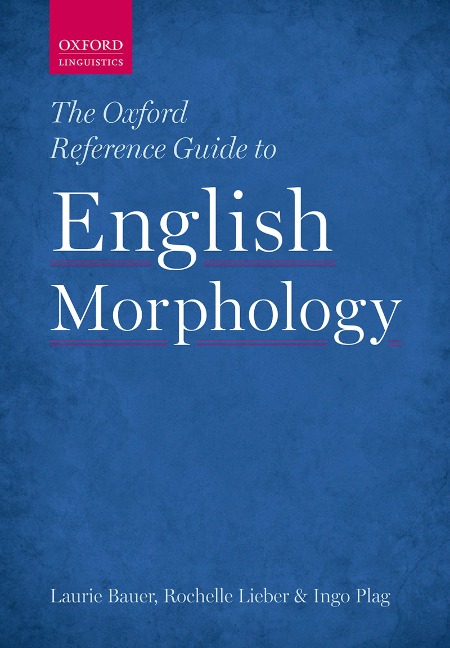
This volume presents a data-rich description of English inflection and word-formation. Based on large corpora including the Corpus of Contemporary American English and the British national Corpus, it is the first comprehensive treatment of contemporary English morphology that includes both inflection and word-formation. It covers not only well-studied topics such as compounding, conversion, and the inflection and derivation of nouns and verbs, but also areas that have received less scholarly attention, such as the formation of adjectives, locatives, negatives, evaluatives, neoclassical compounds and blends, among many other topics. Equal wieght is given to form and meaning. The volume also contains sections devoted to phonological and orthographics aspects of morphology and to combinatorial and paradigmatic properties of English morphology. It ends with a series of chapters that assess the implications of English morphology for morphological theory, discussing topics such as stratification, blocking and comprtition, the analysis of conversion, and the relationship between inflection and derivation.
Winner of the 2015 Bloomfield Book Award and written by three outstanding scholars, this outstanding book will interest all scholars and students of English and of linguistic morphology more generally.
Laurie Bauer is Professor of Linguistics at Victoria University of Wellington. His books include English Word-formation (CUP 1983), Introducing Linguistic Morphology (2nd edn EUP 2003), Morphological Productivity (CUP 2001) and A Glossary of Morphology (EUP 2004). He is one of the editors of the journal Word Structure. Rochelle Lieber is Professor of Linguistics at the University of New Hampshire and author of Deconstructing Morphology (Chicago 1992), Morphology and Lexical Semantics (CUP 2004), and Introducing Morphology (CUP 2009). She is co-editor with Pavol Stekauer of the Oxford Handbooks of Compounding and Derivational Morphology (OUP 2009 and 2013). Ingo Plag is Professor of English Language and Linguistics at the Heinrich-Heine-Universität, Düsseldorf. His books include Morphological Productivity (Mouton de Gruyter 1999), Word-formation in English (CUP 2003), and Introduction of English Linguistics (with co-authors, Mouton de Gruyter 2009). He is co-editor of the journal Morphology.
- Part I - Introduction - 1: Aims and Structures - 2: Basic principles: terminology - 3: Basic principles: methods - 4: Orthography - Part II - Inflection - 5: Verb inflection - 6: Adjective and adverb inflection - 7: Noun inflection - 8: Function words: pronouns, determiners, wh-forms, deictics - Part III - Derivation - 9: Derivation: phonological considerations - 10: Derived nouns: event, state, result - 11: Derived nouns: personal and participant - 12: Derived nouns: quality, collective, and other abstracts - 13: Derived verbs - 14: Derived adjectives - 15: Derived adverbs - 16: Locatives of time and space - 17: Negatives - 18: Size, quantity, and attitude - Part IV Compounding - 19: Compounds: formal considerations - 20: Compounds: semantic considerations - Part V Interaction - 21: Combination of affixes - 22: Affixation on compounds and phrases - 23: Paradigmatic processes - Part VI Themes - 24: Inflection versus derivation - 25: The analysis and limits of conversion - 26: Blocking, competition, and productivity - 27: The nature of stratification - 28: English morphology in a typological perspective - 29: English morphology and theories of morphology - References - Index of affixes and other formatives - Index of names - Index of subjects
Dieses eBook wird im PDF-Format geliefert und ist mit einem Adobe Kopierschutz (DRM) versehen. Sie können dieses eBook mit allen Geräten lesen, die das PDF-Format und den Adobe Kopierschutz (DRM) unterstützen.
Zum Beispiel mit den folgenden Geräten:
• tolino Reader
Laden Sie das eBook direkt über den Reader-Shop auf dem tolino herunter oder übertragen Sie das eBook auf Ihren tolino mit einer kostenlosen Software wie beispielsweise Adobe Digital Editions.
• Sony Reader & andere eBook Reader
Laden Sie das eBook direkt über den Reader-Shop herunter oder übertragen Sie das eBook mit der kostenlosen Software Sony READER FOR PC/Mac oder Adobe Digital Editions auf ein Standard-Lesegeräte mit epub- und Adobe DRM-Unterstützung.
• Tablets & Smartphones
Möchten Sie dieses eBook auf Ihrem Smartphone oder Tablet lesen, finden Sie hier unsere kostenlose Lese-App für iPhone/iPad und Android Smartphone/Tablets.
• PC & Mac
Lesen Sie das eBook direkt nach dem Herunterladen mit einer kostenlosen Lesesoftware, beispielsweise Adobe Digital Editions, Sony READER FOR PC/Mac oder direkt über Ihre eBook-Bibliothek in Ihrem Konto unter „Meine eBooks“ - „online lesen“.
Schalten Sie das eBook mit Ihrer persönlichen Adobe ID auf bis zu sechs Geräten gleichzeitig frei.
Bitte beachten Sie, dass die Kindle-Geräte das Format nicht unterstützen und dieses eBook somit nicht auf Kindle-Geräten lesbar ist.