Und dann auf "Zum Home-Bildschirm [+]".

Stöbern
genialokal zum Startbildschirm hinzufügen
Installieren Sie die genialokal App auf Ihrem Startbildschirm für einen schnellen Zugriff und eine komfortable Nutzung.
Installieren Sie die genialokal App auf Ihrem Startbildschirm für einen schnellen Zugriff und eine komfortable Nutzung.



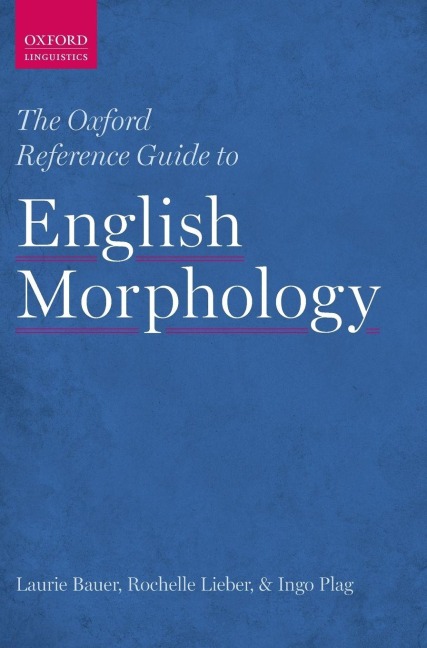
This book presents a comprehensive, data-rich, theory-neutral description of English word formation, including inflection and derivation, compounding, conversion, and such minor processes as subtractive morphology. It also offers analyses of the theoretical challenges these phenomena present. It is the first to make systematic use of large linguistic corpora, including the Corpus of Contemporary American English, the British National Corpus, and the American National Corpus by which, for example, the authors are able to measure the productivity of different patterns and to trace semantic developments as they happen.
Laurie Bauer is Professor of Linguistics at Victoria University of Wellington. His books include English Word-formation (CUP 1983), Introducing Linguistic Morphology (2nd edn EUP 2003), Morphological Productivity (CUP 2001) and A Glossary of Morphology (EUP 2004). He is one of the editors of the journal Word Structure.
Rochelle Lieber is Professor of Linguistics at the University of New Hampshire and author of Deconstructing Morphology (Chicago 1992), Morphology and Lexical Semantics (CUP 2004), and Introducing Morphology (CUP 2009). She is co-editor with Pavol Stekauer of the Oxford Handbooks of Compounding and Derivational Morphology (OUP 2009 and 2013).
Ingo Plag is Professor of English Language and Linguistics at the Heinrich Heine University, Düsseldorf. His books include Morphological Productivity (Mouton de Gruyter 1999), Word-formation in English (CUP 2003), and Introduction to English Linguistics (with co-authors, Mouton de Gruyter 2009). He is co-editor of the journal Morphology.
Part I - Introduction
1: Aims and Structures
2: Basic principles: terminology
3: Basic principles: methods
4: Orthography
Part II - Inflection
5: Verb inflection
6: Adjective and adverb inflection
7: Noun inflection
8: Function words: pronouns, determiners, why-forms, deictics
Part III - Derivation
9: Derivation: phonological considerations
10: Derived nouns: event, state, result
11: Derived nouns: personal and participant
12: Derived nouns: quality, collective, and other abstracts
13: Derived verbs
14: Derived adjectives
15: Derived adverbs
16: Locatives of time and space
17: Negatives
18: Size, quantity, and attitude
Part IV Compounding
19: Compounds: formal considerations
20: Compounds: semantic considerations
Part V Interaction
21: Combination of affixes
22: Affi xation on compounds and phrases
23: Paradigmatic processes
Part VI Themes
24: Inflection versus derivation
25: The analysis and limits of conversion
26: Blocking, competition, and productivity
27: The nature of stratifi cation
28: English morphology in a typological perspective
29: English morphology and theories of morphology
References
Index of affixes and other formatives
Index of names
Index of subjects