Und dann auf "Zum Home-Bildschirm [+]".

Stöbern
genialokal zum Startbildschirm hinzufügen
Installieren Sie die genialokal App auf Ihrem Startbildschirm für einen schnellen Zugriff und eine komfortable Nutzung.
Installieren Sie die genialokal App auf Ihrem Startbildschirm für einen schnellen Zugriff und eine komfortable Nutzung.
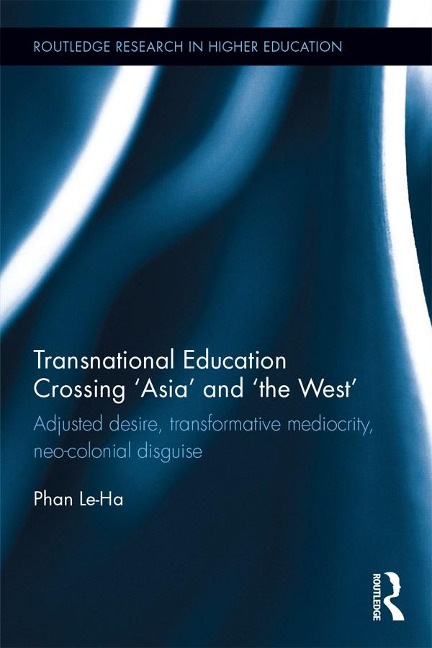
In this book, Phan Le-Ha identifies and discusses four growing self-sustained/sustaining fundamental phenomena in transnational education (TNE), namely (1) the planned, evolving and transformative mediocrity behind the endorsement of English-medium education legitimized by the interactive Asia-the West relationship; (2) the strategic employment of the terms 'Asia/Asian' and 'West/Western' by all stakeholders in their perceptions and construction of choice, quality, rigour, reliability and attractiveness of programs, courses, and locations; (3) the adjusted desire for an imagined (and often misinformed) 'West' among various stakeholders of transnational education; and (4) the assigned and self-realized ownership of English by otherwise normally on-the-margin groups of speakers. A focus on how these phenomena impact questions of identity and desire in TNE is a running theme. The above phenomena are discussed against the backdrop of 'the rise of Asia' sentiment and how this sentiment has played out in interactions and relationships between 'the West' and 'Asia' and among Asian institutions and various entities. Phan Le-Ha's examination of the identified phenomena in TNE has been informed by her multi-layered engagement with the dialectic of the Asia-the West relationship, her critical take on certain pro-Asia and decolonisation scholarship, and her interdisciplinary and multidisciplinary approach to theorise the field and the specific topic under scrutiny. Phan Le-Ha shows that the current Asia chooses (not necessarily by force but largely by will and often with an informed and well-articulated agency) to go with the idea of the West and often desires an affiliation with the West either directly or indirectly, something that is getting more intense in the context of globalization, regionalization, and commercialization of education. The rise of Asia has made the idea of the West even more looked-for in Asia. TNE in Asia, in many ways, is the transforming and dynamic transit point, a layover that facilitates entry into a wanted destination - the West and/or the idea of the West. The West and Asia need one another more than ever in the context of the internationalization and commercialization of higher education. What's more, the West and Asia have hardly ever been mutually exclusive but have rather been in an eventful love-and-obsession relationship with each other. This is the very dialectic proposition that Phan Le Ha takes throughout this book while paying specific attention to transnational higher education in the greater Asian region including the Middle East, following her several research projects conducted in the region since 2005 to date. Transnational Education Crossing 'the West' and 'Asia' explores: . English, Internationalisation of Higher Education, and Identity: Increasing Academic Monolingualism and English-only Package . Transnational Education and Dream Realization: From the Philippines to Vietnam, From Afghanistan to Dubai, From Everywhere in Asia to Thailand . Desiring International /Transnational Education: Theorisation of Key Concepts and Next Steps from Here The book will be of interest to researchers in the field of transnational education, Asia education and education policy.
Phan Le-Ha is with the College of Education at The University of Hawai-i at Manoa. She also holds an adjunct appointment in the Faculty of Education, Monash University, Australia.
Acknowledgements Foreword 1. Defining a Stance 2. Foregrounding the Debates 3. The West, Asia, and 'The Rise of Asia' 4. Engaging with the 'Convenient' Western- Asian Paradox 5. English, Internationalisation of Higher Education, and Identity: Increasing Academic Monolingualism and English-only Package 6. Appropriating and Abusing Transnational Education in Saudi Arabia: Commericalisation, Neoliberalism, Desire, and English (with Osman Barnawi) 7. Student Identities in Transnational Space: Vietnam in Focus 8. Intercultural Interactions in English-medium Programmes as Imagined Interactions with a 'Western' Entity 9. International Teaching Staff and International Students Raising Concerns over Questions of Integration and Belonging in TNE 10. Transnational Education and Dream Realization: From the Philippines to Vietnam, From Afghanistan to Dubai, From Everywhere in Asia to Thailand 11. Desiring International /Transnational Education: Theorisation of Key Concepts and Next Steps from Here 12.Afterword References
Dieses eBook wird im PDF-Format geliefert und ist mit einem Adobe Kopierschutz (DRM) versehen. Sie können dieses eBook mit allen Geräten lesen, die das PDF-Format und den Adobe Kopierschutz (DRM) unterstützen.
Zum Beispiel mit den folgenden Geräten:
• tolino Reader
Laden Sie das eBook direkt über den Reader-Shop auf dem tolino herunter oder übertragen Sie das eBook auf Ihren tolino mit einer kostenlosen Software wie beispielsweise Adobe Digital Editions.
• Sony Reader & andere eBook Reader
Laden Sie das eBook direkt über den Reader-Shop herunter oder übertragen Sie das eBook mit der kostenlosen Software Sony READER FOR PC/Mac oder Adobe Digital Editions auf ein Standard-Lesegeräte mit epub- und Adobe DRM-Unterstützung.
• Tablets & Smartphones
Möchten Sie dieses eBook auf Ihrem Smartphone oder Tablet lesen, finden Sie hier unsere kostenlose Lese-App für iPhone/iPad und Android Smartphone/Tablets.
• PC & Mac
Lesen Sie das eBook direkt nach dem Herunterladen mit einer kostenlosen Lesesoftware, beispielsweise Adobe Digital Editions, Sony READER FOR PC/Mac oder direkt über Ihre eBook-Bibliothek in Ihrem Konto unter „Meine eBooks“ - „online lesen“.
Schalten Sie das eBook mit Ihrer persönlichen Adobe ID auf bis zu sechs Geräten gleichzeitig frei.
Bitte beachten Sie, dass die Kindle-Geräte das Format nicht unterstützen und dieses eBook somit nicht auf Kindle-Geräten lesbar ist.