Und dann auf "Zum Home-Bildschirm [+]".

Stöbern
genialokal zum Startbildschirm hinzufügen
Installieren Sie die genialokal App auf Ihrem Startbildschirm für einen schnellen Zugriff und eine komfortable Nutzung.
Installieren Sie die genialokal App auf Ihrem Startbildschirm für einen schnellen Zugriff und eine komfortable Nutzung.
Ihr gewünschter Artikel ist in 0 Buchhandlungen vorrätig - wählen Sie hier eine Buchhandlung in Ihrer Nähe aus:

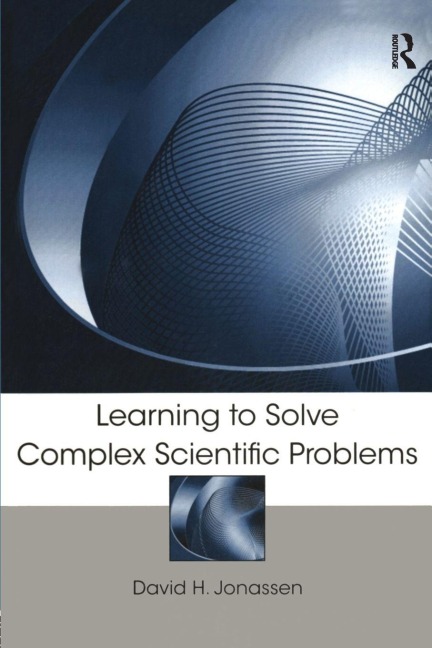
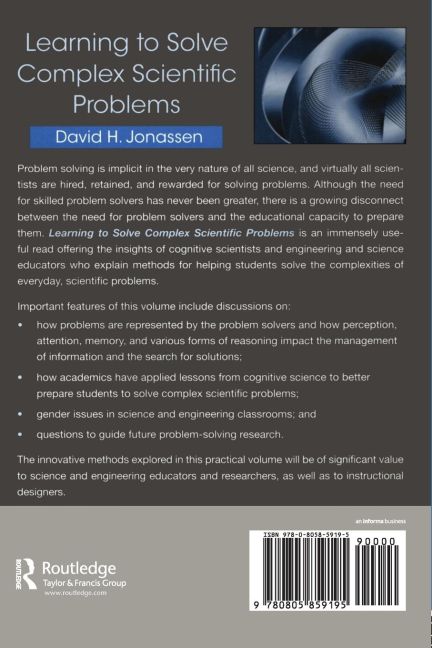
Learning to Solve Complex Scientific Problems is an immensely useful read offering the insights of cognitive scientists and engineering and science educators who explain methods for helping students solve the complexities of everyday, scientific problems. Important features of this volume include discussions on:
how problems are represented and how perception, attention, memory, and various forms of reasoning impact the management of information and search for solutions;
how academics have applied lessons from cognitive science to better prepare students to solve problems;
gender issues in science and engineering classrooms; and
questions to guide future problem-solving research.
David H. Jonassen
Contents: Introduction. Part I:Cognitive Science Views of Problem Solving.D. Jonassen, What Makes Scientific Problem Solving Complex. J. Funcke, P. Frensch, Complex Problem Solving-The European Perspective: 10 Years After. J. Price, R. Catrambone, R. Engle, When Capacity Matters: The Role of Working Memory in Problem Solving. F. Oswald, Z. Hambrick, On Keeping All the Plates Spinning: Understanding and Predicting Multi-Tasking Performance. P. Cheng, Representing Complex Problems: A Representational Epistemic Approach. M. Rosen, S.M. Fiore, E. Salas, Of Memes and Teams: Exploring the Memetics of Team Problem Solving. Part II:Scientific Views of Problem Solving.C. Ogilvie, Moving Students From Simple to Complex Problem Solving. S. Ryan, J. Jackman, P. Kumsaikaew, V. Dark, S. Olafsson, Use of Information in Collaborative Problem Solving. G. Gray, F. Costanzo, Making Dynamics Interactive. S. Rebello, L. Cui, A. Bennett, D.A. Zollman, D.J. Ozimek, Transfer of Learning in Problem Solving in the Context of Mathematics and Physics. S. Ryan, J. Jackman, S. Olafsson, V. Dark, Meta-Problem Spaces and Problem Structure. M. Ogot, G. Okudan, Educating for Complex Problem Solving Using a Theory of Inventive Problem Solving (TRIZ). A. Bhandari, L. Erickson, M. Steichen, W. Jacoby, Preparing Students to Work Effectively as Members of Interdisciplinary Design Teams. B. Bogue, R. Marra, Addressing Gender in Complex Problem Solving. D. Jonassen, R. Engle, P. Cheng, E. Salas, Part III: Research Agenda for the Future: What We Need to Learn About Complex, Scientific Problem Solving.