Und dann auf "Zum Home-Bildschirm [+]".

Stöbern
genialokal zum Startbildschirm hinzufügen
Installieren Sie die genialokal App auf Ihrem Startbildschirm für einen schnellen Zugriff und eine komfortable Nutzung.
Installieren Sie die genialokal App auf Ihrem Startbildschirm für einen schnellen Zugriff und eine komfortable Nutzung.
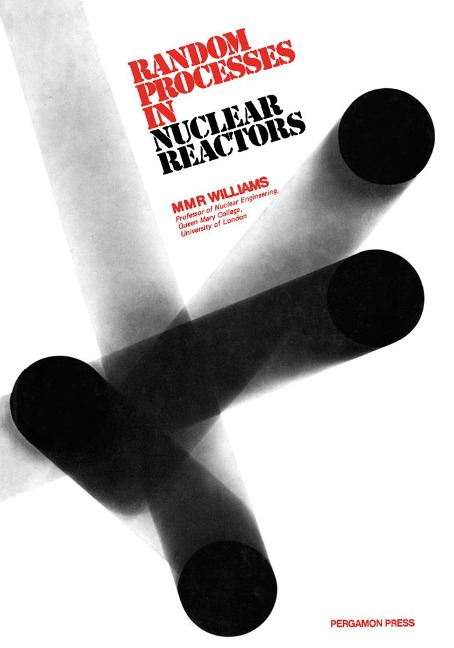
Random Processes in Nuclear Reactors describes the problems that a nuclear engineer may meet which involve random fluctuations and sets out in detail how they may be interpreted in terms of various models of the reactor system. Chapters set out to discuss topics on the origins of random processes and sources; the general technique to zero-power problems and bring out the basic effect of fission, and fluctuations in the lifetime of neutrons, on the measured response; the interpretation of power reactor noise; and associated problems connected with mechanical, hydraulic and thermal noise sources. The book will be very useful to nuclear engineers.
Preface1. Historical Survey and General Discussion 1.1. Introduction 1.2. The Boltzmann Equation 1.3. Applications in Other Fields 1.4. Applications to Nuclear Reactors 1.5. Reactor Noise 1.6. Classification of Reactor Noise 1.7. Zero-Energy Systems 1.8. Power Reactor Noise References2. Introductory Mathematical Treatment 2.1. Introduction 2.2. The Poisson Process 2.3. A Simple Birth and Death Problem 2.4. Application to Neutrons: Prompt Effect Only 2.5. Detector and Delayed Neutrons References3. Applications of the General Theory 3.1. Introduction 3.2. The Variance to Mean Method (Feynman Technique) 3.3. Correlation Function Method 3.4. Time Average and Ensemble Average 3.5. Calculation of Auto-Correlation Function 3.6. Power Spectral Density (P.S.D,) 3.7. The Rossi-a Technique 3.8. Experimental Method for Rossi-a Technique 3.9. Related Techniques 3.10. Sign Correlation Techniques 3.11. The Method of Zero Crossings 3.12. Space and Energy Effects 3.13. A Note on Divergence at Criticality References4. Practical Applications of the Probability Distribution 4.1. Introduction 4.2. Weak Source Start-up 4.3. Theory of Weak Source Fluctuations 4.4. The Extinction Probability References5. The Langevin Technique 5.1. Introduction 5.2. Brownian Motion 5.3. The Gaussian Nature of Noise 5.4. Random Source Perturbation of a Nuclear Reactor 5.5. Random Reactivity Perturbation 5.6. The Fokker-Planck Equation 5.7. Applications of Fokker-Planck Equation to Neutron Noise 5.8. Generalization of Fokker-Planck Equation to an nth Order System 5.9. The Extinction Probability 5.10. Artificial Generation of Random Noise References6. Point Model Power Reactor Noise 6.1. Introduction 6.2. The Probability Balance Method for Power Reactor Noise Studies 6.3. The Langevin Technique: Application to Power Reactors 6.4. Calculation of the Transfer Function Between Coolant Temperature and Fuel Temperature in a Gas-Cooled, Graphite-Moderated Reactor 6.5. Fluctuations Due to Multiple Random Inputs 6.6. Application to Control-Rod Vibration 6.7. Application to Model of Power Reactor System with Random Fluctuations in the Coolant-Flow Velocity 6.8. Noise in Boiling-Water Reactors 6.9. Additional Applications References7. The Spatial Variation of Reactor Noise 7.1. Introduction 7.2. The Generating Function Equation for Zero-Power Noise 7.3. The Diffusion Approximation to the Generating Function Equation 7.4. The Covariance Function 7.5. The Detection Process 7.6. Delayed Neutrons 7.7. The Power Spectral Density 7.8. Fluctuations in an Infinite Medium 7.9. Detector Shape Effects 7.10. Finite Medium Corrections 7.11. Variance to Mean Method 7.12. The Rossi-a Method 7.13. Energy-Dependent Fluctuations 7.14. The Langevin Method: A Random Source Problem 7.15. Power Reactor Noise: The Homogeneous Approximation 7.16. Noise Sources 7.17. Effects of Noise on Spatial Distribution of Power References8. Random Phenomena in Heterogeneous Reactor Systems 8.1. Introduction 8.2. Diffusion in Media with Random Physical Properties 8.3. A Simple Critical Problem 8.4. Application to Self-Shielding in Random Media 8.5. The Microstructure Distribution Function 8.6. Microscopic Self-Shielding Factors 8.7. Localized Noise Sources 8.8. Heat Transfer and Fluid Flow 8.9. Rod Vibration 8.10. Boiling Moderator and Coolant 8.11. The Void Fraction 8.12. A Simplified Model of Boiling 8.13. Hydrodynamics of the Moderator 8.14. Application of the Source-Sink Method to a Zero-Power Problem 8.15. Vibrating Absorber in an Infinite Sub-Critical Medium 8.16. The Variable Strength Absorber 8.17.