Und dann auf "Zum Home-Bildschirm [+]".

Stöbern
genialokal zum Startbildschirm hinzufügen
Installieren Sie die genialokal App auf Ihrem Startbildschirm für einen schnellen Zugriff und eine komfortable Nutzung.
Installieren Sie die genialokal App auf Ihrem Startbildschirm für einen schnellen Zugriff und eine komfortable Nutzung.

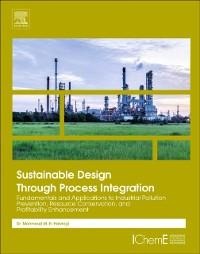
Sustainable Design through Process Integration: Fundamentals and Applications to Industrial Pollution Prevention, Resource Conservation, and Profitability Enhancement, Second Edition, is an important textbook that provides authoritative, comprehensive, and easy-to-follow coverage of the fundamental concepts and practical techniques on the use of process integration to maximize the efficiency and sustainability of industrial processes. The book is ideal for adoption in process design and sustainability courses. It is also a valuable guidebook to process, chemical, and environmental engineers who need to improve the design, operation, performance, and sustainability of industrial plants. The book covers pressing and high growth topics, including benchmarking process performance, identifying root causes of problems and opportunities for improvement, designing integrated solutions, enhancing profitability, conserving natural resources, and preventing pollution. Written by one of the world's foremost authorities on integrated process design and sustainability, the new edition contains new chapters and updated materials on various aspects of process integration and sustainable design. The new edition is also packed with numerous new examples and industrial applications.
- Allows the reader to methodically develop rigorous targets that benchmark the performance of industrial processes then develop cost-effective implementations- Contains state-of-the-art process integration and improvement approaches and techniques including graphical, algebraic, and mathematical methods- Covers topics and applications that include profitability enhancement, mass and energy conservation, synthesis of innovative processes, retrofitting of existing systems, design and assessment of water, energy, and water-energy-nexus systems, and reconciliation of various sustainability objectives
Dr. Mahmoud El-Halwagi is professor and holder of the McFerrin Professorship at the Artie McFerrin Department of Chemical Engineering, Texas A&M University. He is internationally recognized for pioneering contributions in the principles and applications of process integration and sustainable design. He has served as a consultant to a wide variety of processing industries. He is a fellow of the American Institute of Chemical Engineers (AIChE) and is the recipient of prestigious research and educational awards including the American AIChE Sustainable Engineering Forum Research Excellence Award, the Celanese and the Fluor Distinguished Teaching Awards, and the US National Science Foundation's National Young Investigator Award.
1. Introduction to Sustainability, Sustainable Design, and Process Integration2. Overview of Process Economics3. Benchmarking Process Performance Through Overall Mass Targeting4. Direct-Recycle Networks: Graphical and Algebraic Targeting Approaches5. Synthesis of Mass-Exchange Networks6. Combining Mass-Integration Strategies7. Heat Integration8. Integration of Combined Heat and Power Systems9. Synthesis of Heat-Induced Separation Network for Condensation of Volatile10. Property Integration 11. Overview of Optimization12. An Optimization Approach to Direct Recycle13. Synthesis of Mass-Exchange Networks: A Mathematical Programming Approach14. Synthesis of Reactive Mass-Exchange Networks15. Mathematical Optimization Techniques for Mass Integration16. Mathematical Techniques for the Synthesis of Heat-Exchange Networks17. Synthesis of Combined Heat and Reactive Mass-Exchange Networks18. Water- Energy Nexus for Thermal Desalination Processes19. Design of Membrane-Separation Systems20. Macroscopic Approaches of Process Integration21. Concluding Thoughts: Launching Successful Process-Integration Initiatives and ApplicationsAppendix I: Conversion Relationships for Concentrations and Conversion Factor for UnitsAppendix II: Modeling of Mass-Exchange Units for Environmental Applications