Und dann auf "Zum Home-Bildschirm [+]".

Stöbern
genialokal zum Startbildschirm hinzufügen
Installieren Sie die genialokal App auf Ihrem Startbildschirm für einen schnellen Zugriff und eine komfortable Nutzung.
Installieren Sie die genialokal App auf Ihrem Startbildschirm für einen schnellen Zugriff und eine komfortable Nutzung.
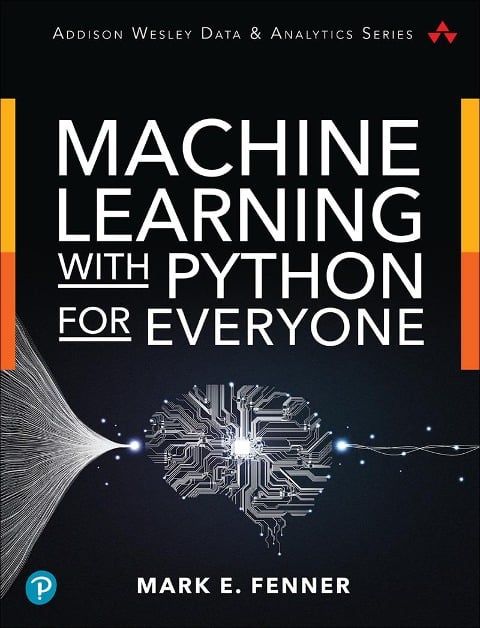
The Complete Beginner's Guide to Understanding and Building Machine Learning Systems with Python Machine Learning with Python for Everyone will help you master the processes, patterns, and strategies you need to build effective learning systems, even if you're an absolute beginner. If you can write some Python code, this book is for you, no matter how little college-level math you know. Principal instructor Mark E. Fenner relies on plain-English stories, pictures, and Python examples to communicate the ideas of machine learning. Mark begins by discussing machine learning and what it can do; introducing key mathematical and computational topics in an approachable manner; and walking you through the first steps in building, training, and evaluating learning systems. Step by step, you'll fill out the components of a practical learning system, broaden your toolbox, and explore some of the field's most sophisticated and exciting techniques. Whether you're a student, analyst, scientist, or hobbyist, this guide's insights will be applicable to every learning system you ever build or use. - Understand machine learning algorithms, models, and core machine learning concepts - Classify examples with classifiers, and quantify examples with regressors - Realistically assess performance of machine learning systems - Use feature engineering to smooth rough data into useful forms - Chain multiple components into one system and tune its performance - Apply machine learning techniques to images and text - Connect the core concepts to neural networks and graphical models - Leverage the Python scikit-learn library and other powerful tools Register your book for convenient access to downloads, updates, and/or corrections as they become available. See inside book for details.
Dr. Mark Fenner, owner of Fenner Training and Consulting, LLC, has taught computing and mathematics to diverse adult audiences since 1999, and holds a PhD in computer science. His research has included design, implementation, and performance of machine learning and numerical algorithms; developing learning systems to detect user anomalies; and probabilistic modeling of protein function.
Foreword xxi Preface xxiii About the Author xxvii Part I: First Steps 1 Chapter 1: Let's Discuss Learning 3 1.1 Welcome 3 1.2 Scope, Terminology, Prediction, and Data 4 1.3 Putting the Machine in Machine Learning 7 1.4 Examples of Learning Systems 9 1.5 Evaluating Learning Systems 11 1.6 A Process for Building Learning Systems 13 1.7 Assumptions and Reality of Learning 15 1.8 End-of-Chapter Material 17 Chapter 2: Some Technical Background 19 2.1 About Our Setup 19 2.2 The Need for Mathematical Language 19 2.3 Our Software for Tackling Machine Learning 20 2.4 Probability 21 2.5 Linear Combinations, Weighted Sums, and Dot Products 28 2.6 A Geometric View: Points in Space 34 2.7 Notation and the Plus-One Trick 43 2.8 Getting Groovy, Breaking the Straight-Jacket, and Nonlinearity 45 2.9 NumPy versus "All the Maths" 47 2.10 Floating-Point Issues 52 2.11 EOC 53 Chapter 3: Predicting Categories: Getting Started with Classification 55 3.1 Classification Tasks 55 3.2 A Simple Classification Dataset 56 3.3 Training and Testing: Don't Teach to the Test 59 3.4 Evaluation: Grading the Exam 62 3.5 Simple Classifier #1: Nearest Neighbors, Long Distance Relationships, and Assumptions 63 3.6 Simple Classifier #2: Naive Bayes, Probability, and Broken Promises 68 3.7 Simplistic Evaluation of Classifiers 70 3.8 EOC 81 Chapter 4: Predicting Numerical Values: Getting Started with Regression 85 4.1 A Simple Regression Dataset 85 4.2 Nearest-Neighbors Regression and Summary Statistics 87 4.3 Linear Regression and Errors 91 4.4 Optimization: Picking the Best Answer 98 4.5 Simple Evaluation and Comparison of Regressors 101 4.6 EOC 104 Part II: Evaluation 107 Chapter 5: Evaluating and Comparing Learners 109 5.1 Evaluation and Why Less Is More 109 5.2 Terminology for Learning Phases 110 5.3 Major Tom, There's Something Wrong: Overfitting and Underfitting 116 5.4 From Errors to Costs 125 5.5 (Re)Sampling: Making More from Less 128 5.6 Break-It-Down: Deconstructing Error into Bias and Variance 142 5.7 Graphical Evaluation and Comparison 149 5.8 Comparing Learners with Cross-Validation 154 5.9 EOC 155 Chapter 6: Evaluating Classifiers 159 6.1 Baseline Classifiers 159 6.2 Beyond Accuracy: Metrics for Classification 161 6.3 ROC Curves 170 6.4 Another Take on Multiclass: One-versus-One 181 6.5 Precision-Recall Curves 185 6.6 Cumulative Response and Lift Curves 187 6.7 More Sophisticated Evaluation of Classifiers: Take Two 190 6.8 EOC 201 Chapter 7: Evaluating Regressors 205 7.1 Baseline Regressors 205 7.2 Additional Measures for Regression 207 7.3 Residual Plots 214 7.4 A First Look at Standardization 221 7.5 Evaluating Regressors in a More Sophisticated Way: Take Two 225 7.6 EOC 232 Part III: More Methods and Fundamentals 235 Chapter 8: More Classification Methods 237 8.1 Revisiting Classification 237 8.2 Decision Trees 239 8.3 Support Vector Classifiers 249 8.4 Logistic Regression 259 8.5 Discriminant Analysis 269 8.6 Assumptions, Biases, and Classifiers 285 8.7 Comparison of Classifiers: Take Three 287 8.8 EOC 290 Chapter 9: More Regression Methods 295 9.1 Linear Regression in the Penalty Box: Regularization 295 9.2 Support Vector Regression 301 9.3 Piecewise Constant Regression 308 9.4 Regression Trees 313 9.5 Comparison of Regressors: Take Three 314 9.6 EOC 318 Chapter 10: Manual Feature Engineering: Manipulating Data for Fun and Profit 321 10.1 Feature Engineering Terminology and Motivation 321 10.2 Feature Selection and Data Reduction: Taking out the Trash 324 10.3 Feature Scaling 325 10.4 Discretization 329 10.5 Categorical Coding 332 10.6 Relationships and Interactions 341 10.7 Target Manipulations 350 10.8 EOC 356 Chapter 11: Tuning Hyperparameters and Pipelines 359 11.1 Models, Parameters, Hyperparameters 360 11.2 Tuning Hyperparameters 362 11.3 Down the Recursive Rabbit Hole: Nested Cross-Validation 370 11.4 Pipelines 377 11.5 Pipelines and Tuning Together 380 11.6 EOC 382 Part IV: Adding Complexity 385 Chapter 12: Combining Learners 387 12.1 Ensembles 387 12.2 Voting Ensembles 389 12.3 Bagging and Random Forests 390 12.4 Boosting 398 12.5 Comparing the Tree-Ensemble Methods 401 12.6 EOC 405 Chapter 13: Models That Engineer Features for Us 409 13.1 Feature Selection 411 13.2 Feature Construction with Kernels 428 13.3 Principal Components Analysis: An Unsupervised Technique 445 13.4 EOC 462 Chapter 14: Feature Engineering for Domains: Domain-Specific Learning 469 14.1 Working with Text 470 14.2 Clustering 479 14.3 Working with Images 481 14.4 EOC 493 Chapter 15: Connections, Extensions, and Further Directions 497 15.1 Optimization 497 15.2 Linear Regression from Raw Materials 500 15.3 Building Logistic Regression from Raw Materials 504 15.4 SVM from Raw Materials 510 15.5 Neural Networks 512 15.6 Probabilistic Graphical Models 516 15.7 EOC 525 Appendix A: mlwpy.py Listing 529 Index 537