Und dann auf "Zum Home-Bildschirm [+]".

Stöbern
genialokal zum Startbildschirm hinzufügen
Installieren Sie die genialokal App auf Ihrem Startbildschirm für einen schnellen Zugriff und eine komfortable Nutzung.
Installieren Sie die genialokal App auf Ihrem Startbildschirm für einen schnellen Zugriff und eine komfortable Nutzung.
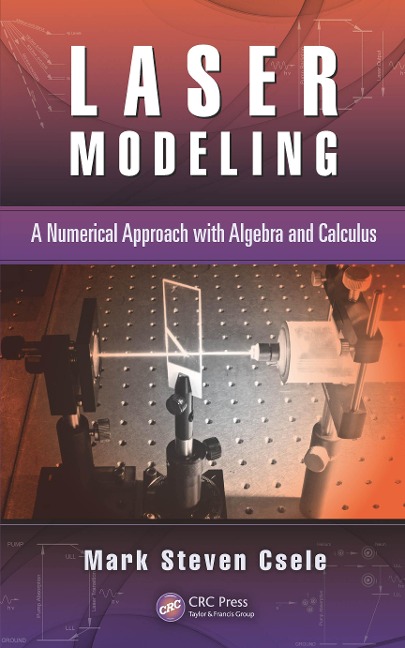
Offering a fresh take on laser engineering, Laser Modeling: A Numerical Approach with Algebra and Calculus presents algebraic models and traditional calculus-based methods in tandem to make concepts easier to digest and apply in the real world. Each technique is introduced alongside a practical, solved example based on a commercial laser. Assuming some knowledge of the nature of light, emission of radiation, and basic atomic physics, the text: - Explains how to formulate an accurate gain threshold equation as well as determine small-signal gain - Discusses gain saturation and introduces a novel pass-by-pass model for rapid implementation of "what if?" scenarios - Outlines the calculus-based Rigrod approach in a simplified manner to aid in comprehension - Considers thermal effects on solid-state lasers and other lasers with new and efficient quasi-three-level materials - Demonstrates how the convolution method is used to predict the effect of temperature drift on a DPSS system - Describes the technique and technology of Q-switching and provides a simple model for predicting output power - Addresses non-linear optics and supplies a simple model for calculating optimal crystal length - Examines common laser systems, answering basic design questions and summarizing parameters - Includes downloadable Microsoft® Excel(TM) spreadsheets, allowing models to be customized for specific lasers Don't let the mathematical rigor of solutions get in the way of understanding the concepts. Laser Modeling: A Numerical Approach with Algebra and Calculus covers laser theory in an accessible way that can be applied immediately, and numerically, to real laser systems.
Mark Steven Csele is a full-time professor at Niagara College, Welland, Ontario, Canada. A physicist and professional engineer, he has taught for over 20 years at levels ranging from two-year technician to four-year undergraduate. Currently, he teaches photonics at Niagara College, which features an array of dedicated laboratories hosting a variety of laser systems. He has authored a previous book on fundamental laser concepts as well as several articles in magazines and trade encyclopedias.
Basic Laser Processes. Threshold Gain. Gain Saturation. Analytical Solutions. Thermal Issues. Generating Massive Inversions: Q-Switching. Non-Linear Optics. Common Lasers and Parameters.
Dieses eBook wird im PDF-Format geliefert und ist mit einem Adobe Kopierschutz (DRM) versehen. Sie können dieses eBook mit allen Geräten lesen, die das PDF-Format und den Adobe Kopierschutz (DRM) unterstützen.
Zum Beispiel mit den folgenden Geräten:
• tolino Reader
Laden Sie das eBook direkt über den Reader-Shop auf dem tolino herunter oder übertragen Sie das eBook auf Ihren tolino mit einer kostenlosen Software wie beispielsweise Adobe Digital Editions.
• Sony Reader & andere eBook Reader
Laden Sie das eBook direkt über den Reader-Shop herunter oder übertragen Sie das eBook mit der kostenlosen Software Sony READER FOR PC/Mac oder Adobe Digital Editions auf ein Standard-Lesegeräte mit epub- und Adobe DRM-Unterstützung.
• Tablets & Smartphones
Möchten Sie dieses eBook auf Ihrem Smartphone oder Tablet lesen, finden Sie hier unsere kostenlose Lese-App für iPhone/iPad und Android Smartphone/Tablets.
• PC & Mac
Lesen Sie das eBook direkt nach dem Herunterladen mit einer kostenlosen Lesesoftware, beispielsweise Adobe Digital Editions, Sony READER FOR PC/Mac oder direkt über Ihre eBook-Bibliothek in Ihrem Konto unter „Meine eBooks“ - „online lesen“.
Schalten Sie das eBook mit Ihrer persönlichen Adobe ID auf bis zu sechs Geräten gleichzeitig frei.
Bitte beachten Sie, dass die Kindle-Geräte das Format nicht unterstützen und dieses eBook somit nicht auf Kindle-Geräten lesbar ist.