Und dann auf "Zum Home-Bildschirm [+]".

Stöbern
genialokal zum Startbildschirm hinzufügen
Installieren Sie die genialokal App auf Ihrem Startbildschirm für einen schnellen Zugriff und eine komfortable Nutzung.
Installieren Sie die genialokal App auf Ihrem Startbildschirm für einen schnellen Zugriff und eine komfortable Nutzung.
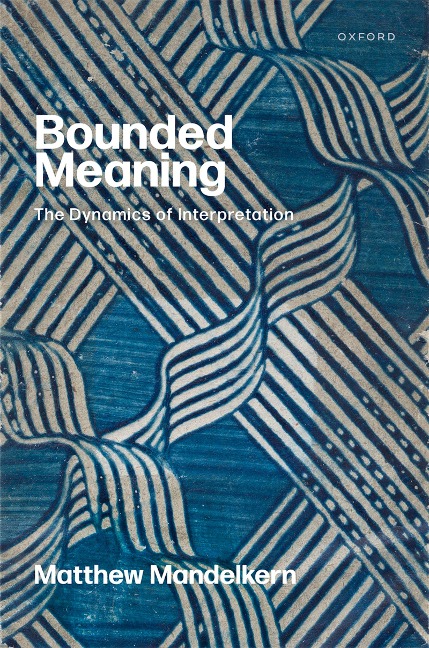
Bounded Meaning investigates the dynamics of interpretation: how and why the interpretation of the building blocks of human language is sensitive, not just to the context in which the expression is used, but also to the expression's linguistic environment-in other words, how and why interpretation depends not just on global information, but also on local information. Matthew Mandelkern motivates a range of generalizations about the dynamics of interpretation, some known and some novel, involving modals, conditionals, and anaphora, and an overview of the best extant theory of those patterns, dynamic semantics, is provided. After bringing out the striking motivations and successes of that framework, the discussion turns to criticisms of dynamic semantics, focusing on its puzzling predictions about the logic of natural language. In response to these problems, Mandelkern develops a novel framework for explaining dynamic phenomena without dynamic semantics: the bounded theory of meaning. On the bounded theory, dynamic phenomena arise from the interaction of two dimensions of meaning. One dimension is a standard truth-conditional layer, which, relative to a context of use, associates each sentence with a proposition. The second dimension, the dimension of bounds, limits the admissible interpretations of an expression, relative to the expression's context of use and its local information. Bounds thus play an essential role in coordinating on the resolution of context-sensitive language, explaining dynamic effects in natural language while avoiding a variety of problematic predictions of dynamic semantics.
Matthew Mandelkern is Assistant Professor of Philosophy at New York University. He received a PhD in Philosophy from MIT. He was a Post-Doctoral Research Fellow at All Souls College, Oxford, 2017-2020. He works on the philosophy of language and its intersections with neighbouring fields.
- 1: Introduction - Part I: Modals and Conditionals - 2: The Dynamics of Modality - 3: The Dynamics of Conditionals - 4: Against Dynamic Semantics - 5: Bounded Modals and Conditionals - Part II: Conditionals: Reasoning and Probability - 6: Reasoning with Conditionals - 7: Probabilities of Conditionals - Part III: Anaphora - 8: The Dynamics of Anaphora - 9: Bounded Anaphora - 10: Quantification and Subordination - Part IV: Concluding - 11: Local Contexts - 12: Conclusion
Dieses eBook wird im PDF-Format geliefert und ist mit einem Adobe Kopierschutz (DRM) versehen. Sie können dieses eBook mit allen Geräten lesen, die das PDF-Format und den Adobe Kopierschutz (DRM) unterstützen.
Zum Beispiel mit den folgenden Geräten:
• tolino Reader
Laden Sie das eBook direkt über den Reader-Shop auf dem tolino herunter oder übertragen Sie das eBook auf Ihren tolino mit einer kostenlosen Software wie beispielsweise Adobe Digital Editions.
• Sony Reader & andere eBook Reader
Laden Sie das eBook direkt über den Reader-Shop herunter oder übertragen Sie das eBook mit der kostenlosen Software Sony READER FOR PC/Mac oder Adobe Digital Editions auf ein Standard-Lesegeräte mit epub- und Adobe DRM-Unterstützung.
• Tablets & Smartphones
Möchten Sie dieses eBook auf Ihrem Smartphone oder Tablet lesen, finden Sie hier unsere kostenlose Lese-App für iPhone/iPad und Android Smartphone/Tablets.
• PC & Mac
Lesen Sie das eBook direkt nach dem Herunterladen mit einer kostenlosen Lesesoftware, beispielsweise Adobe Digital Editions, Sony READER FOR PC/Mac oder direkt über Ihre eBook-Bibliothek in Ihrem Konto unter „Meine eBooks“ - „online lesen“.
Schalten Sie das eBook mit Ihrer persönlichen Adobe ID auf bis zu sechs Geräten gleichzeitig frei.
Bitte beachten Sie, dass die Kindle-Geräte das Format nicht unterstützen und dieses eBook somit nicht auf Kindle-Geräten lesbar ist.