Und dann auf "Zum Home-Bildschirm [+]".

Stöbern
genialokal zum Startbildschirm hinzufügen
Installieren Sie die genialokal App auf Ihrem Startbildschirm für einen schnellen Zugriff und eine komfortable Nutzung.
Installieren Sie die genialokal App auf Ihrem Startbildschirm für einen schnellen Zugriff und eine komfortable Nutzung.
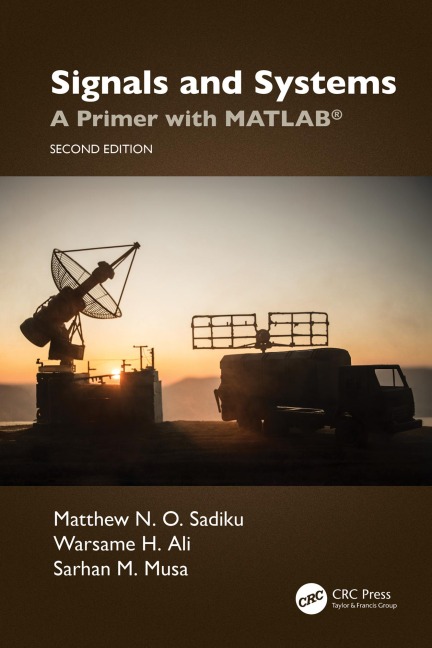
The idea of signals and systems arises in different disciplines such as science, engineering, economics, politics, and medicine. Typical examples of systems include radio and television, telephone networks, radar systems, computer networks, wireless communication, military surveillance systems, and satellite communication systems. Knowledge of a broad range of signals and systems is of practical value to engineering students because engineers must be familiar with signal and system concepts to analyze some specific signals and systems they will deal with in their professional lives. This book is intended to serve as a textbook for junior-level students in electrical and computer engineering. The main aim of this second edition is to improve the clarity of the first edition and fulfill the same objective as the first, which is to present continuous-time and discrete-time signals and systems to electrical and computer engineering students in a manner that is clearer, more interesting, and easier to understand than other texts.
Matthew N. O. Sadiku received his B. Sc. degree in 1978 from Ahmadu Bello University, Zaria, Nigeria, and his M.Sc. and Ph.D. degrees from Tennessee Technological University, Cookeville, TN in 1982 and 1984 respectively. From 1984 to 1988, he was an assistant professor at Florida Atlantic University, Boca Raton, FL, where he did graduate work in computer science. From 1988 to 2000, he was at Temple University, Philadelphia, PA, where he became a full professor. From 2000 to 2002, he was with Lucent/Avaya, Holmdel, NJ as a system engineer and with Boeing Satellite Systems, Los Angeles, CA as a senior scientist. He is presently a professor emeritus of electrical and computer engineering at Prairie View A&M University, Prairie View, TX. He is the author of over 1,050 professional papers and over 100 books including Elements of Electromagnetics (Oxford University Press, 7th ed., 2018), Fundamentals of Electric Circuits (McGraw-Hill, 7th ed., 2021, with C. Alexander), Computational Electromagnetics with MATLAB (CRC Press, 4th ed., 2019), Principles of Modern Communication Systems (Cambridge University Press, 2017, with S. O. Agbo), and Emerging Internet-based Technologies (CRC Press, 2019). In addition to the engineering books, he has written Christian books including Secrets of Successful Marriages, How to Discover God's Will for Your Life, and commentaries on all the books of the New Testament Bible. Some of his books have been translated into French, Korean, Chinese (and Chinese Long Form in Taiwan), Italian, Portuguese, and Spanish. He was the recipient of the 2000 McGraw-Hill/Jacob Millman Award for outstanding contributions in the field of electrical engineering. He was also the recipient of the Regents Professor award for 2012-2013 by the Texas A&M University System. He is a registered professional engineer and a Life Fellow of the Institute of Electrical and Electronics Engineers (IEEE) "for contributions to computational electromagnetics and engineering education". He was the IEEE Region 2 Student Activities Committee Chairman. He was an associate editor for IEEE Transactions on Education. He is also a member of the Association for Computing Machinery (ACM) and the American Society of Engineering Education (ASEE). His current research interests are in the areas of computational electromagnetic, computer networks, and engineering education. His works can be found in his autobiography, My Life and Work (Trafford Publishing, 2017) or his website: www.matthew-sadiku.com. Warsame H. Ali received his BSc from King Saud University Electrical Engineering Department, Riyadh, Saudi Arabia, and his MS from Prairie View A & M University, Prairie View, Texas. He received his Ph.D. in electrical engineering from University of Houston, Houston, Texas. Dr. Ali was promoted to associate professor and tenured in 2010 and to the Full professor to 2017. Dr. Ali joined NASA, Glenn Research Center, in the summer of 2005, and Texas Instruments (TI) in 2006 as a faculty fellow. Dr. Ali has given several invited talks and is also the author more than 100 research articles in major scientific journals and conference. Dr. Ali has received several major National Sience Foundation (NSF), Naval Sea Systems Command (NAVSEA), Air Force Research Laboratory (AFRL), and Department of Energy (DOE) awards. At present, he is teaching undergraduate and graduate courses in the Electrical and Computer Engineering Department at Prairie View A & M University. His main research interests are the application of digital PID Controllers, digital methods to electrical measurements, and mixed-signal testing techniques, power systems, high voltage direct current (HVDC) power transmission, sustainable power and energy systems, power electronics and motor drives, electric and hybrid vehicles, and control system. Sarhan M. Musa, is a professor in Electrical and Computer Engineering Department at Prairie View A&M University. He holds a Ph.D. in Electrical Engineering from the City University of New York. He is the founder and director of Prairie View Networking Academy (PVNA), Texas. He is LTD Sprint and Boeing Welliver Fellow. Professor Musa is internationally known through his research, scholarly work, and his published books. He has had a number of invited talks at international conferences. He has received a number of prestigious national and university awards and research grants. He is a senior member of the IEEE and has also served as a member of the technical program committee and steering committee for a number of major journals and conferences. Professor Musa has written more than a dozen books on various areas in Electrical and Computer Engineering. His current research interests cover many topics in artificial intelligence/machine learning, renewable energy, power system, control systems, and computational methods.
1. Basic Concepts 2. Convolution 3. The Laplace Transform 4. The Fourier Series 5. The Fourier Transform 6. Discrete Fourier Transform 7. z-Transform
Dieses eBook wird im PDF-Format geliefert und ist mit einem Adobe Kopierschutz (DRM) versehen. Sie können dieses eBook mit allen Geräten lesen, die das PDF-Format und den Adobe Kopierschutz (DRM) unterstützen.
Zum Beispiel mit den folgenden Geräten:
• tolino Reader
Laden Sie das eBook direkt über den Reader-Shop auf dem tolino herunter oder übertragen Sie das eBook auf Ihren tolino mit einer kostenlosen Software wie beispielsweise Adobe Digital Editions.
• Sony Reader & andere eBook Reader
Laden Sie das eBook direkt über den Reader-Shop herunter oder übertragen Sie das eBook mit der kostenlosen Software Sony READER FOR PC/Mac oder Adobe Digital Editions auf ein Standard-Lesegeräte mit epub- und Adobe DRM-Unterstützung.
• Tablets & Smartphones
Möchten Sie dieses eBook auf Ihrem Smartphone oder Tablet lesen, finden Sie hier unsere kostenlose Lese-App für iPhone/iPad und Android Smartphone/Tablets.
• PC & Mac
Lesen Sie das eBook direkt nach dem Herunterladen mit einer kostenlosen Lesesoftware, beispielsweise Adobe Digital Editions, Sony READER FOR PC/Mac oder direkt über Ihre eBook-Bibliothek in Ihrem Konto unter „Meine eBooks“ - „online lesen“.
Schalten Sie das eBook mit Ihrer persönlichen Adobe ID auf bis zu sechs Geräten gleichzeitig frei.
Bitte beachten Sie, dass die Kindle-Geräte das Format nicht unterstützen und dieses eBook somit nicht auf Kindle-Geräten lesbar ist.