Und dann auf "Zum Home-Bildschirm [+]".

Stöbern
genialokal zum Startbildschirm hinzufügen
Installieren Sie die genialokal App auf Ihrem Startbildschirm für einen schnellen Zugriff und eine komfortable Nutzung.
Installieren Sie die genialokal App auf Ihrem Startbildschirm für einen schnellen Zugriff und eine komfortable Nutzung.
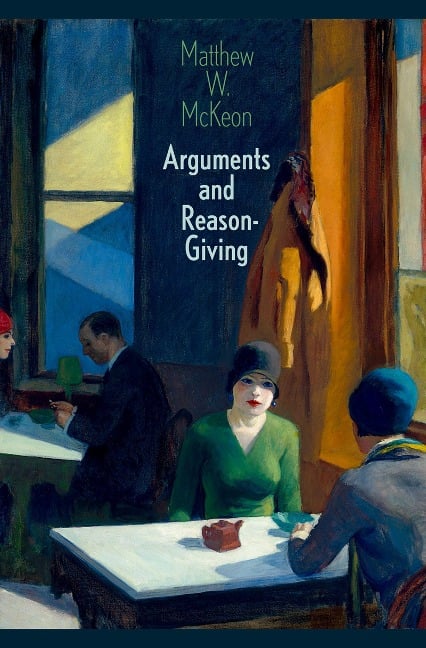
Arguments help us to give reasons for things. We use them to advance reasons for their conclusions in order to explain why we believe or did something, to justify our beliefs or actions, and to persuade others to do or to believe something. In Arguments and Reason-Giving, philosopher Matthew W. McKeon addresses the uses of arguments to advance their premises as reasons for believing their conclusions, that is, for believing that their conclusions are true. This book has two parts. In the first part, McKeon develops a conception of reason-giving uses of arguments that aims to deepen our understanding of the argument-centric dimension of our practices of reason-giving in everyday contexts. Inference claims play a central role in reason-giving uses of arguments. You use an argument to advance its premises as reasons for believing the conclusion only if you claim that they are such reasons. Taking such reason-giving to be rationally intentional, you believe what you claim. In the second part of the book, McKeon appeals to this conception of reason-giving uses of arguments to shed light on the nature of their persuasive force, the nature of the inferential reasoning that is expressed, argumentative rationality, and intellectual honesty and intellectual integrity. The notions of inference claims, reasons for belief, and reflective inferences provide the conceptual framework for the book's engagement with reason-giving uses of arguments and rational persuasion, argumentative rationality, and intellectual honesty and integrity.
Matthew W. McKeon is Associate Professor of Philosophy at Michigan State University where he has been Chair of the Department of Philosophy since 2011.
Chapter 1: Introduction Part I: Arguments, Inference Claims, and Reflective Inference Chapter 2: Reason-Giving Uses of Arguments 2.1 Preamble 2.2 Arguing and arguments 2.3 Arguments in informal logic, argumentation studies, and formal logic 2.3.1 Arguments in informal logic 2.3.2 Argumentation studies 2.3.3 Arguments in formal logic 2.4 Reason-giving uses of arguments 2.5 Conclusion Chapter 3: Inference Claims 3.1 Preamble 3.2 Argument claims and uses of arguments 3.3 The connection between inference claims and reason-giving uses of argument 3.3.1 Inference claim and reasons for believing 3.3.2 Dialectical arguments and reason-giving uses of arguments 3.4 How, exactly, are inference claims conveyed by one's statement of an argument? 3.4.1 Mere implication 3.4.2 Conversational implicature 3.4.3 Conventional implicature 3.4.4 Assertion 3.5 Conclusion Chapter 4: Reflective Inference 4.1 Preamble 4.2 Critical Thinking 4.2.1 Baseline characterizations of critical thinking 4.2.2 Inference and critical thinking 4.3 Reflective inferences and reason-giving uses of arguments 4.4 Conclusion Part II: Formal Validity, Rational Persuasion, Argumentative Rationality, Intellectual Honest and Intellectual Integrity Chapter 5: Reason-Giving Uses of Arguments, Formally Valid Arguments, and Demonstrative Arguments 5.1 Preamble 5.2 Deductive arguments, demonstrative arguments, and reflective inferences 5.3 Formally valid arguments and demonstrative arguments 5.4 Formally valid arguments and reason-giving uses of arguments 5.5 Demonstrative arguments and reason-giving uses of arguments 5.6 Conclusion Chapter 6: Reason-Giving Uses of Argument, Invitations to Inference, and Rational Persuasion 6.1 Preamble 6.2 Invitations to inference are reason-giving uses of arguments 6.3 Invitations to inference invite only the inferences expressed by the arguments used 6.4 Indirect persuasion 6.5 Conclusion Chapter 7: Reason-Giving Uses of Arguments and Argumentative Rationality 7.1 Preamble 7.2 Reason for belief and the rationality of belief 7.3 The Pragma-epistemic approach to argumentative rationality 7.4. The epistemic and pragma-dialectic approaches to argumentative rationality 7.4.1 The objective epistemic approach to argumentative rationality 7.4.2 The Pragma-dialectic approach to argumentative rationality 7.5 Argumentative rationality and good argumentation 7.6 Conclusion Chapter 8: Reason-Giving Uses of Arguments, Intellectual Honesty, and Intellectual integrity 8.1 Preamble 8.2 Intellectual honesty and truthfulness 8.3 Reason-giving uses of arguments and intellectual honesty 8.4 Reason-giving uses of arguments and intellectual integrity 8.5 Conclusion Index
Dieses eBook wird im PDF-Format geliefert und ist mit einem Adobe Kopierschutz (DRM) versehen. Sie können dieses eBook mit allen Geräten lesen, die das PDF-Format und den Adobe Kopierschutz (DRM) unterstützen.
Zum Beispiel mit den folgenden Geräten:
• tolino Reader
Laden Sie das eBook direkt über den Reader-Shop auf dem tolino herunter oder übertragen Sie das eBook auf Ihren tolino mit einer kostenlosen Software wie beispielsweise Adobe Digital Editions.
• Sony Reader & andere eBook Reader
Laden Sie das eBook direkt über den Reader-Shop herunter oder übertragen Sie das eBook mit der kostenlosen Software Sony READER FOR PC/Mac oder Adobe Digital Editions auf ein Standard-Lesegeräte mit epub- und Adobe DRM-Unterstützung.
• Tablets & Smartphones
Möchten Sie dieses eBook auf Ihrem Smartphone oder Tablet lesen, finden Sie hier unsere kostenlose Lese-App für iPhone/iPad und Android Smartphone/Tablets.
• PC & Mac
Lesen Sie das eBook direkt nach dem Herunterladen mit einer kostenlosen Lesesoftware, beispielsweise Adobe Digital Editions, Sony READER FOR PC/Mac oder direkt über Ihre eBook-Bibliothek in Ihrem Konto unter „Meine eBooks“ - „online lesen“.
Schalten Sie das eBook mit Ihrer persönlichen Adobe ID auf bis zu sechs Geräten gleichzeitig frei.
Bitte beachten Sie, dass die Kindle-Geräte das Format nicht unterstützen und dieses eBook somit nicht auf Kindle-Geräten lesbar ist.