Und dann auf "Zum Home-Bildschirm [+]".

Stöbern
genialokal zum Startbildschirm hinzufügen
Installieren Sie die genialokal App auf Ihrem Startbildschirm für einen schnellen Zugriff und eine komfortable Nutzung.
Installieren Sie die genialokal App auf Ihrem Startbildschirm für einen schnellen Zugriff und eine komfortable Nutzung.
Ihr gewünschter Artikel ist in 0 Buchhandlungen vorrätig - wählen Sie hier eine Buchhandlung in Ihrer Nähe aus:

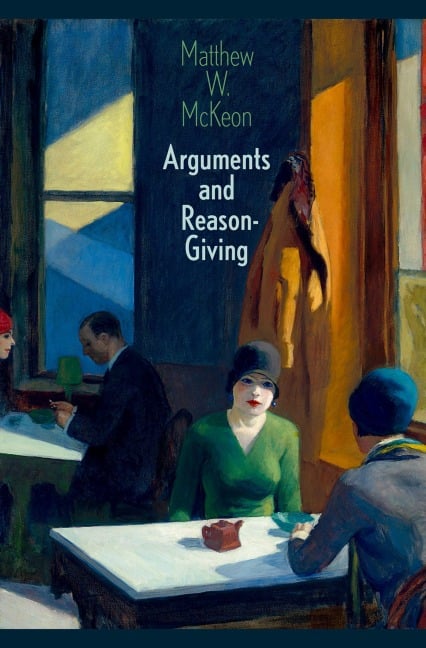
Arguments figure in our everyday practices of giving reasons. For example, we use arguments to advance reasons to explain why we believe or did something, to justify our beliefs or actions, to persuade others to do or to believe something, and to advance reasons to worry or to fear that something is true. This book is about our uses of arguments to advance their premises as reasons for believing their conclusions, i.e., as reasons for believing that their conclusions are true. What, exactly, is involved when you successfully use an argument to advance the premises as reasons for believing the conclusion? Philosopher Matthew W. McKeon suggests there is more involved than one might think.
Matthew W. McKeon is Associate Professor of Philosophy at Michigan State University where he has been Chair of the Department of Philosophy since 2011.
Chapter 1: Introduction
Part I: Arguments, Inference Claims, and Reflective Inference
Chapter 2: Reason-Giving Uses of Arguments
2.1 Preamble
2.2 Arguing and arguments
2.3 Arguments in informal logic, argumentation studies, and formal logic
2.3.1 Arguments in informal logic
2.3.2 Argumentation studies
2.3.3 Arguments in formal logic
2.4 Reason-giving uses of arguments
2.5 Conclusion
Chapter 3: Inference Claims
3.1 Preamble
3.2 Argument claims and uses of arguments
3.3 The connection between inference claims and reason-giving uses of argument
3.3.1 Inference claim and reasons for believing
3.3.2 Dialectical arguments and reason-giving uses of arguments
3.4 How, exactly, are inference claims conveyed by one's statement of an argument?
3.4.1 Mere implication
3.4.2 Conversational implicature
3.4.3 Conventional implicature
3.4.4 Assertion
3.5 Conclusion
Chapter 4: Reflective Inference
4.1 Preamble
4.2 Critical Thinking
4.2.1 Baseline characterizations of critical thinking
4.2.2 Inference and critical thinking
4.3 Reflective inferences and reason-giving uses of arguments
4.4 Conclusion
Part II: Formal Validity, Rational Persuasion, Argumentative Rationality, Intellectual Honest and Intellectual Integrity
Chapter 5: Reason-Giving Uses of Arguments, Formally Valid Arguments, and Demonstrative Arguments
5.1 Preamble
5.2 Deductive arguments, demonstrative arguments, and reflective inferences
5.3 Formally valid arguments and demonstrative arguments
5.4 Formally valid arguments and reason-giving uses of arguments
5.5 Demonstrative arguments and reason-giving uses of arguments
5.6 Conclusion
Chapter 6: Reason-Giving Uses of Argument, Invitations to Inference, and Rational Persuasion
6.1 Preamble
6.2 Invitations to inference are reason-giving uses of arguments
6.3 Invitations to inference invite only the inferences expressed by the arguments used
6.4 Indirect persuasion
6.5 Conclusion
Chapter 7: Reason-Giving Uses of Arguments and Argumentative Rationality
7.1 Preamble
7.2 Reason for belief and the rationality of belief
7.3 The Pragma-epistemic approach to argumentative rationality
7.4. The epistemic and pragma-dialectic approaches to argumentative rationality
7.4.1 The objective epistemic approach to argumentative rationality
7.4.2 The Pragma-dialectic approach to argumentative rationality
7.5 Argumentative rationality and good argumentation
7.6 Conclusion
Chapter 8: Reason-Giving Uses of Arguments, Intellectual Honesty, and Intellectual integrity
8.1 Preamble
8.2 Intellectual honesty and truthfulness
8.3 Reason-giving uses of arguments and intellectual honesty
8.4 Reason-giving uses of arguments and intellectual integrity
8.5 Conclusion
Index