Und dann auf "Zum Home-Bildschirm [+]".

Stöbern
genialokal zum Startbildschirm hinzufügen
Installieren Sie die genialokal App auf Ihrem Startbildschirm für einen schnellen Zugriff und eine komfortable Nutzung.
Installieren Sie die genialokal App auf Ihrem Startbildschirm für einen schnellen Zugriff und eine komfortable Nutzung.
Ihr gewünschter Artikel ist in 0 Buchhandlungen vorrätig - wählen Sie hier eine Buchhandlung in Ihrer Nähe aus:

0
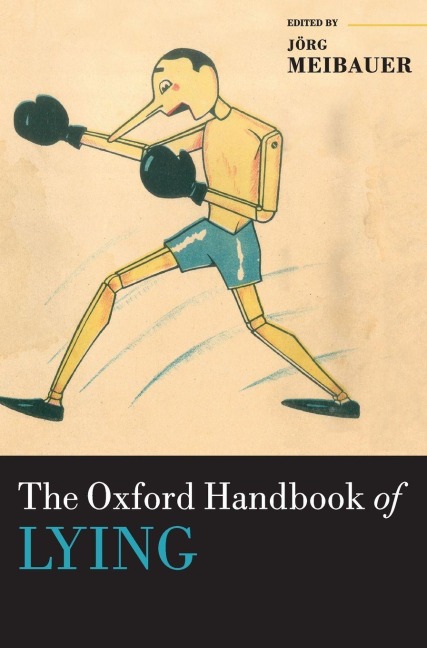
Jörg Meibauer is Professor of German Language and Linguistics at Johannes Gutenberg University Mainz. His research focuses on cognitive pragmatics, with an emphasis on the grammar-pragmatics interface. His many publications include Lying at the Semantics-Pragmatics Interface (De Gruyter Mouton 2014) and he is the editor of multiple volumes such as What is a Context? Linguistic Approaches and Challenges (with R. Finkbeiner and P. B. Schumacher; Benjamins 2012) and Pejoration (with R. Finkbeiner; Benjamins 2016).
- 1: Jörg Meibauer: Introduction: What is lying?
- Part I: Traditions
- 2: James Edwin Mahon: Classic philosophical approaches to lying and deception
- 3: James Edwin Mahon: Contemporary approaches to the philosophy of lying
- 4: Karol J. Hardin: Linguistic approaches to lying and deception
- 5: Lewis Bott and Emma Williams: Psycholinguistic approaches to lying and deception
- 6: Alexa Decker, Amanda Disney, Brianna D'Elia, and Julian Paul Keenan: Lying, deception, and the brain
- Part II: Concepts
- 7: Stephen Wright: Lying and truth
- 8: Mark Jary: Lying and assertion
- 9: Matthew Benton: Lying, belief, and knowledge
- 10: Andreas Stokke: Lying, sincerity, and quality
- 11: Swati Gupta and Andrew Ortony: Lying and deception
- 12: Neri Marsili: Lying and certainty
- 13: Don Fallis: Lying and omissions
- 14: Jörg Meibauer: Lying, implicating, and presupposing
- 15: Kathi Beier: Lying and self-deception
- 16: Eliot Michaelson: Lying, testimony, and epistemic vigilance
- Part III: Types of lies and deception
- 17: Julia Staffel: Knowledge lies and group lies
- 18: Jennifer Lackey: Selfless assertions
- 19: Jörg Meibauer: Bald-faced lies
- 20: Andreas Stokke: Bullshitting
- 21: Jennifer Perillo: Bluffing
- 22: Simone Dietz: White and prosocial lies
- Part IV: Distinctions
- 23: Emar Maier: Lying and fiction
- 24: Matthew McGlone and Max Baryshevtsev: Lying and quotation
- 25: Marta Dynel: Lying and humour
- 26: Rachel Giora: Lying, irony, and default interpretation
- 27: Paul EgrÃ(c) and Benjamin Icard: Lying and vagueness
- 28: Claudia Claridge: Lying, metaphor, and hyperbole
- 29: Marina Terkourafi: Lying and politeness
- Part V: Domains
- 30: Victoria Talwar: Development of lying and cognitive abilities
- 31: Samantha Mann: Lying and lie detection
- 32: Kees van Deemter and Ehud Reiter: Lying and computational linguistics
- 33: Bella M. DePaulo: Lying in social psychology
- 34: Matthias Gamer and Kristina Suchotzki: Lying and psychology
- 35: Giorgio Ganis: Lying and neuroscience
- 36: Thomas L. Carson: Lying and ethics
- 37: Stuart P. Green: Lying and the law
- 38: Marta Serra-Garcia: Lying in economy
- 39: Anita E. Kelly: Lying and education
- 40: Dariusz Galasi-ski: Lying and discourse analysis
- 41: Piers Robinson, David Miller, Eric Herring, and Vian Bakir: Lying and politics
- 42: Thomas L. Carson: Lying and history
- 43: Bettina KÃ-mmerling-Meibauer: Lying and the arts
- 44: Fumiko Nishimura: Lying in different cultures