Und dann auf "Zum Home-Bildschirm [+]".

Stöbern
genialokal zum Startbildschirm hinzufügen
Installieren Sie die genialokal App auf Ihrem Startbildschirm für einen schnellen Zugriff und eine komfortable Nutzung.
Installieren Sie die genialokal App auf Ihrem Startbildschirm für einen schnellen Zugriff und eine komfortable Nutzung.
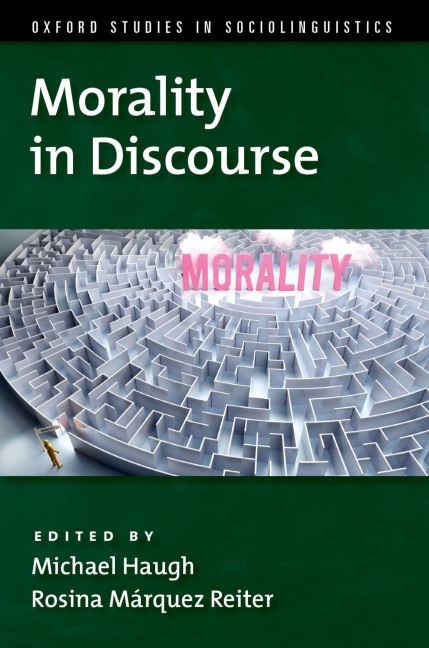
Morality is pervasive, touching all aspects of social life. The contributors to this volume provide an introduction to research on how morality is socially constructed in and through discourse, and the implications of this for the empirical analysis and theorization of morality. The volume addresses both how morality gets done through everyday practices, as well as the practical concerns that discussions of morality inevitably entail. It does so by delving into how morality is socially constructed in an array of communicative environments through the lens of a range of different discourse analytic traditions. Drawing on the conceptual tools of moral stance, positioning, responsiveness and authority, the chapters address the ways in which morality is enacted, interactionally negotiated, contested and policed. What emerges from these discussions and analyses is an understanding of morality from a discursive perspective that encompasses both morality as action, in which moral stances become the articulated object of action, and moral framing, in which the situated context itself is morally charged for evaluation.
Michael Haugh is Professor of Linguistics and Applied Linguistics in the School of Languages and Cultures at the University of Queensland, Australia. His research interests lie primarily in the field of pragmatics, with a particular focus on the role of language in social interaction. He has published more than 120 books and articles, including the Sociopragmatics of Japanese (2023, Routledge; with Y. Obana) and Action Ascription in Interaction (ed. 2022, Cambridge University Press; with A. Deppermann). He is a former co-editor in chief of the Journal of Pragmatics (2015-2020), and is currently co-editor in chief of Cambridge Elements in Pragmatics. Rosina Márquez-Reiter is Professor of Pragmatics and Interaction in the School of Languages and Applied Linguistics at The Open University, UK. Her research interests focus on how language is used in social interactions. She has published on indirectness, (im)politeness, pragmatic variation, face-to-face and technology-mediated service encounters, multimodality and immobility, and publications include The Pragmatics of Sensitive Activities in Institutional Discourse (co-ed. 2018, Benjamins), Language Practices and Processes among Latin Americans in Europe (co-ed. 2023, Routledge) and Leveraging Relations in Diaspora (in press, Cambridge University Press). She is Associate Editor of Pragmatics, founding editor and Editor-in-Chief (2005-2011) of Spanish in Context.
1. Morality and discourse (Michael Haugh and Rosina Márquez Reiter)
Part 1: Moralizing in Interaction 2. The negotiation of moral improprieties in the everyday interactions of young adult romantic partners (Neill Korobov)
3. The morality of contested descriptions in everyday and institutional settings (Jessica S. Robles)
4. Negotiating moral responsibility for remedying troubles in institutional encounters (Bandar Alshammari and Michael Haugh)
Part 2: Morality and Narrative 5. Narrating the Indian hip hop OG: Ethnography, epistemic-deontic stance and chronotypes (Jaspal Naveel Singh and Elloit Cardozo)
6. Moral stance in mothers' stories in online peer advice-giving approach (Loukia Lindholm)
7. Mothering morality in the everyday violence of domestic abuse (Shonna Trinch)
Part 3: The Politics of Morality 8. Morality at the abyss: Grassroots activism, counter-securitization and moral authority in Rio de Janeiro's favelas (Daniel N. Silva)
9. Rituals of morality: Questions of regret and sorrow in news interviews (Michal Hamo and Zohar Kampf)
10. The discursive construction of morality in political blame games (Sten Hansson)
Part 4: Digitally-Mediated Morality 11. Morality, metapragmatics and race: Debates about whitesplain on social media (Judith Bridges and Camilla Vásquez)
12. Whose morality is out of order? A case study of deviance and respectability in online chats in China (Chaoqun Xie)
13. Moralizing (un)civil behavior: The case of interpellations on Facebook (Rosina Márquez Reiter and Patricia Bou-Franch)
Dieses eBook wird im PDF-Format geliefert und ist mit einem Adobe Kopierschutz (DRM) versehen. Sie können dieses eBook mit allen Geräten lesen, die das PDF-Format und den Adobe Kopierschutz (DRM) unterstützen.
Zum Beispiel mit den folgenden Geräten:
• tolino Reader
Laden Sie das eBook direkt über den Reader-Shop auf dem tolino herunter oder übertragen Sie das eBook auf Ihren tolino mit einer kostenlosen Software wie beispielsweise Adobe Digital Editions.
• Sony Reader & andere eBook Reader
Laden Sie das eBook direkt über den Reader-Shop herunter oder übertragen Sie das eBook mit der kostenlosen Software Sony READER FOR PC/Mac oder Adobe Digital Editions auf ein Standard-Lesegeräte mit epub- und Adobe DRM-Unterstützung.
• Tablets & Smartphones
Möchten Sie dieses eBook auf Ihrem Smartphone oder Tablet lesen, finden Sie hier unsere kostenlose Lese-App für iPhone/iPad und Android Smartphone/Tablets.
• PC & Mac
Lesen Sie das eBook direkt nach dem Herunterladen mit einer kostenlosen Lesesoftware, beispielsweise Adobe Digital Editions, Sony READER FOR PC/Mac oder direkt über Ihre eBook-Bibliothek in Ihrem Konto unter „Meine eBooks“ - „online lesen“.
Schalten Sie das eBook mit Ihrer persönlichen Adobe ID auf bis zu sechs Geräten gleichzeitig frei.
Bitte beachten Sie, dass die Kindle-Geräte das Format nicht unterstützen und dieses eBook somit nicht auf Kindle-Geräten lesbar ist.