Und dann auf "Zum Home-Bildschirm [+]".

Stöbern
genialokal zum Startbildschirm hinzufügen
Installieren Sie die genialokal App auf Ihrem Startbildschirm für einen schnellen Zugriff und eine komfortable Nutzung.
Installieren Sie die genialokal App auf Ihrem Startbildschirm für einen schnellen Zugriff und eine komfortable Nutzung.
Ihr gewünschter Artikel ist in 0 Buchhandlungen vorrätig - wählen Sie hier eine Buchhandlung in Ihrer Nähe aus:

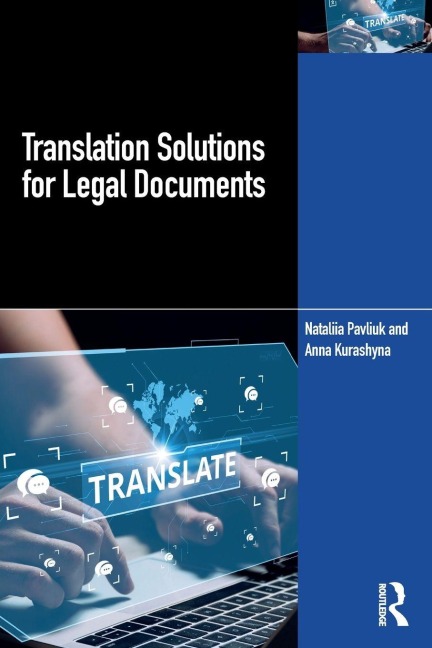
The course book covers the legal translation themes by the types of legal documents. The three parts of the book are devoted to the translation of legislative documents, contracts, and court documentation.
Nataliia Pavliuk is a British Academy Research Fellow at the University of Leeds, UK (researcher in the field of legal translation studies), and Associate Professor (Ukraine). Her course involvement includes Introduction to Legal Translation, Genres in Translation, and Translation in International Organisations. She is an English-Ukrainian legal translator, entrepreneur, and chairperson of the Ukrainian Association of Translators and Interpreters. Anna Kurashyna is Assistant Professor at the National University of Kyiv-Mohyla Academy, Ukraine (English for Specific Purposes (ESP) lecturer and researcher in the field of legal English and translation). Her courses include English for Specific Purposes. She is an English-Ukrainian legal translator and board member of the Ukrainian Association of Translators and Interpreters.
List of tables List of figures Preface Acknowledgements Introduction 1 Legal translation today - between law, language, and technologies 1.1 Practical aspects of legal translation 1.2 Legal systems and translation 1.3 Translation strategies and techniques 1.4 Modern technologies in translation Part 1 Translating legislation 2 General information about legislation and its translation 2.1 The purpose of legislation and its translation 2.2 Structure, classification, and hierarchy of legislative texts 2.3 A translator of legislation 2.4 When legislative acts need to be translated 3 Translating EU legislative acts 3.1 Types and general characteristics of EU legislative acts 3.2 Machine translation in EU institutions 3.3 Challenges of translating titles, subject matter, scope, and definitions of EU legislative acts 3.4 Exercises 4 Translating UK legislation 4.1 Primary and secondary legislation in UK law 4.2 Structure and linguistic characteristics of Acts of Parliament of the UK, Scotland, and Northern Ireland 4.3 Translating different structural parts of UK legislative acts 4.4 Grammatical issues of translating UK legislation: infinitive phrases and clauses 4.5 Exercises 5 Translating US legislation 5.1 The hierarchy of US legislative acts 5.2 Translating the Constitution 5.3 Grammatical challenges of translating passive voice structures 5.4 Exercises Part 2 Translating contracts 6 General information about contracts and their translation 6.1 The nature of contracts 6.2 The goals of signing contracts 6.3 Contracts in common and civil law jurisdictions 6.4 Structural elements of the contract 6.5 Language of contracts and translation problems 6.6 When contracts need to be translated 7 Translating contracts for an unlimited number of users 7.1 Types of contracts for an unlimited number of users 7.2 The functions of a website's "Terms of Use" 7.3 Common provisions included in the "Terms of Use" 7.4 Translation of contracts with an indefinite number of users 7.5 Language categories. Language of obligation, permission, and prohibition 7.6 Limitation of liability and disclaimer clauses 7.7 Exercises 8 Translating service provision contracts 8.1 Functions and goals of the service contract 8.2 Common clauses and structures of service provision contracts 8.3 Challenges of translating service provision contracts. Titles 8.4 An introductory clause and its translation - Language of performance as a translation problem 8.6 Exercises 9 Translating building construction contracts 9.1 Specific features of a building construction contract 9.2 Common provisions and structure of a building construction contract 9.3 Archaic words and phrases in legal English as a translation problem 9.4 Noun premodification as a specific feature of the English language and methods of its translation 9.5 Exercises Part 3 Translating court judgments and opinions 10 General information about courts and court documents 10.1 Functions of courts and court documents 10.2 Court documents in different law systems 10.3 Definitions of "judgment" 10.4 When court judgments and opinions need to be translated 11 Translating judgments of the European Court of Human Rights 11.1 The history, jurisdiction, and structure of the European Court of Human Rights 11.2 Structural parts of ECtHR judgments and their translation 11.3 Translation of the circumstances of the case as a narrative 11.4 Relevant legal framework and practice and the "Law" section 11.5 Grammatical challenges of translating ECtHR judgments: tense forms of the verbs in different sections of the judgment 11.6 Exercises 12 Translating UK court judgments 12.1 UK judicial system, structure, and hierarchy 12.2 Participants in the proceedings 12.3 Pre-translation analysis of the judgment 12.4 Structural elements of UK judgments and their translation 12.5 Exercises 13 Translating US Supreme Court opinions 13.1 The judicial system of the United States 13.2 Judicial opinion as a post-trial document: definition and types 13.3 Common structural elements of the US judicial opinions and how to understand them to translate properly 13.4 References and citations: how to understand abbreviations and translate them correctly 13.5 Participants in the US Supreme Court 13.6 Grammatical challenges of translating gerunds and gerundial structures 13.7 Exercises Glossary Grammatical topics Index