Und dann auf "Zum Home-Bildschirm [+]".

Stöbern
genialokal zum Startbildschirm hinzufügen
Installieren Sie die genialokal App auf Ihrem Startbildschirm für einen schnellen Zugriff und eine komfortable Nutzung.
Installieren Sie die genialokal App auf Ihrem Startbildschirm für einen schnellen Zugriff und eine komfortable Nutzung.


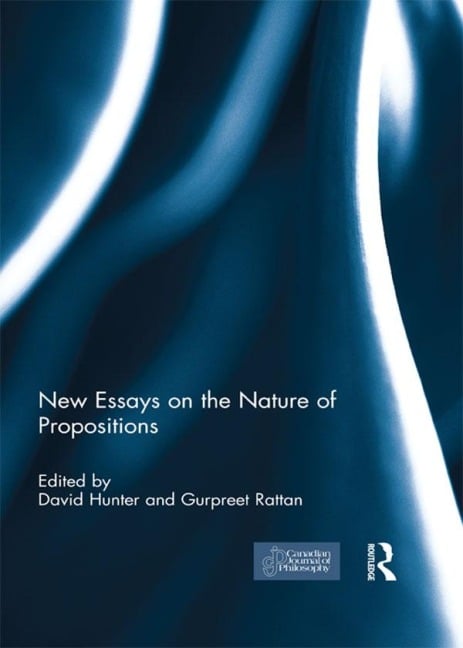
These are exciting times for philosophical theorizing about propositions, with the last 15 years seeing the development of new approaches and the emergence of new theorists. Propositions have been invoked to explain thought and cognition, the nature and attribution of mental states, language and communication, and in philosophical treatments of truth, necessity and possibility. According to Frege and Russell, and their followers, propositions are structured mind- and language-independent abstract objects which have essential and intrinsic truth-conditions. Some recent theorizing doubts whether propositions really exist and, if they do, asks how we can grasp, entertain and know them? But most of the doubt concerns whether the abstract approach to propositions can really explain them. Are propositions really structured, and if so where does their structure come from? How does this structure form a unity, and does it need to? Are the representational and structural properties of propositions really independent of those of thinking and language? What does it mean to say that an object occurs in or is a constituent of a proposition? The volume takes up these and other questions, both as they apply to the abstract object approach and also to the more recently developed approaches. While the volume as a whole does not definitively and unequivocally reject the abstract objection approach, for the most part, the papers explore new critical and constructive directions. This book was originally published as a special issue of the Canadian Journal of Philosophy.
David Hunter is Associate Professor at Ryerson University, Toronto, Canada. He works on issues at the intersection of belief and action, and is the Editorial Board Coordinator of the Canadian Journal of Philosophy. Gurpreet Rattan is Associate Professor at the University of Toronto, Canada. His primary interests are in the philosophy of language, mind, and epistemology. His current project attempts to articulate unified accounts of truth, disagreement, and relativism, accounts organized around the semantics and epistemology of the metarepresentation involved in critical reflective thinking and disagreement. His longer term project is on the comparative metaphysics and epistemology of propositions and numbers.
1. Introduction Part I: On Act- and Language-Based Conceptions of Propositions 2. Two aspects of propositional unity 3. An empirically-informed cognitive theory of propositions 4. What are the primary bearers of truth? 5. Not the optimistic type 6. Why it isn't syntax that unifies the proposition 7. Why we should not identify sentence structure with propositional structure Part II: Constituents and Constituency 8. Individuating Fregean sense 9. The metaphysics of propositional constituency Part III: Theoretical Alternatives to Propositions 10. Propositions, attitudinal objects, and the distinction between actions and products 11. What are Propositions? 12. Conversational implicature, communicative intentions, and content 13. Propositions and higher-order attitude attributions Part IV: Modal Metaphysics 14. Unnecessary existents 15. Contingently existing propositions
Dieses eBook wird im PDF-Format geliefert und ist mit einem Adobe Kopierschutz (DRM) versehen. Sie können dieses eBook mit allen Geräten lesen, die das PDF-Format und den Adobe Kopierschutz (DRM) unterstützen.
Zum Beispiel mit den folgenden Geräten:
• tolino Reader
Laden Sie das eBook direkt über den Reader-Shop auf dem tolino herunter oder übertragen Sie das eBook auf Ihren tolino mit einer kostenlosen Software wie beispielsweise Adobe Digital Editions.
• Sony Reader & andere eBook Reader
Laden Sie das eBook direkt über den Reader-Shop herunter oder übertragen Sie das eBook mit der kostenlosen Software Sony READER FOR PC/Mac oder Adobe Digital Editions auf ein Standard-Lesegeräte mit epub- und Adobe DRM-Unterstützung.
• Tablets & Smartphones
Möchten Sie dieses eBook auf Ihrem Smartphone oder Tablet lesen, finden Sie hier unsere kostenlose Lese-App für iPhone/iPad und Android Smartphone/Tablets.
• PC & Mac
Lesen Sie das eBook direkt nach dem Herunterladen mit einer kostenlosen Lesesoftware, beispielsweise Adobe Digital Editions, Sony READER FOR PC/Mac oder direkt über Ihre eBook-Bibliothek in Ihrem Konto unter „Meine eBooks“ - „online lesen“.
Schalten Sie das eBook mit Ihrer persönlichen Adobe ID auf bis zu sechs Geräten gleichzeitig frei.
Bitte beachten Sie, dass die Kindle-Geräte das Format nicht unterstützen und dieses eBook somit nicht auf Kindle-Geräten lesbar ist.