Und dann auf "Zum Home-Bildschirm [+]".

Stöbern
genialokal zum Startbildschirm hinzufügen
Installieren Sie die genialokal App auf Ihrem Startbildschirm für einen schnellen Zugriff und eine komfortable Nutzung.
Installieren Sie die genialokal App auf Ihrem Startbildschirm für einen schnellen Zugriff und eine komfortable Nutzung.
Ihr gewünschter Artikel ist in 0 Buchhandlungen vorrätig - wählen Sie hier eine Buchhandlung in Ihrer Nähe aus:

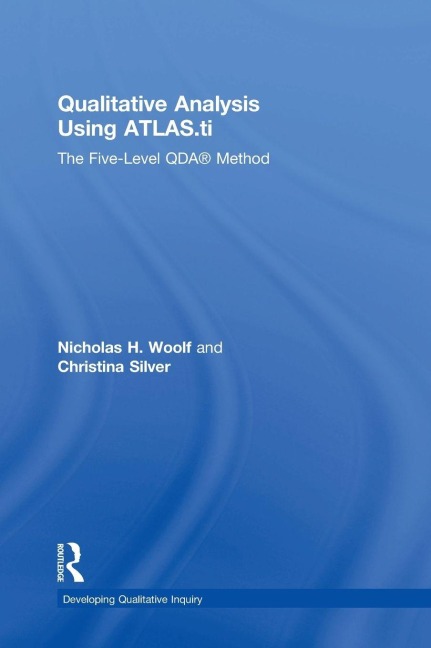
The method of Five-Level QDA® helps researchers to analyse what makes for an expert analytic performance when using qualitative data analysis software. Written by experienced trainers, this practical guide to ATLAS.ti will allow qualitative researchers to increase the effectiveness of their data analysis.
Nicholas H. Woolf has worked as an independent qualitative research consultant, coach, and trainer since 1998. He has conducted or consulted on numerous research studies, from single-site to multinational studies in various fields in the behavioral sciences using a wide range of methodologies, from highly structured content analyses, to evaluations, grounded theory-style projects, and interpretive phenomenology. As a trainer Nick specializes in teaching qualitative analysis using ATLAS.ti. He has conducted 285 workshops at over 100 universities and other institutions, primarily in the USA and Canada, for more than 3,000 PhD students, professors, and research and evaluation consultants. In 2013 Nick introduced Five-Level QDA in his keynote address at the first ATLAS.ti user's conference in Berlin (Woolf, 2014). Christina Silver has worked at the CAQDAS Networking Project at the University of Surrey, UK since 1998. She is responsible for capacity-building activities and has designed and led training in all the major qualitative software programs, including ATLAS.ti, Dedoose, MAXQDA, NVivo, Transana, QDA Miner, Qualrus, and Quirkos. Christina also works as an independent researcher, consultant, and trainer, supporting researchers to plan and implement computer-assisted analysis, and contributing to doctoral research programs in several UK universities.
List of Figures List of Tables List of Boxes Acknowledgments Case Contributors Orientation Part I: The Principles of the Five-Level QDA Method Chapter 1. Strategies and Tactics Chapter 2. Developing Objectives and Analytic Plans (Levels 1 and 2) Chapter 3. Translating Analytic Tasks Into Software Tools (Levels 3, 4, and 5) Part II: The Five-Level QDA Method in Practice Chapter 4. Orientation to ATLAS.ti Chapter 5: The Architecture of ATLAS.ti Chapter 6: Mastering the Process of Translation Part III: Case IIlustrations Chapter 7. Orientation to Case Illustrations Chapter 8. Case Illustration - An Exploratory Literature Review Chapter 9. Case Illustration - A Discourse Analysis Study Appendices Appendix 1. Three Levels of Detail of Analytic Tasks Appendix 2. Five Analytic Activities Appendix 3. Examples of Units in Analytic Tasks Appendix 4. Identifying the Units of Analytic Tasks Appendix 5. Identifying the Purpose of Analytic Tasks Index