Und dann auf "Zum Home-Bildschirm [+]".

Stöbern
genialokal zum Startbildschirm hinzufügen
Installieren Sie die genialokal App auf Ihrem Startbildschirm für einen schnellen Zugriff und eine komfortable Nutzung.
Installieren Sie die genialokal App auf Ihrem Startbildschirm für einen schnellen Zugriff und eine komfortable Nutzung.
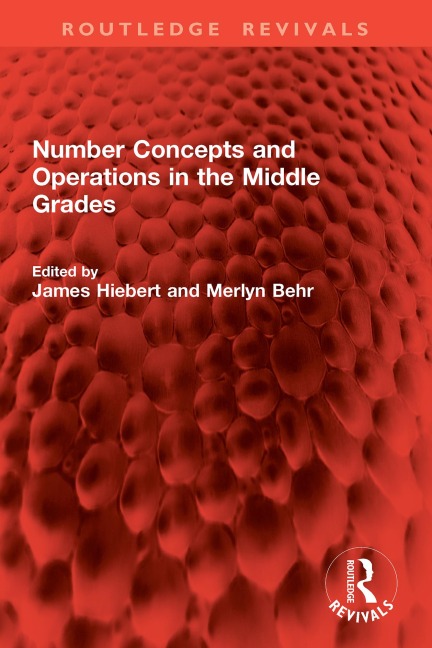
For many students, learning mathematics in the middle grades represents a watershed activity. If they fall behind or fail at this point, they are unlikely to recover and to pursue a career in the sciences or other mathematics-dependent occupations. Originally published in 1988, the authors reveal at least two of the reasons for this watershed experience. First, the content itself is much more complex than that at the primary grades, a complexity that was only then being fully appreciated. Second, conventional instruction often is based on faulty assumptions about the way in which the content is learned. The chapters present the latest understanding of the nature of the mathematics content in the middle grades and the processes by which it is learned.
Edited by James Hiebert and Merlyn Behr
Preface. Series Forward J. T. Sowder. Introduction: Capturing the Major Themes J. Hiebert & M. Behr. Part I: Analyses of Subject Matter 1. Multiplicative School Word Problems: Theoretical Approaches and Empirical Findings P. Nesher 2. Intensive Quantity and Referent Transforming Arithmetic Operations J.L. Schwartz 3. Mathematical Meaning and Applicational Meaning in the Semantics of Fractions and Related Concepts S. Ohlsson 4. Proportional Reasoning R. Lesh, T. Post & M. Behr. Part II: Theoretical Analyses of Emerging Competence 5. Children's Construction of Number Sequences and Multiplying Schemes L. P. Steffe 6. Multiplicative Structures G. Vergnaud 7. Personal Knowledge of Rational Numbers: Its Intuitive and Formal Development T. E. Kieren. Part III: Effects of Conventional and Experimental Instruction 8. Mental Computation and Number Comparison: Their Roles in the Development of Number Sense and Computational Estimation J. T. Sowder 9. Ratio and Proportion K. Hart 10. Constructing and Using Meaning for Mathematical Symbols: The Case of Decimal Fractions D. Wearne & J. Hiebert 11. A Developmental Approach to the Identification and Teaching of Central Conceptual Structures in Mathematics and Science in the Middle Grades R. Case & R. Sandieson 12. Summary Comments: Meaning in Middle Grade Number Concepts K. Fuson 13. Summary Comments: Developing a Research Agenda for Mathematics in the Middle Grades R. Case. Participants.
Dieses eBook wird im PDF-Format geliefert und ist mit einem Adobe Kopierschutz (DRM) versehen. Sie können dieses eBook mit allen Geräten lesen, die das PDF-Format und den Adobe Kopierschutz (DRM) unterstützen.
Zum Beispiel mit den folgenden Geräten:
• tolino Reader
Laden Sie das eBook direkt über den Reader-Shop auf dem tolino herunter oder übertragen Sie das eBook auf Ihren tolino mit einer kostenlosen Software wie beispielsweise Adobe Digital Editions.
• Sony Reader & andere eBook Reader
Laden Sie das eBook direkt über den Reader-Shop herunter oder übertragen Sie das eBook mit der kostenlosen Software Sony READER FOR PC/Mac oder Adobe Digital Editions auf ein Standard-Lesegeräte mit epub- und Adobe DRM-Unterstützung.
• Tablets & Smartphones
Möchten Sie dieses eBook auf Ihrem Smartphone oder Tablet lesen, finden Sie hier unsere kostenlose Lese-App für iPhone/iPad und Android Smartphone/Tablets.
• PC & Mac
Lesen Sie das eBook direkt nach dem Herunterladen mit einer kostenlosen Lesesoftware, beispielsweise Adobe Digital Editions, Sony READER FOR PC/Mac oder direkt über Ihre eBook-Bibliothek in Ihrem Konto unter „Meine eBooks“ - „online lesen“.
Schalten Sie das eBook mit Ihrer persönlichen Adobe ID auf bis zu sechs Geräten gleichzeitig frei.
Bitte beachten Sie, dass die Kindle-Geräte das Format nicht unterstützen und dieses eBook somit nicht auf Kindle-Geräten lesbar ist.