Und dann auf "Zum Home-Bildschirm [+]".

Stöbern
genialokal zum Startbildschirm hinzufügen
Installieren Sie die genialokal App auf Ihrem Startbildschirm für einen schnellen Zugriff und eine komfortable Nutzung.
Installieren Sie die genialokal App auf Ihrem Startbildschirm für einen schnellen Zugriff und eine komfortable Nutzung.
Ihr gewünschter Artikel ist in 0 Buchhandlungen vorrätig - wählen Sie hier eine Buchhandlung in Ihrer Nähe aus:

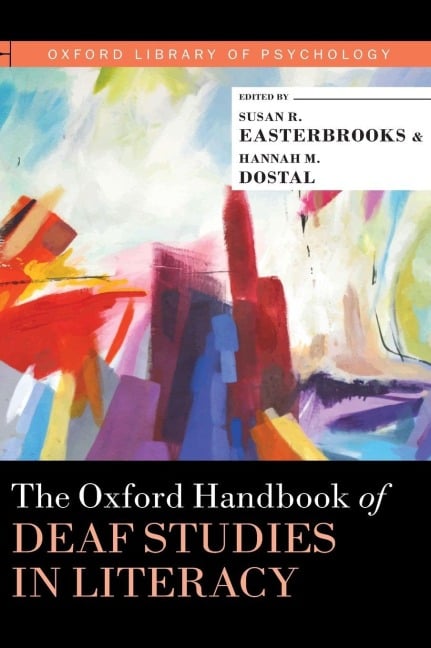
The Oxford Handbook of Deaf Studies in Literacy brings together state-of-the-art research on literacy learning among deaf and hard of hearing learners (DHH). With contributions from experts in the field, this volume covers topics such as the importance of language and cognition, phonological or orthographic awareness, morphosyntactic and vocabulary understanding, reading comprehension and classroom engagement, written language, and learning among challenged populations. Avoiding sweeping generalizations about DHH readers that overlook varied experiences, this volume takes a nuanced approach, providing readers with the research to help DHH students gain competence in reading comprehension.
Susan R. Easterbrooks is Emerita Professor in the Deaf Education program at Georgia State University and co-director of the Center on Literacy and Deafness. Her interests include language and literacy acquisition of deaf and hard of hearing learners and current research focuses on reading fluency in DHH learners.
Hannah M. Dostal is Associate Professor of Reading Education in the Department of Curriculum and Instruction and a Researcher in the Social Justice and Equity Research Cluster at the University of Connecticut. Dr. Dostal is a certified reading specialist and holds a Ph.D. in Education with a concentration in literacy studies and Deafness from the University of Tennessee.
- Preface
- Introduction
- 1. Deaf Studies in Literacy: Where is the Compass Pointing Us?
- Susan Easterbrooks and Hannah Dostal
- Fundamentals of Literacy and Deafness
- 2. Literacy Attainment among Children who are Deaf or Hard of Hearing: The Past, the Present and the Future
- Margaret Harris and Emmanouela Terlektsi
- 3. This is Your Brain on Print: The Neurological Processes of Print Literacy
- Jonathan Henner and Erica Bergmann
- 4. Listening, Language, and Literacy Development in Children with Hearing Loss Learning Spoken Language
- Lyn Robertson
- 5. Prevailing Theories of Reading Development and Deafness
- Carol Connor and Jamie Greenberg
- 6. What is Malleable in Literacy Learning?
- Jennifer Lubke, Anne McGill-Franzen, and Natalia Ward
- Elements of Literacy
- 7. Written Word Recognition and Production Processes: Phonology, Morphology, and Orthography
- Daniel Daigle and Rachel Berthiaume
- 8. Vocabulary Acquisition and Literacy in Deaf and Hard-of-Hearing Learners
- Shirin Antia and Christina Rivera
- 9. Bimodal Word Learning by Deaf and Hard-of-Hearing Children
- Daan Hermans, Lian van Berkel-van Hoof and Harry Knoors
- 10. Connections, Research, and Recommendations for the Importance of Morphosyntax in Literacy Acquisition across Languages for Learners who are Deaf or Hard of Hearing
- Joanna Cannon and Jessica Trussell
- 11. Reading and Academic Language(s): Advanced Academic Literacy Skills
- Jessica Scott and Scott Cohen
- 12. The Interplay between Pragmatics and Reading Comprehension in Children who are Deaf or Hard of Hearing
- Louise Paatsch and Diane Toe
- 13. Reading Comprehension: A Comparison of Typically Hearing (TH) and Deaf or Hard-of- Hearing (DHH) Children
- Susan Sullivan, Jane Oakhill, Barbara Arfe`, and Nadina Gomez-Merino
- 14. The Role of Fluency in the Literacy Acquisition of Deaf and Hard-of-Hearing Learners
- Susan Easterbrooks and Paula Schwanenflugel
- 15. Supporting School Readiness Skills and Home Literacy Environments in Young Children who are Deaf and Hard of Hearing
- Loes Wauters, Jean DesJardin, and Evelien Dirks
- Assessments, Interventions and Instruction
- 16. Psychoeducational Assessment, Classroom Testing, and the Measurement of Literacy in Deaf and Hard-of-Hearing Learners
- Donna Morere
- 17. Language Assessment: Links to Literacy for Bilingual Learners
- Charlotte Enns and Lynn McQuarrie
- 18. The Role of Speechreading in Literacy Acquisition and Development of Deaf and Hard-of-Hearing Readers
- Fiona Kyle
- 19. Literacy and Academic Engagement in Learners who are Deaf and Hard of Hearing
- Jennifer Catalano
- 20. Phonologically Based Interventions in Spoken Language and Sign Bilingual Settings
- Beverly Trezek, Connie Mayer and Ye Wang
- 21. Spelling: Why Explicit Instruction is a Critical Component of Literacy Intervention for Children Who Are Deaf or Hard of Hearing
- Heather Grantham
- 22. The Writing Bridge: Investigating Reading and Writing Reciprocity
- Hannah Dostal and Steve Graham
- 23. Literacy Skills of Deaf College Students: Has Elvis Already Left the Building?
- Marc Marschark and Mark Rosica
- 24. Adult Reading Strategies: Visual-Spatial Conceptualization and Patterns of Thought
- Julia Silvestri and Hannah Ehrenberg
- Approaches to Teaching Unique Learners
- 25. Literacy in Emerging Sign Language Communities: The Impact of Social, Political, and Educational Resources
- Deanna Gagne and Marie Coppola
- 26. Alternative Routes toward Literacy for Individuals with Deafblindness: The Role of Assistive Technology
- Vassilios Argyropoulos, Magda Nikolaraizi and Maria Papazafiri
- 27. Literacy in Learners who are Deaf or Hard of Hearing with Disabilities
- Susan Bruce and Christy Borders
- Research Designs for Literacy
- 28. The Development and Evaluation of Literacy Interventions for Deaf and Hard-of-Hearing Children
- Hannah Dostal and Amy Lederberg
- 29. Bridging the Divide between Research and Practice: Recommendations for the Next Generation of Literacy Research in Deaf Education
- Stephanie Cawthon and Susan Easterbrooks
- 30. A Didactic Illustration of Longitudinal Analysis for Language and Literacy Research among Individuals who are Deaf or Hard of Hearing
- Lee Branum-Martin
- Closing Thoughts
- 31. Deaf Studies in Literacy: Progress by Degrees?
- Hannah Dostal and Susan Easterbrooks