Und dann auf "Zum Home-Bildschirm [+]".

Stöbern
genialokal zum Startbildschirm hinzufügen
Installieren Sie die genialokal App auf Ihrem Startbildschirm für einen schnellen Zugriff und eine komfortable Nutzung.
Installieren Sie die genialokal App auf Ihrem Startbildschirm für einen schnellen Zugriff und eine komfortable Nutzung.
Ihr gewünschter Artikel ist in 0 Buchhandlungen vorrätig - wählen Sie hier eine Buchhandlung in Ihrer Nähe aus:

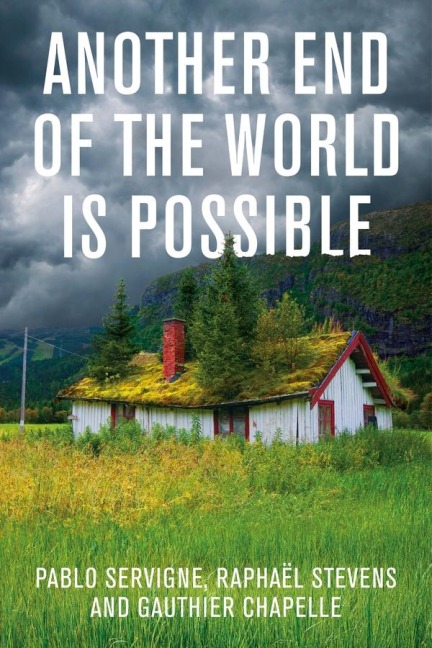
The critical situation in which our planet finds itself is no longer in doubt. Some things are already collapsing while others are beginning to do so, increasing the possibility of a global catastrophe that would mean the end of the world as we know it.
As individuals, we are faced with a daily deluge of bad news about the worsening situation, preparing ourselves to live with years of deep uncertainty about the future of the planet and the species that inhabit it, including our own. How can we cope? How can we project ourselves beyond the present, think bigger and find ways not just to survive the collapse but to live it? In this book, the sequel to How Everything Can Collapse, the authors show that a change of course necessarily requires an inner journey and a radical rethinking of our vision of the world. Together these might enable us to remain standing during the coming storm, to develop a new awareness of ourselves and of the world and to imagine new ways of living in it. Perhaps then it will be possible to regenerate life from the ruins, creating new alliances in differing directions - with ourselves and our inner nature, between humans, with other living beings and with the earth on which we dwell.
Pablo Servigne is an agronomist with a PhD in biology.
Raphaël Stevens is an eco-adviser and co-founder of the consulting office Greenloop.
Gauthier Chapelle is an agronomist, co-founder of Greenloop and founder of Biomimicry Europa.
Foreword Notes Preface Notes Introduction: Learning to live with it The change in attitude over the last few years Surviving ... is that all? A branch of collapsology directed towards inner experience Expanding out to 'collapsosophy' Breaking down walls Notes Part One: Recovery 1. Experiencing the impact Living through the disasters Giving people the bad news Notes 2. Regaining our spirits Resilience after disasters Living and dancing with the shadows Notes 3. Moving on Mistrusting optimism Mistrusting hope What about the children? Notes Part Two: New Horizons 4. Integrating other ways of knowing New scientific (in)disciplines Outside the ivory tower Towards a post-normal science Notes 5. Opening to other visions of the world From the universe to the pluriverse The emergence of a pluriversal mycelium Notes 6. Telling other stories 'Zombie' stories Stories as weapons for large-scale subversion Stories of times to come Notes Interlude: Entry to collapsosophy Rediscovering connections through ecopsychology Accepting our feminine side through ecofeminism Notes Part Three: Collapsosophy 7. Weaving connections Between humans With 'other-than-humans' With deep time With what is beyond us Notes 8. Growing up and settling down Emerging from patho-adolescence Reconciling our masculine and feminine sides Restoring the wild Constituting 'rough-weather networks' Notes Conclusion: Apocalypse or 'happy collapse'? The inner path and the outer effect Survival as the first step Making breaches and holding on to them Notes Afterword Notes